Wednesday, March 11, 2015

Same Head, New Body


Imagine yourself ten years from now and that your body is failing you.  The only part of your being that is still functioning properly is your head.  You’re given the option of transplanting your head onto a brand new body: a perfectly healthy body.  Do you do it?  Would you still be the same person?  Is a new body worth all of the potential risks?  Would head transplants for medical reasons begin a slippery slope to head transplants for cosmetic purposes?  The idea of a head transplant sounds like something out of a science fiction novel, but it may be closer than we think, and these are the sorts of questions that are being asked.  


While it may seem impossible, Sergio Canavero – an Italian neuroscientist – claims that the medical technology to perform a head transplant is already here, the world just needs to embrace it.  In the 1970s there was an attempted transplant of one monkey head to the body of another monkey.  The transplant was technically successful, but the monkey was unable to move its body and was only able to breathe with help.  It then died eight days later. 


This certainly doesn’t sound successful to me, but Canavero claims that science and technology have advanced enough that not only could a head transplant be successful, but if embraced by the scientific community it could be successful on humans in just two years!  He claims that by cleanly severing the head from the spinal cord and using a mixture of chemicals to fuse the spinal cord together on the new body, the person would wake up with all of their own memories and would be able to walk after only a year of therapy. 


            While this entire idea is fascinating, Canavero himself exhibits many signs of creative thinking.  He appears to have strong intrinsic motivation, something that Collins and Amabile note is essential to a creative mind.  The idea of a head transplant is likely to be controversial.  There is a strong likelihood that the idea will not be accepted by the scientific community, and that all of his research and theories become irrelevant since they cannot truly be tested.  Canavero also seems to exhibit the “six resources” that Lubart and Sternberg address in their chapter “An Investment Approach to Creativity: Theory and Data”.  The six resources that they address are intellectual processes, knowledge, intellectual styles, personality, motivation, and environmental context.  Canavero clearly exhibits a tendency toward problem solving in his intellectual process, as he took previous work done and came up with what he believes could be a successful solution – fusing the spinal cord.  His knowledge cannot be discounted as he had to do a lot of research in order to come up with a possible solution, and his intellectual style seems to be a combination of global and local.  While a local style is generally associated with negative creativity according to Lubart and Sternberg, Canavero uses it as a way of making his global thoughts concrete.  He was able to think about the task in a broad (global) way in order to realize that fusing the spinal cord successfully would help solve problems previously experienced, and was then able to use a local style to come up with a solution of how to fuse the spinal cord.  He exhibits most of the personality traits that Lubart and Sternberg attribute to a creative personality, which goes along with his intrinsic motivation that was discussed earlier.  Finally, though I don’t know much about his typical environment, it would follow logically that he was in an environment that allowed creative thinking since his ideas are not likely to be accepted without serious controversy. 
            Who knows if head transplants will be a reality in the near future, but the fact that it is even being discussed is in large part thanks to Sergio Canavero.  I certainly don’t know how I feel about the idea, but it will be interesting to see whether the idea is accepted as something worth investigating and pursuing.


http://www.newscientist.com/article/mg22530103.700-first-human-head-transplant-could-happen-in-two-years.html?page=1#.VQCCYOH7CLM 

http://www.medicaldaily.com/first-human-head-transplant-horizon-says-italian-scientist-sergio-canavero-technology-easy-247371

Collins & Amabile: Collins, M. A., & Amabile, T. M. (1999). Motivation and creativity. In Robert J. Sternberg (Ed.) Handbook of Creativity. New York: Cambridge University Press.

Lubart & Sternberg: Lubart, T.I., & Sternberg, R.J. (1995). An investment approach to creativity: theory and data. In S.M. Smith, T.B. Ward, & R.A. Finke (Eds.) The Creative Cognition Approach (pp.271–302). Cambridge, MA: MIT Press.

Polka Dots are a Way to Infinity

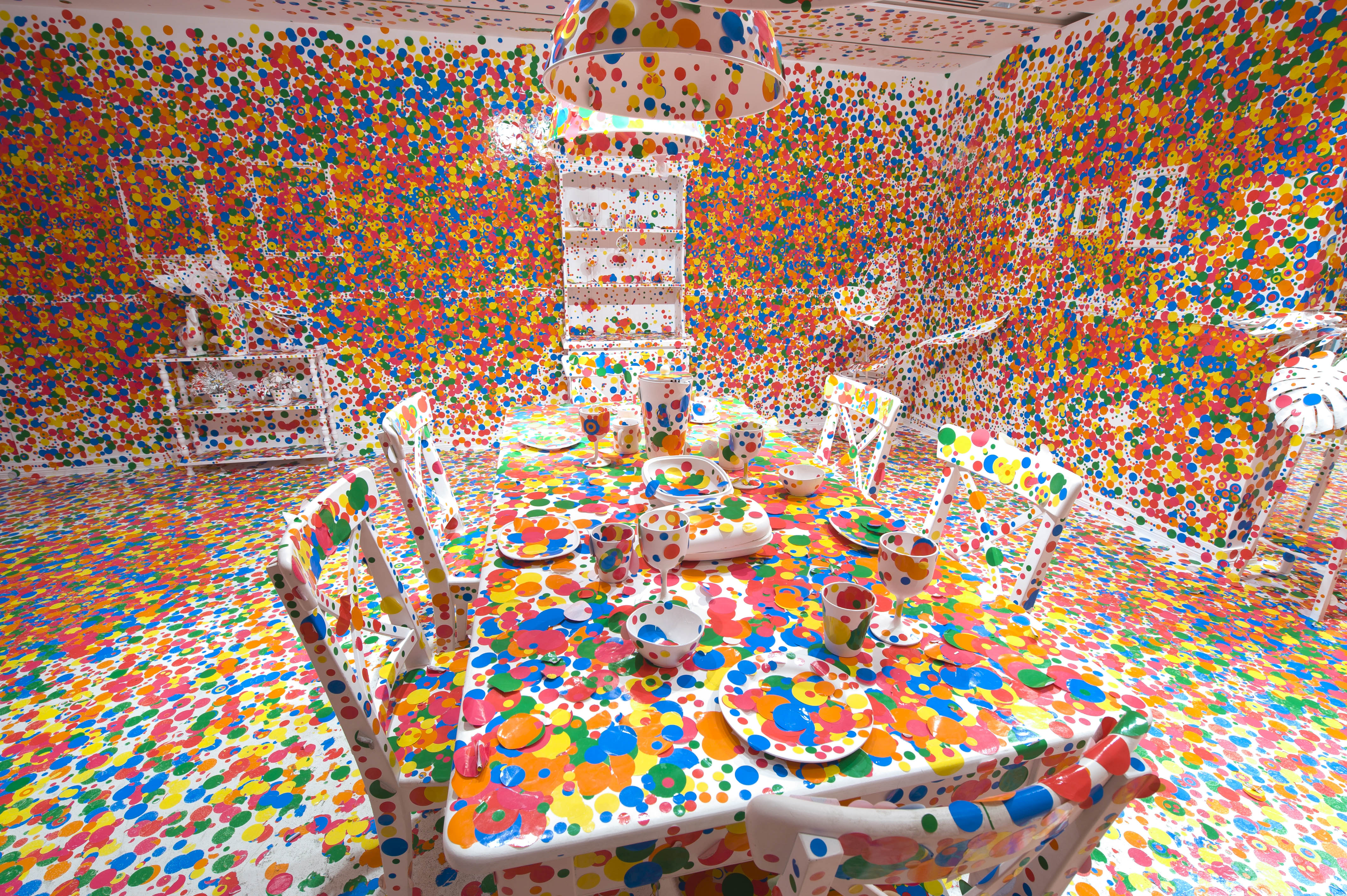
Yayoi Kusama was born in Japan into a conservative, upper-middle class family in 1929. She did not like the traditional mindset that her peers had in regards to art and soon left her homeland to live in the United States. Here she was able to express herself better and soon became known for her polka dots, psychedelic colors, and avant-garde style. She is known for her unique artistic talents, including paintings, sculpture, performance art, installation art, fashion, writing, and more. She has said that without art, she would definitely not be here with us today.


As a young child, Kusama has suffered from vivid hallucinations and suicidal thoughts, likely stemming from having an abusive mother. These hallucinations often manifest themselves as polka dots on her surroundings. Instead of cowering in fear of these invasive apparitions, she embraces her fear and utilizes them in her art and incorporates it into something beautiful. Despite using her art as a way to cope with her mental illness, she voluntarily admitted herself into a mental hospital in Japan and has taken up a permanent residence there ever since. Her studio is a short distance away from the hospital, and she continues to be active in the art community.


As Nancy C. Andreasen describes in her "Secrets of the Creative Brain", there is a strong correlation between mental illness and creativity. She concludes with, 
           "Some people see things others cannot, and they are right, and we call them creative geniuses. Some people see things others cannot, and they are wrong, and we call them mentally ill. And some people...are both."
Kusama is both in the sense that she makes others see what she all around her regularly. There is a kind of twisted beauty in the distorted world that she sees. Without her hallucinations, maybe polka dots wouldn't become her signature and she might not have captured the attention of so many, including Marc Jacobs and Louis Vuitton. 


Due to the different lens that Kusama had in viewing the world, she was able to create art that would lead to her becoming the precursor to pop art, minimalism and feminist art movements. She has been very influential in the development of Andy Warhol and Yoko Ono. She tends to work fast and in bulk, so a rhythm of productivity exists; this shows her tendencies towards repetition. Her most famous works consist of her "infinity nets" or "infinity rooms" (shown below). She installs the room with complex mirror patterns hanging at various heights to create the illusion of never ending space. The result is something extraordinary and I can only imagine have awesome it must feel to be in one of these rooms and to experience this beauty. 


She explored the possibilities of infinite space using mirrors, water, and flickering lights. These ideas stemmed from her mental illness and the polka dots, which started out as something she feared and turned it into something so beautiful. They are still a part of her, but no longer symbolize what only she can see. She integrated them and shared them with the world in her art and I am glad that she has done so because her art is truly mesmerizing. She is an inspiration not only as an artist, but as a person with a disability as well. She shows us that we do not have to fear what is wrong but embrace it to make us stronger.

http://www.yayoi-kusama.jp/e/information/index.html
http://www.victoria-miro.com/artists/31-yayoi-kusama/

Tuesday, March 10, 2015

One Hot Tamale


     So it's blog post time again, and once more I'm called on to titillate your senses. Now listen, I'm not saying I deserve an award or anything...but everyone reading this should feel obligated to send me a large sum of money, or jewels, or something as a gesture of gratitude, because the creative I found for this week is really gonna blow your socks off. I'm talk'n about the one...the only...the burlesque phenomenon...Tamale! A multitalented dancer who takes off her clothes for a living, Tamale is rekindling the old flame of burlesque here in the Windy City. Now don't freak out, I'm not going to show you anything too scandalous...


But I am going to talk about how this kick-ass baby on the right:


became this motorcycling rebel on the left.


     I'm also going to talk about how a person who performs naked on stage can become a champion for body positivity, social justice, and all around queer-awesomeness. So lace-up your corset, dust off your feather-boa, and let's get to talk'n about striptease!


     So, before we begin, let me say that I'm something of a connoisseur of burlesque, and that's not just because I like rhinestones and fluorescents. It's because as a gay man living in Chicago (the land of Boy's Town and beautiful people) I know that trying to be comfortable in your own skin can suck-hard-core. And that's the awesome thing about neo-burlesque ("neo" meaning the modern interpretation of the dance form as opposed to the traditional striptease performed in old-school burlesque houses), it's not about what you think you don't have or what society has led you to believe about your body, it's about knowing what you've got and flaunting it - to hell with social norms! So before I continue, I'd like to politely ask of anyone uncomfortable with nudity or stripping because of moral or ideological reasons to please stop reading and find another post to pass your time with. I respect everyone's turn-ons and hand-ups and I expect the same curtesy in return. As for those of you too fascinated to turn away, I ask that you keep an open mind and reevaluate what stripping actually means in 2015 and how it can be reclaimed as a vehicle for self-love and celebration.


A Crash Course in Burlesque...

     More than just an excuse to whip-out your birthday suit, burlesque actually has a long and "sophisticated" history dating all the way to ancient Greece. Remember that guy Aristophanes who's plays you may or may not have actually read freshman year? Well, more than just being an id on an honors exam, he's credited as the father of burlesque. His play, Lysistrata - a comedy about how the women of Athens ended the Peloponnesian war by withholding sex from their husbands - is the earliest example of burlesque, or at least some would argue. Now, you may be wondering, "how does this old dude's play count as a striptease?" Well, it doesn't, and that's the point. Aristophanes isn't the father of burlesque because he took off his clothes, he's the father of burlesque because he was a funny, raunchy satirist, and that's what burlesque is, a satire.
      Of course, nowadays nudity is the defining element of American burlesque, but the humor is still there, and remains a key focus in the dancer's craft. Performers will openly poke fun at themselves, society, politics, economics...you name it and I guarantee there's some naked person out there making a parody of it while twirling tasseled pasties. Take for example the show-stopping Dirty Martini who comments on capitalism while rocking some bejeweled lingerie...


     Despite it's awesomeness, burlesque came close to extinction in the eighties and nineties thanks to the proliferation of strip-clubs (burlesque houses minus the comedy, theatrics, and sequins). That's where Tamale comes in - fighting in an artistic war to revive Burlesque and reinvent it for our modern times. But before we get into all of that, introductions are in order...

     A true Renaissance woman, Tamale got a degree in agricultural technology and worked with Second City as a comedian before becoming the sequined super-star she is today.
 
     Like lots of us, burlesque wasn't even on her radar until a friend dragged her to a performance by the Butch Brothers (a dance troupe). Enamored by the laughs and glamour, Tamale contacted the group soon after, offering to trade her roadie skills for free tickets to their shows. She must have roadied her butt off, because within no time they had her dancing main stage. Tamale is currently an independent performer and draws inspiration from drag, belly dancing, and everything in between.

     Rather than talking your ear off about her, why don't you take a look at her signature shaving cream act and form an opinion for yourself...


     So, we've established that Tamale is a dancer, but what is it that makes her a creative dancer?
Well, on one level you could argue that creative thinking is a prerequisite for performing burlesque. When Tamale gets up on stage, her job is to entertain, and to do so she must appeal to all five of her audience's senses (yes taste and smell too...Tamale incorporates lots of chocolate in her acts). For lack of better words, she's got to figure out how to turn on a crowd of people. As Ivan Hagendoorn explains, "most of the people who attend the [dancer's] performance have paid to see it...some may be interested in dance, others may have been dragged along by a partner, and some may be paid to write a review. All of this influences how people perceive and will remember the performance." Hagendoorn is referring to the psychological concept of priming - basically how prior information and attitudes set up how you experience something, in this case burlesque. Arguably more so than other dancers, burlesque dancers - being purveyors of equal parts sensuality and comedy - have mastered the art of priming an audience to their advantage. "In a performance setting, almost everything can be controlled" and by exercising control over her body and environment, Tamale is able to hit her audience at a gut level, understanding that attention is largely "driven by sensory cues". 


     On another level, Tamale earns creativity points for taking something old and dying and turning it into something new, fun, and of the times. A lot of Tamale's burlesque contemporaries are guilty of using the same old acts over and over again. Take for example the champagne number where the dancer bathes in a glass of bubbly, a dusty staple that pops up in seemingly every burlesque revue...


     Tamale on the other hand is a self sufficient artist, choreographing completely unique numbers that you won't see danced by anyone else. Her acts are also refreshingly modern and incorporate current themes that make her brand of burlesque applicable to our society. For example, her chocolate act, during which she strategically dribbles Hersey's syrup all over her body...


     The act, while delicious and seductive, is also a commentary on drug addiction. The curtain parts on Tamale fumbling around with a piece of tinfoil, shaking like she's got a craving. Then it becomes apparent that her drug of choice is chocolate and...well, you get the point.

     The dance is fun and lighthearted, but also has a dark undertone, which allows it to operate both as entertainment and a source of awareness (she dedicates the act to those experiencing addiction).

    This gets me to my next point, which speaks more towards the creativity of neo-burlesque as a whole. There's no denying that striptease has some serious negative connotations -  objectification and exploitation being two of the most blatant. But where some people see trash, other people see treasure. In a society saturated with a singular image of beauty, artists like Tamale have adopted burlesque with the intent of reclaiming the word "sexy" and reshaping it to apply to all kinds of people. Taking an old dance form most people had lost interest in, modern performers are stripping to celebrate their bodies rather than covering them up to mask their insecurities. As anyone lucky enough to watch a burlesque performance knows, it's not about the looks, it's about the attitude, and when the curtain draws everyone gets whistles and applause. Burlesque is now home to people of all different shapes, heights, colors, genders, and orientations. Tamale's tribe of dancers is a rainbow coalition in the truest sense, and in this day and age, that is refreshingly creative thing.


Sources:

http://www.chicagoburlesque.org/
http://www.tamalerocks.com/

http://www.dailymail.co.uk/news/article-2136620/Meet-original-Dita-Von-Teese-Saucy-vintage-burlesque-posters-display.html
Hagendoorn, I. Dance, Choreography, and the Brain 

Monday, March 9, 2015

Heart of Dichotomy

            On my spring break plane ride I dove into Joseph Conrad's classic novel Heart of Darkness so that my adventure to Santa Cruz could parallel Charles Marlow's adventure through the African jungle.  For this blog post I have decided to measure the creativity of this novel as a whole up to some of the common dichotomies identified in creative individuals.  Heart of Darkness became the basis for one of the greatest films of all time - Apocalypse Now. I will use some of the beautiful images from that film to accompany the text here.

Imagination and Reality
These opposing concepts represent Heart of Darkness as a creative work most effectively.  At the age of 31 Joseph Conrad worked on a trading steamboat on the Congo River.  On this journey he witnessed some of the cruelty and savagery associated with the slave and ivory trade.  These real experiences which were documented further in the history book King Leopold's Ghost informed Conrad's writing.  The mix of imagination into this reality brought to us the legendary character Colonel Kurtz as well as his many graphic surroundings.


Wisdom and Naivety
           This is the dichotomy which is most apparent in the protagonist and narrator of most of the novel – Charles Marlow.  The character is introduced in his background as a reasonably experienced traveler and boat captain.  Throughout his journey to Kurtz’s island he encounters a number of other men involved in the ivory trade who seem incompetent and foolish to him.   For much of the book, we are provided with an image of a worthy and wise storyteller.  It is the darkness of British Imperialism to which Marlow is naïve.  He is shocked at the images of Africans left to die in the jungle as well as the severed heads mounted on spears outside of Kurtz’s “palace”.  Perhaps this contrast in Marlow reflects the very dichotomy within the creative himself – Conrad.  Conrad is obviously an intelligent writer, though he reminds us through this character that there is always an opportunity to be surprised in this world. 


Joy and Suffering
            The classic creative mix of agony and ecstasy is poured out of Conrad and into the island of Colonel Kurtz.  In the novel Kurtz has established himself as a God among the locals by thrilling them with his “wisdom”, but also by terrifying them.  Here is a quote from Marlow describing one of his adorers. 

            “It was curious to see his mingled eagerness and reluctance to speak of Kurtz. The man filled his life, occupied his thoughts, swayed his emotions.”


            Even within the character Kurtz there is the dichotic mix.  He is described as a worshipped man who has attained more treasured ivory than he can handle.  He lives with every amenity the African jungle can offer him.  However, his famous last words which end up haunting Marlow are – “The horror, the horror!”  As the centerpiece of the plot, Kurtz is a mythically incredible yet horribly dark figure.               


Thursday, March 5, 2015

Lou Conte: Standardizing Dance Education in Chicago

Most people know that Broadway is more than a street in New York City. Broadway has become synonymous with live entertainment. Anything Off-Broadway is deemed second tier to tourists’ evening plans. Why is that? Dance.


The Theater District on Broadway Street in Manhattan has always been largely successful with over 40 theaters. The aspect of entertainment has not changed, but how we entertain has changed. Early performers just had the “it factor” and grew famous through their performances. There was no standardization to what Broadway dancing meant. Typically, Broadway dance includes tap and jazz, but that was just what matched the flashy show tunes of most theatrical performances. Nowadays, you can flip through Playbills and see there is a wide variety of shows; there’s Phantom of the Opera, Lion King, Mamma Mia!, all the way to the Book of Mormons. That being said, Broadway dancers just can’t be a tap legend like Fred Astaire. They have to have the whole package.

Lou Conte began tap-dancing at age 7 and later studied ballet and jazz. He kept dancing while he studied zoology in college, but he postponed his scientific career to dance in New York City. He was hired as a dancer on Broadway’s How to Succeed in Business without Really Trying. He toured the world with musicals, gaining an abundance of theatrical experience. Upon returning to the United States, he focused on choreography. He established the Lou Conte Dance Studio in Chicago in 1972. In 1977, he founded the Hubbard Street Dance Company. It said that Hubbard Street defined Chicago dance to the rest of the world.

What does that mean to define dance? In any given Hubbard Street performance at the Harris Theater of the Museum of Contemporary Art, the company is mainly a contemporary dance company. While beautiful and entertaining, it is by no means Broadway. How did Lou Conte transfer his theatrical experience to a deeply artistic contemporary company?


The Lou Conte Dance Studio teaches a variety of dance classes. From classical ballet to jazz funk, Lou Conte instructs dancers to be malleable dancers. Since not everyone can be a tap-dancing protégé, dancers need a fundamental background in technique. With this broad-based technique, dancers are able to pursue a wide variety of performance opportunities upon maturity.
Audiences are no longer one size fits all. Aesthetic concepts have different effects on different audiences, as explained by Hagendoorn. What makes one person laugh might not be as enjoyable to what makes another person cry.


Of course dancers want to be able to explore their creative outlets and pursue their own dreams, but most dancers are just trying to get hired. By studying fundamental techniques as outlined by Lou Conte, dancers are more likely to be able to succeed in any field they pursue, whether it Broadway or Hubbard Street. Lou Conte’s experience traveling the world as a Broadway dancer helped him outline the techniques necessary for a diverse dance career. His first choreographic performance featured four women at a nursing home, so while that may not have been Tony-worthy, there was some creative genius that was able to unite a world of dance.


Lou Conte definitely was not the only one of his kind to quantify such a field of creativity and performance, but he did that for Chicago. Young dancers aspire to moving to New York City for Broadway or Los Angeles for commercial dance, either of which can be trained in the Midwest via Lou Conte Dance Studio.


Hagendoorn: Hagendoorn, I. (2011 ). Dance, choreography and the brain. In F. Bacci and D. Melcher (Eds.) Art & The Senses. New York, NY: Oxford University Press.

"Chicago Gay and Lesbian Hall of Fame." Chicago Gay and Lesbian Hall of Fame. N.p., n.d. Web. 05 Mar. 2015.

Wednesday, March 4, 2015

Lle quena i'lambe tel' Eldalie?

Maybe as a child, you experimented with creating a new language that only you and your best friend would know. I think a lot of kids enjoyed this, however, for people like J. R. R. Tolkien, this was a reality.  Tolkien loved languages all of his life, but when he began writing his tales of Middle Earth, including The Hobbit and The Lord of the Rings trilogy, he began inventing his own languages.

Tolkien is most known for his creation of Middle Earth; however, most people leave out Tolkien’s true creative genius, his creation of various languages. Many authors create their own universe for their characters, like J. K. Rowling’s Wizarding World in the Harry Potter series. However, Tolkien went above and beyond in his creation of Middle Earth; he created the geography, the history, and the languages spoken by many of his characters.

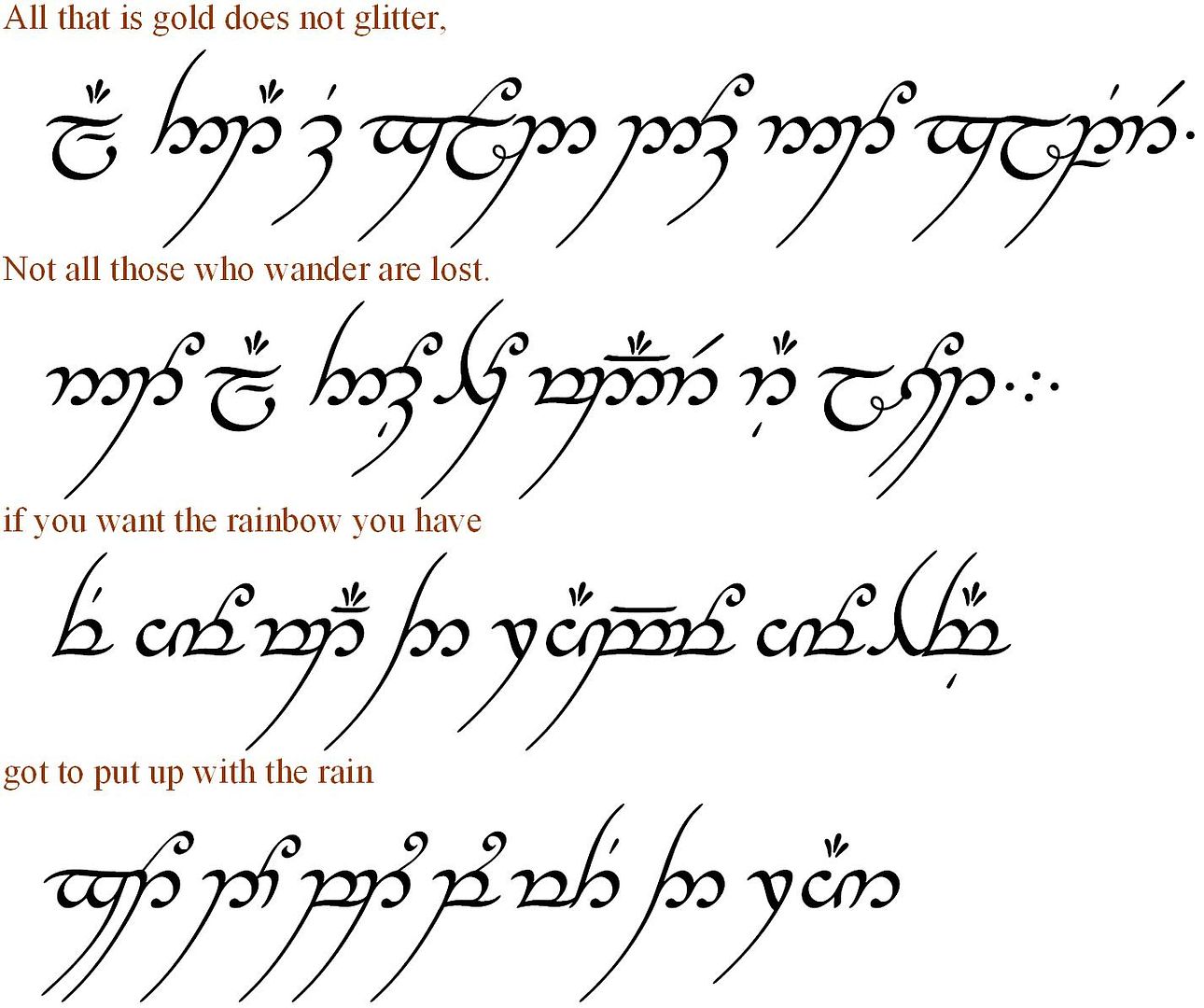
Two languages that Tolkien fully developed include Quenya and Sindarin, both of which were spoken by the elves in his tales. Not only did Tolkien create these languages, but he also created specific instances when these languages would be used. Quenya is the equivalent of Elvish Latin, a language that is not used for everyday conversations, but rather for poetry, song, lament, and magic. He based this language on the grammatical principles of Finnish, while Sindarin is based on Welsh, Tolkien’s favorite language. Sindarin, in contrast to Quenya, is a spoken language and appears often in his works.

(Quenya alphabet)

In order to use the proper pronunciation in the movies, clips of J. R.R. Tolkien reading his novels were used as reference. So, not only did Tolkien create a language, but he also developed the pronunciation. Thus, Sindarin and Quenya could be reproduced for the movies and the reproduction is fairly authentic.

(Here are excerpts from the movie of Legolas speaking Quenya and Sindarin.)

There were several other languages that he invented for the people of Middle Earth, but they are not as fully developed as Quenya and Sindarin, because they are not spoken as often in the books or movies. Dwarvish and Orcs’ black speech (the language of Mordor) are not as fully developed because they are missing many words that would be essential to conversations, however, there are various sentences throughout the books that are written in Dwarvish and the Black Speech of Mordor.


(Here, Gandalf speaks the Black Speech of Mordor and due to movie magic, the skies darken to show the true impact.)

Like Andreasen in her article, “Secrets of the Creative Brain,” I do not think that IQ is the sole indicator of creative genius. For example, not all smart people have the capability to create their own languages. Thus, Tolkien’s creative genius is not solely from his IQ, but rather another aspect of maybe his personality or some other way that he thinks. In this article, Andreasen expands on the idea of divergent thinking, which is the ability to come up with various responses to assessments of creativity. In this definition, I believe J. R. R. Tolkien would have been a very divergent thinker due to the fact that he not only invented one language, but several.

The study of “big C” creativity is important to Andreasen, and there is much value in studying what makes people, such as Tolkien, so creative that they fit into the “big C” creative category.  Andreasen believes that “[c]apturing human mental processes can be like capturing quicksilver” which I believe to be accurate. Unfortunately, Tolkien is no longer around to allow us a glimpse into his mental processes that went into the creation of these new languages. I guess the only option we have, is to dissect his writings ever further…off I go to read The Lord of the Rings again.


(Prophecy of Aragorn’s ascension as King of Gondor)

Other useful links:

Image Sources:

Here, you can learn how to write your name in Elvish: