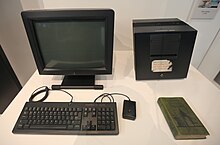
Starting in the 1960's the internet was developed to send information between computers. Sir Tim Berners-Lee, however, sought to use the internet nodes and combine hypertext and domains. Berners-Lee is a English computer scientist who is credited with creating the World Wide Web.
He developed the idea for creating the web when he was an independent contractor that focused heavily on sharing information between different researchers in different locations. To make this process easier he thought of using a system that was based on hypertext (an electronic language). The system that he developed to solve the problem of electronic data sharing to researchers that were far away was called ENQUIRE.
The computer Berners-Lee used to create the ENQUIRE program
Years later in 1989, Berners-Lee wrote his proposal for the World Wide Web. The web used a similar system as ENQUIRE and he created the very first web page (link to the very first web page: http://info.cern.ch/hypertext/WWW/TheProject.html). The first web page is a site that helps people learn about hypertext so that they can create their own page. Berners-Lee has stated that he did not create the internet or hypertext, he just put it all together to be what we know it as today.
In 1994 Berners-Lee founded the World Wide Web consortium. The organisation was created to improve the quality and standard of the web. He could have tried to earn money off of his creation but instead offered it to the world with no patent. His reasoning was that if he did not offer it for free someone else would have eventually created the same thing for free.
In "Creating Minds", Gardner suggests that "creativity is far more often characterized by the fashioning of a new kind of product, or by the discovery of an unknown or neglected set of issues or themes that call for fresh exploration". In the development of the web, Berners-Lee explored what could possibly be done with the internet and created something truly world changing.
Works cited:
http://www.biographyonline.net/business/tim-berners-lee.html
http://info.cern.ch/hypertext/WWW/TheProject.html
In most discussions of public health, menstruation is often not brought up, primarily because it is seen as a taboo and is generally an uncomfortable subject. However, issues related to periods can lead to serious health consequences in populations that don't have easy access to basic medical resources. For example, in rural India, 92% of women do not use sanitary pads due to their costs, instead using cloths (which often do not get sun dried due to the stigma around period products, which leads to bacterial growth) and, in extreme cases, sawdust and ash to collect the blood, leading to a variety of reproductive health problems. Arunachalam Muruganantham, a southern Indian man and high school dropout, first became aware of these problems when, as a newlywed, he saw his wife handling some old rags that he "would not have used to clean his scooter" and asked why she didn't buy herself menstrual pads instead. After she explained that she could not afford both pads and milk, he chose to surprise her by buying her a pad to use. Noticing that they were made of cotton, a fairly cheap crop, he started to wonder if it was possible to produce an affordable sanitary pad that his wife and women in similar situations could use, and shortly set off to work on creating this affordable pad. Muruganantham encountered many obstacles in his research; in order to test if the pads he created worked, he needed women to test them, but he learned that only a few of the women in the study filled out everyone else's feedback sheets, meaning these results could not be trusted. He then decided he would test the pads himself, crafting a homemade uterus by punching holes in a soccer ball and filling it with goat blood and wearing it beneath his clothes. He also had the idea to distribute his sanitary napkins for free and study the used napkins to understand how they were working. When he realized his pads did not work as well as the more expensive pads, he decided to shift his focus; pretending to be a millionaire, he wrote to the heads of the manufacturing companies to ask for raw samples, which led him to the key material - cellulose, a material from tree bark that typically is extracted using expensive machinery. However, after four and a half years of trial-and-error, he created an inexpensive machine that extracts the cellulose from trees and can produce packs containing eight pads each for the equivalent of $0.25, making them much more available to rural women. Currently, there are around 1,300 villages across India that have these machines in operation and they have provided thousands of rural women with improved reproductive health options.
In Collins and Amabile's essay on motivation and creativity, they argue that in order for creativity to be achieved, motivation must come from within an individual rather than from concern for what others think of their work. It would be difficult to think of someone who exemplifies this more than Muruganantham; in his initial research, the villagers in his town thought he was a pervert, his wife left him because of his reputation, and even his own mother became disgusted with his work. However, he continued his work regardless because he truly thought he could make a difference, and as a result, he was able to find an innovative solution for a pervasive problem, and his work will continue to benefit women for years to come. More about his work in his own words:
----------------------------------- Works cited Collins, M. A., & Amabile, T. M. (1999). Motivation and creativity. In Robert J. Sternberg (Ed.) Handbook of Creativity.New York: Cambridge University Press. https://www.youtube.com/watch?v=zkQL7UJYDIY http://www.bbc.com/news/magazine-26260978 http://www.slate.com/blogs/xx_factor/2014/03/05/arunachalam_muruganantham_the_man_who_created_his_own_sanitary_pad_and_made.html
Dr. Sile O’Modhrain, a blind associate professor at the University of Michigan, is curently developing a kindle style tablet that uses braille lettering and is refreshable. She was born in Iredland, and attended Trinity College in Dublin where she earned a BA in music. She then went on to earn an MS in music technology from the University of
York in England, and a Ph.D. in computer-based music theory from
Stanford University.
She has an eye condition similar to retinitis pigmentosa, which has left her blind. In order to perform her duties as a professor, she uses screen a braille reader to read email and uses the internet. But she has encountered numerous problems with them. Current braille readers can only read one line at a time, so it's impossible to figure out any charts, graphs, or anything that is spatially distributed. The one line braille readers available are very expensive, costing at a minimum $3,000. With the current technology a kindle size braille reader would cost around $55,000. With her own struggles and the struggles of other blind people in mind, Dr. O'Modhrain and her research assistants set out to develop a braille reader tablet that was refreshable and affordable. What they've created is and entirely pneumatic system that uses air or liquid to push up pins on the tablet surface to form braille letters. Because of this their tablet doesn't need to worry about wiring tons of circuits, reducing the cost of production. Dr. O'Modhrain's lab has the technology working, "the biggest difficulty faced by the team
is controlling the thousands of pneumatic pumps needed to create an
entire page of text, while keeping the entire device small enough to be
portable" (1).
Dr. O'Modhrain felt "'One
of the consequences of blind people not being able to access Braille,
is that they're limited in terms of the kind of scientific or
mathematical things they can do in their access to spatially displayed
information. And
even being able to do something fun, like see a graphic that represents
performance statistics for their football team over the last year'"(1). She believes that "the findings of this project and the availability of a large-area
tactile display would open up the possibility for a wide range of
scientific exploration" (2).
Obviously Dr. O'Modhrain had a lot of intrinsic motivation to work on this project, as this technology would greatly benefit her. She also was motivated to help blind people around the world and made it a goal of the project to use the technology to increase braille literacy of blind people around the world (2). But she also has a lot of extrinsic motivation to complete this project. She works for a university that pays her not only to teach, but also to do research like this braille reader project, and she received grant money to fund this project, so people have invested in her completing this product.
Dr. O'Modhrain has taken a problem she experienced personally and found a novel way to make the technology even more useful while also reducing the cost. With her design the technology will be more readily available to blind people around the world.
Student anxiety has been increasing incrementally for years, and slowly creeping into the younger and younger age groups.
Picture this:
Pressure of success blossoms in the mind of a second-grader, who worries that if she does not get a spotless report card, she will have no future. A boy in his fourth grade class is unable to finish his math test because he has forgotten 9x5. An eighth grade girl is still terrified to speak in public because of one stuttered project in elementary school.
This stress has been all too real for students growing up in and after the Millennial Generation, with job competition and academic expectation skyrocketing.
Jennifer Cohen Harper has decided to change all that. She takes a comprehensive, and somewhat radical approach to calming the young and developing minds of elementary-aged children, known as Little Flower Yoga. Yoga has been proven to give great results in decreasing stress levels in adults, and Harper is hoping to bring the practice to youth subject to stress.
Harper's entire curricular concept is creative in that it reinvents existing fields, combining the worlds of meditation and education. Interdisciplinary creativity is another aspect that allows this to be considered Big C creativity, along with the fact that she already reaches over 3500 children per week between her in class and after school programming. The mindfulness exercises increase emotional control and understanding as well as healthy development. Combined with the physical aspects of yoga, these exercises decrease likeliness for unhealthy lifestyles later in life, and increase the likelihood of these students performing well in their academic efforts.
In addition, Harper is trying to implement this strategy for improving the lives of our children throughout the country. Currently she is based in New York, but has also written three books about her creative experience in teaching children, all incorporating the duality of mindfulness and yoga education, with each book being targeted to a specific age group of developing children and teens.
Her creative experience began for her in 2006, when she implemented a small yoga break during the day instead of open-ended free time allowed by other kindergarten teachers. Her coworkers quickly realized the possibilities of this program, and she immediately had a following as well as volunteer yoga instructors with educational backgrounds. She looked out into a classroom full of five year old children, and saw how she could improve their coping techniques and set them up to be emotionally and physically healthy later in life-- an insight only someone who could think beyond themselves, or with divergence, could possess.
She also possesses the characteristics of Creatives that seek the ability to mentor, or pass along their experiences onto the new generation. She begins directly at the root of the generation, in a group of children who both need her, and have plenty of opportunity to grow with and around her teachings.
Jennifer Cohen Harper utilizes the six creative resources presented by Lubart and Sternberg, particularly intellectual styles and environmental context, to contribute to her creativity, Her intellectual style involves thinking on the level of an elementary school student, as she planned lessons around that thought process and has multiple degrees researching this particular age group and their emotional and intellectual ranges. Her environmental context is what allowed for her breakthrough, as she was surrounded by fellow educators who both fostered and encouraged her advancements, and eventually volunteered to be part of her revolution of childhood stress management education.
Her classes are expanding, and increasing attendants are all reporting favorably. Hopefully Little Flower Yoga, a wonderful stride in creative childcare, will be able to reach and calm the stressed and pressured developing minds of our country's future generation.
The days of pulling out a sketchbook to record a building using one's hand and a pencil are long gone. Or at least, they could be. In recent years, the development of 3D imaging technology has allowed contractors, architects, and engineers to acquire a full scan of a building within seconds, with no more than the click of a few buttons. The creation of this technology is a result of a collaboration of many different companies, engineers, mathematicians, and architects, but my research comes from research published by the American Institute of Architects (AIA). This technology rapidly compiles a massive amount of information--coordinates, points on an object, ranges--to create a flawless 2D "scan" of a building. Buildings that rise into the sky are quickly translated into 2D scans (most often compatible with the Auto CAD software), with dimensions and intricate features accurately labeled.
The data is collected using multiple distance-measuring tools that have left rulers and tape measures in the dust. My Dad is an architect, and he was recently explaining this technology to me. He pulled a laser distance measure out of his bag, turned it on, set it on the ground, and aimed it at the ceiling of the cafe in which we were enjoying a sandwich. Before I had even located the tiny laser point dancing above my head, the small machine beeped and showed a measurement on its screen. With the push of a button, we knew that the ceiling was 15 feet and 6.5 inches above our heads.
Since it's inception in 2007, 3D imaging technology has successfully been used in a wide range of projects. In addition to translating 3D, tangible information to 2D drawings, this technology has the capability of instantaneously producing 3D models. The 3D laser scanning sends out laser beams that hit a surface and return, the speed at which they return containing a plethora of information. During this time, the x-y-z coordinates of that specific point are captured. In a full scan, this process occurs rapidly millions of times. The culmination of all of these points creates a "point cloud," a data set that can then translate to a 3D model.
This technology is being used often for historic preservation or renovations of buildings. In the past few weeks, I have seen multiple building scanners (as seen below) set up along Michigan Ave, pointed upward to capture the dimensions and intricate flourishes of the skyscrapers.
Learning about this technology sparked my curiosity about its origins. 3D
Imaging Technology is a recombination of all of the discoveries about
perception and technologies that precede it, with the boost of more
accurate devices that greatly improve the efficiency of many people's
jobs. Although this specific technology is only recently gaining momentum, these concepts have origins that date back to 300 B.C. No, laser measuring devices did not exist among the ancient Greeks...but Euclid did. Euclid, a Greek mathematician whose dissertation Optics created a paradigm shift for the study of vision, can be considered the Big C Creative behind 3d imaging technology. Euclid's secret lies in his application of an existing perspective (mathematics) in a novel way. Vision had previously been studied from psychological and physical perspectives, but Euclid was a pioneer for approaching the theory of vision with a mathematical lens. While there are no autobiographies or Ted Talks giving us insight into Euclid's creative process, his divergent thinking is obvious. He offered a new way to "solve the problem" of understanding how we perceive the world around us. Euclid's ideas laid the groundwork for understanding human vision, which has led us (over 2,000 years later) to develop 3d imaging technology that acts as human eyes and records what it sees.
While it is hard to trace the first use of the 3d Imaging architectural or engineering purposes that AIA describes, it is interesting to consider the work environment that kindled this creative invention. This specific architecturally-oriented technology is undoubtedly categorized as employee creativity, as was described in Baer's "Rewarding Creativity" study: "We consider employee creativity to be the production of ideas, products, or procedures that are (a) novel or original and (b) potentially useful to the organization (Amabile, 1996; Shalley, 1991; Zhou & George, 2001). These ideas may reflect either a recombination of existing materials or an introduction of new materials to the organization."
I can speculate that the creators of this technology were intrinsically
motivated to make their own jobs more efficient. The AIA lists many
benefits of this new technology: value, accuracy, efficiency,
non-invasiveness, and flexibility, validating this technology as BOTH "novel or original" and "useful to the organization."
When you say the
name Disney, it automatically brings up memories of childhood
cartoons and beloved characters. Disney is known internationally for
its cartoons, TV shows, movies, iconic characters, and theme parks.
However, the man behind the company, Walt Disney, did not immediately
find success.
Disney's business envelope, around 1921
Walt Disney began his artistic career by taking lessons under Louis Grell from the Chicago Academy of Fine
Arts during his freshman year of high school. Disney dropped out of high school at the age
of 16 to join the army. After finishing his time with the army, he
traveled to Kansas in 1919 in hopes of truly starting his artistic
career. He ended
up getting a job through his brother at the Pesmen-Rubin Art Studio and met Ubbe Iwerks. They teamed up together and started
their own commercial company called Iwerks-Disney Commercial Artists
in 1920. They were unable to get their company off the
ground and Disney went to work at the Kansas City Film Ad Company. At the Kansas City Film Ad
Company, Disney started making commercials based on cutout animation,
which led to his decision to transition
from cartoonist to animator. He went on to open his own animation
business and started making cartoons called “Laugh-O-Grams”,
which became very popular. Due to the success, he was able to open his own studio named Laugh-O-Gram which opened in 1922. The
studio failed to successfully manage its money, and its profits were
unable to cover the high cost of employee salaries. Eventually, the
company was consumed in debt and Laugh-O-Gram declared bankruptcy.
Oswald the Lucky Rabbit
In 1923, Disney went
with his brother Roy to Hollywood to create a cartoon studio, which
became known as the Disney Brothers' Studio. They found reasonable
success with their Alice Comedies, shorts that were a mixture of live
action and cartoon based on the stories of Alice in Wonderland, which was distributed by Margaret Winkler. But
by 1927, the shorts had run their course in popularity. They also created the character Oswald the Lucky Rabbit, but they would later find out that Winkler and her husband had stole the rights to Oswald and had stolen all of the Disney Brothers' animators except for Iwerks. The loss of Oswald meant that Disney had to come up with new ideas, and eventually settled on the character being a mouse. The mouse was named Mickey, after Walt's wife persuaded Walt away from the name Mortimer. Walt decided to create a Mickey Mouse cartoon with sound that was titled "Steamboat Willie", and it was met with great success, leading Walt to utilize sound in all his subsequent cartoons. Disney received an honorary Academy Award in 1932 for his creation of Mickey Mouse.
Disney created his most successful cartoon short with "The Three Little Pigs", Walt attributed the success of the short to the belief that people want to watch stories that grab the audience and don't let go, which led to him creating a "story department".
In 1934, Disney decided to create a full-length animated feature, which became Snow White and the Seven Dwarfs. Many were skeptical about Disney's plan, and the film industry believed that this would lead to the end of Disney Studios. Disney's wife and brother both tried to convince him to not follow through with Snow White, but he ignored them both and continued with the project. Disney used "Silly Symphonies" as a way to experiment with different animation techniques in preparation for Snow White, such as the multi-plane camera. Full production of Snow White went from 1934 until mid-1937 when Disney Studios ran out of money. In order to get the rest of the money needed to complete the film, Disney had to show a rough cut of the film to loan officers. The film was released in December 1937 and became the most successful motion picture of 1938, earning the equivalent of $134 million today.
Due to the success of Snow White, Disney was able to create a new campus in Burbank and hire more than 1,000 employees. Disney received a full-size Academy Award and seven miniature ones.
Disney found failure
repeatedly, yet he remained committed. Collins and Amabile argue that “people who work in the creative field...tend to be more
intrinsically motivated towards their work than the general
population” (301). Disney's desire to be part of the world of
animation can only be explained by his intrinsic desire, since the
extrinsic rewards were very slim. Disney's desire to make a feature length animated film emphasizes shows that his drive to create was not dependent on those around him, since everyone around him was saying would lead to his failure. His success came after multiple failures and he was able to create a company that was able to thrive after his death.
Collins, M.A., & Amabile, T.M. (1999). Motivation and creativity. In Robert J Sternberg (Ed.) Handbook of Creativity. New York: Cambridge University Press
A long time ago in a galaxy far, far away, in the year 1977,
Star Wars was released and the movie
industry was changed forever. George
Lucas revolutionized the visual effects industry with the foundation of his own
company, Industrial Light and Magic (ILM).
Lucas founded ILM in 1975 when the production of Star Wars began. He wanted “Star Wars to include visual effects that
had never been seen on film before” (1).
The technology that Lucas needed had not been invented yet, so he took
it upon himself to gather a group of college students, artists, and engineers
to create the computer graphics he needed.
Lucas appointed John Dykstra to head up the company. Together they used “extremely detailed
miniatures, animation and a pioneering system of computer-controlled motion
photography to create these special effects” (2). Over the next 30 years, Lucas and ILM
continued to develop this technology which resulted in two trilogies of the
ongoing Star Wars saga. Both trilogies revolutionized special effects
in film.
In the first trilogy, Lucas used his newly invented special
effects to portray scenes like speeder bike chases and Star Destroyer
explosions. Lucas’s Star Wars won the Academy Award for Visual Effects; the next two
movies in the first trilogy, The Empire
Strikes Back and Return of the Jedi,
won the Special Achievement award from the Academy, also for Visual Effects (3). The second trilogy took special effects to
another level, yet again. The first film
of the second trilogy, The Phantom Menace,
created spaceships, aliens, and robots almost completely out of computer
animation. This movie included “the
first walking, talking, computer graphic film star,” Jar Jar Binks (3). Jar Jar Binks was created through performance
capture; an actor stood in for Jar Jar’s scenes, but the actor himself is disguised
by layers of digital imagery.
Creativity is the invention of new and revolutionary
ideas. Smith and Ward support this in their
writing Cognition and the Creation of
Ideas. They state, “creative ideas
are ones that are novel and potentially of value” (4). If you are to compare Lucas and his creative
ideas, he fits these criteria well. His
invention of computer graphic technology was no doubt novel as these special
effects had never been seen in film before.
This technology is also undoubtedly of great value; ILM has now produced
the special effects for nearly 300 movies.
This company has received 15 Best Visual Effects Oscars as well as 24
Scientific and Technical Awards from the Academy of Motion Picture Arts and
Sciences (5). Lucas’s creative
contribution also supports Smith and Ward’s statement that a domain-specific
view would be favored for a conceptual structure of creativity (4). Lucas needed to have the film industry
background as well as knowledge about computers and animation. Without this background knowledge Lucas would
not have had the means to consider the invention of, let alone successfully
create, such technology.
George Lucas had an imagination that was ahead of the film
industries technological capabilities.
He refused to let this hold him back and tackled this problem head
on. Lucas created the technology that
would allow him to bring his universe to life.
Once he accomplished this he continued to let his creativity flow; he
continued to develop his technology by computer generating characters and
cities.
(4) Smith, S.M. & Ward, T.B. (2012). Cognition and
the creation of ideas. In K.J. Holvak & R.G.Morrison (Eds.), Oxford
handbook of thinking and reasoning. New York: Oxford University Press. p456,
458.