Tuesday, March 22, 2016

Truisims

Have you ever heard a quote and thought ‘wow, that’s so true’? Jenny Holzer aims to captivate exactly that reaction with her art. This Neo- Conceptual artist has captivated her audience with what she calls ‘Truisims’ that often convey contradictory messages. These phrases touch on subject matters of feminist thinking, religion, politics, power, sex and all things controversial.

CRACK THE PELVIS SO SHE LIES RIGHT, THIS IS A MISTAKE. WHEN SHE DIES YOU CANNOT REPEAT THE ACT
Truisim displaying the idea of male dominance and their control of women

 I first discovered Holzer on a trip to the Minneapolis Sculpture Garden. Displayed there is her piece entitled IT TAKES A WHILE BEFORE YOU CAN STEP OVER INERT BODIES, consistent of twenty- eight granite benches with phrases inscribed in them.

My personal favorite?, ‘WHEN YOU ARE ON THE VERGE OF DETERMINING THAT YOU DON’T LIKE SOMEONE IT’S AWFUL WHEN HE SMILES AND HIS TEETH LOOK ABSOLUTELY EVEN AND FALSE’ 

Holzer’s piece at the Minneapolis Sculpture Garden


She is able to reach her audience through the use of a technological framework. Holzer has tried to model contemporary society’s use of advertising practices. To a generation that receives much of it’s information through advertisements, Jenny has been able to transmit her messages in the form of electric soundboards, merchandise sales, and even condoms to reach her audience. 


Holzer truly is an example of what James C Kaufman and Ronald A. Beghetto would call an eminent creative or Big- C creative. Jenny Holzer was chosen to represent the United States in the Italy's Venice Biennale as their first female artist in 1989 and one the most prestigious that year of the Golden Lion. As part of her piece, Holzer sold hats, posters, and T- shirts displaying her Truisims in various languages. Since then she has received worldwide praise and recognition for her provocative and captivating work, signs Kaufman and Beghetto would agree make her a true Big- C creative.

But before entering into the rank of a Big- C creative, Holzer was a Pro- C creative. After moving to New York to pursue her career as an artist, Holzer printed her Truisms anonymously on simple white paper in black italicized script and post then on buildings, posters, and telephone booths. She then asked her audience to scribble any works or phrases her Truisims evoked and would then wait to hear the conversation that followed. The Public Arts Fund program realized her talent and funded her next piece of artwork, an L.E.D machine that would flash her words on buildings located in heavily populated places such as in Times Square, Washington, D.C., and the Guggenheim Museum. Her continuing popularity and recognition caused her to move from the realm of a Pro- C creative to a Big- C creative.


Sources:
Kaufman, James C., & Beghetto, Ronald A. (2009). Beyond Big and Little: The Four C Model of Creativity.


Paris is ON FIRE

Do you know what Voguing is?  Maybe you’ve heard of  the popular Madonna song or you’ve (legally) gone out to a club and saw some co-ordinated dancers hitting the floor and busting some moves (is that what it’s still called?).  Regardless of your answer, you probably don’t know where it originated from or, more importantly, who created the dance sensation.  This leads me to my “What’s creative…?” topic: NYC Ball Culture!  Get excited because chances are you’ve never seen anything like these men and women before.


Are you a fan of Edward Sharpe and the Magnetic Zeros? Perhaps you’ve seen the band’s music video for Better Days (a great song)?  If you have then you’ve seen clips from a great documentary called “Paris is Burning”.  The short film depicts the lives of drag queens and gender queer individuals who live in New York City during the AIDS epidemic.  Not to completely spoil the whole thing for you, the film is melancholy and truly highlights the struggles that the men and women of that time had to deal with.  For every up there seemed to be at least two downs and they were constantly faced with a society that just wasn’t quite ready to embrace them for the individual that they were.  However, sometimes late in the night and very early in the mornings, these individuals got to fully express themselves at balls and this is what is creative.


                                                      (LANGUAGE WARNING!!)

You’ll hear many of the men talk about how they have no money and what cash they do get for working almost always goes towards looking fabulous at the balls.  These women and men would come together in drag and would compete for glory.  Often times they would be part of families or groups in which the members would financially, emotionally, and physically support one another.  The mother of the house would give advice and often provide for the younger members of the house as they were cast out from their family homes or as they struggled with their identities.  


I don’t want to spoil anything too much because I strongly, strongly encourage everyone to watch this documentary (it’s on Netflix!!!), but I must highlight a few things.  The outfits! These queens drew inspiration from the most mundane things and were able to change simple things like a T-shirt or a garbage bag into the most beautiful pieces of clothing you’ve ever seen.  The dances and movements.  Gardner talks a lot about bodily kinesthetic movement and the creativity behind it, but the queens of New York created a style of dance that is used in hip-hop, modern dance, modeling, and fashion today.  Voguing (if I can cast my vote) is one of the creative things to come out of ball culture.  It involves swift movements, posing, freezing, looking glamorous, and out shining your competition all in one dance.  It was often performed as a kind of turf war between different houses in what any of the queens likened to “gang wars”.  Check it out.  You have my permission. 


  • Livingston, Jennie, Pepper Labeija, Kim Pendavis, Freddie Pendavis, Dorian Corey, Venus Xtravaganza, Willi Ninja, and Laurent O. St. Paris Is Burning. United States: Fox Lorber Home Video, 1992.

You only have to know one thing: You can learn anything

If you've ever taken a math class before, chances are you've seen a video that looks like this:


These videos are a part of the calculus series at Khan Academy, the non-profit educational organization that produces highly popular short lectures in the form of YouTube videos. These lectures - which now include lessons in everything from medicine and computer programming to art history and entrepreneurship - have reached millions of people all over the world. The organization's slogan is, "You only have to know one thing: You can learn anything." 

The man behind the magic, Salman "Sal" Khan, was a former hedge fund analyst when he posted his first video in 2006. As stated in Creativity, Intelligence and Personality by Frank Barron and David M. Harrington, "The aha! comes when the process reaches a conclusion." Khan's aha! moment came about while we was tutoring his cousins, who lived in New Orleans, from Boston by posting YouTube videos they could use for review. He says that he recognized something profound when "they told me that they preferred me on YouTube than in person." Now, with over 2,200 videos and 762 million views, his creative insight has allowed him to transform education as we know it on the global scale.


In the Handbook of Creativity, Mary Ann Collins and Teresa Amabile discuss the distinction between intrinsic and extrinsic motivation in relation to creativity. Many believe that greater creativity would result if a person was primarily intrinsically motivated to do a task (Crutchfield, 1962). There is no doubt that Khan was intrinsically motivated when deciding to create Khan Academy. He quit his day job and poured his energy into the organization, with a vision for what he realized could lead to "a global one-world classroom." His lack of conventionality, along with his intellect and vision for change are perhaps the result of an inner drive to pursue this "craft."

Although Khan's vision - which would be fulfilled by this online breakthrough - has been criticized by educators as an example of "technology replacing teachers." In response, he says, "I want to be clear: we don't view this as a complete math education...it frees up time for the simulations, for the games, for the mechanics, for the robot-building, for the estimating how high that hill is based on its shadow." In fact, Khan Academy has actually allowed teachers across the country to flip the classroom - assigning videos as lectures for homework, and completing what would have otherwise been assigned as homework in the classroom, allowing for more teacher and peer interaction, further "humanizing" the classroom.

From young boys and girls who must provide for their families and cannot attend school, to adults who are continuing their education, Sal Khan's videos - and ultimately his creativity - have allowed individuals all over the world to realize that they really can learn anything.

Sources:

http://hackeducation.com/2011/07/19/the-wrath-against-khan-why-some-educators-are-questioning-khan-academy
http://www.ted.com/talks/salman_khan_let_s_use_video_to_reinvent_education/transcript?language=en#t-686257
https://www.khanacademy.org/
Barron, F., & Harrington, D. (1981). Creativity, Intelligence, and Personality. 
Collins, M. A., & Amabile, T. M. (1999). Motivation and creativity. In Robert J. Sternberg (Ed.) Handbook of Creativity.New York: Cambridge University Press.

Combining Hip-Hop and Modern Dance


Kyle Abraham, a choreographer and dancer, is a creative that is using dance as a medium to explore his identity as a black male and his personal history. Kyle does this through a unique hybrid of traditional and new dance styles that is attractive to a modern generation of dancers and audience members. In other words, Kyle's new dance style seeks to combine a traditional modern dance techniques with hip-hop culture. His inspiration came from modern dancers, especially Martha Graham, as well as his own experiences with hip-hop and urban culture.

Furthermore, Kyle Abraham has founded his own dance company called Abraham.In.Motion. Through his company, Kyle Abraham is able to express his own creative vision for what dance can and should be and become. Kyle seeks to make dance a creative way for exploring important contemporary issues with a clarity and beauty that resonates with a wide range of audiences. In addition, his company serves not only to reproduce his work through the teaching of his students, but it also provides Kyle with a platform to express his ideas.

For example, one of Kyle Abraham's works, When the Wolves Came In, explores the legacies two triumphs in the international history of civil rights: the Emancipation Proclamation and the end of apartheid in South Africa. This work combines the styles of modern dance and hip-hop dance with a contemporary view of how race relations have been affected by these two momentous events. Kyle is able to tell a story and invoke emotions within the audience through the unique combination of choreography and music from various genres.

https://vimeo.com/149579953

Above is a link to an excerpt of another one of Kyle's works, Absent Matter. In this dance, Kyle Abraham explores the perceived posthumous grandeur of death and violence in urban communities throughout America. Kyle seeks to specifically address the issues caused by and the fallacy in the ideology of gangs. This dance is performed to songs from Notorious B.I.G., Tupac, Kendrick Lamar, and Drake. The choice of music is an intentional ploy to link old rap to new rap and contemporary hip-hop dance. In doing this, Kyle provides the audience with a lineage, of sorts, for the genre of rap. Moreover, the song's title indicates that the story is being told from the perspective of the black race which feels unacknowledged and without value.


Kyle Abraham is a creative for several reasons. First off, Kyle Abraham is a Big C creative who is creating a new domain of dance. By combining modern dance with hip-hop and urban culture, Kyle has formed a new genre of dance altogether. In addition, Kyle Abraham displays enormous levels of bodily-kinesthetic intelligence. This intelligence allows him to utilize his body in creative ways to tell stories and invoke emotions within his audience members. In addition, Kyle Abraham demonstrates divergent thinking which may be a result of the heavy influence Martha Graham, who was a driving factor in the development of the modern dance style, had on Kyle's outlook on dance. Divergent thinking allowed Kyle to create a new form of dance that is unique, popular, and meaningful


Tata Motors: Redefing the Car


Throughout the streets of urban India and Southeast Asia, entire families commute and get around town on a single two-wheel scooter.  It is not uncommon to see a young child standing on the front of a scooter, the father driving, and the mother sitting behind the father holding another child; all this is occurring while driving the scooter 60mpg down a congested highway.  Add hazardous road conditions to these four person scooter scenarios, and you have a very dangerous situation....

This is the scene Ratan Tata saw every day when he would drive through the streets of India to work.  At the time, he was the head of Tata Motors and had the ability to change these perilous driving conditions.  His solution was to create a small, four door vehicle that would cost only $2,500.  This vehicle, named the "Nano" would be marketed as an alternative to scooter travel and would target low-income families in India and throughout the developing world.


Image result for tata nano
 As India has continued to develop and grow economically, millions and millions more people each year have the desire and the income to buy a car.  Tata knows this, and knows the current situation on the road in India; this is why they decided to create the Nano.  Furthermore, as India grows economically, people outside large urban cities, due to economic growth and greatly improved infrastructure, will need a car.  In the rural areas of India, roads and transportation networks are not as developed as in the urban centers.  Typical, large four door cars, are not able to easily travel on these rural roads, leaving many in these areas without transportation.  However, due to the small size, and compact build of the Nano, it can travel better on rural roads then the typical car.  This was problem was clear to Ratan Tata and is another reason he created the Nano.

Ratan Tata is the ultimate problem solver.  On his daily commute, he saw a safety problem that needed to be solved and set out to do so with the creation of the Nano.  Furthermore, he brought automobile travel to thousands by creating an affordable car that was able to traverse poor rural roads.  As Gardner discussed, a creator is someone who solves a particular problem and is also one who creates products.  When analyzing Tata, it is clear he did both. 

On a higher level, Tata was without a doubt a Big C creative.  He brought a product to India that not only changed the culture of travel in the country (by offering a safe and accessible alternative to scooters), all while creating a new domain of cheap automobile travel in the developing world.

 Sources:
http://indefenceofliberty.org/story/862/584/Ratan-Tata-reveals-his-thoughts-behind-the-Nano-and-his-vision
http://nano.tatamotors.com/nano-story.html
Gardner, Howard.  "Creating Minds: An Anatomy of Creativity Seen Through the Lives of Freud, Einstein, Picasso, Stravinsky, Eliot, Graham, and Gandhi".  Basic Books. New York, NY. 1993, 2011.


Thursday, March 17, 2016

Chess... A spectator sport?


On the surface chess seems to be just a game that friends may quietly play on a rainy afternoon. This, however, is a very different image of chess than the one I grew up with. My brother, Michael Auger is a chess master and because of this since I was a child I have been exposed to tournaments where the competition between player's wit and strategy was fierce. Children 6 or 7 would sit down to play a game where all they did was predict and calculate, their minds a flurry with the countless possible positions and moves, for hours on end. This I believe may be the reason that my brother has become one of the most creative people I have ever met. Within the last year he has directed his passion into a pursuit to make chess a spectator game. Basically he set up a site where there would be two teams and on each team there would be 5 players. On each team there would be 2 people designated to play 1 min chess games, 1 person who plays a 3 min game, 1 person who would play a 5 min game, and one person who would play a 15 min game. Each game is worth a different amount of points the shorter games are worth less points but are able to play more games in the hour that the competition goes on for. While the games are going on my brother and other members of the onewaychess.com team who are also high ranked chess players commentate on the games that are occurring. At 30 min there is an intermission where they may interview the players on each team. Spectators can go on to the site when the games are going on at scheduled times and may watch and listen to the commentators. Along with this viewers are given a chance to choose teams to root for and the scores at the end of each competition are scored and put in a scoreboard section of the site. It is not suprising to me that my brother would have come up with an idea like this. Since we were children he was always coming up with games we could play often to the vast entertainment of my younger brother, cousins, and I. Watching him for all these years it always struck me how passionate he would be about anything he set his mind to. Once my brother started creating something no one could stop him. In this way he is highly intrinsically motivated. Michael will not stop creating until he thinks he has reached perfection and even then he might just keep going because he loves to flourish in what he is creating.. This was shown evident to me in the hours he would spend sitting and working on these projects that he starts whether it be creating songs another passion of his (he made the song in the commercial) or programming websites. Michael is not happy unless he is challenged and the only way he can be challenged is if he is creating something new. Often times he will jump head first into things that he has never done before. When he played chess he never played a better game than when he played against those who were ranked way higher than him. When he started learning to code within the first month I remember he was already trying to create websites. While he is highly intrinsically motivated he has also commented to me that certainly is not his only motivation. While he has a decent job now he hopes to continue on with his passion and eventually make this onewaychess.com into a startup business. Another thing that I find uniquely interesting in his creative process is that he loves when he can include others. With his onewaychess.com he is constantly trying to recruit players for the teams, he has almost 80 players many of who are pretty high rated in the chess world. Along with this he also has made onewaychess.com into a group endeavor by recruiting the help of around 20 different people some chess players and others who are simply interested in getting experience starting a website and business such as my roommate who works in marketing for the site. Michael hopes to continue expanding on this chess site eventually offering video lessons in chess and games for those who want to practice their chess skills online.

Link to the site:
http://www.onewaychess.com/ncl/
Link to facebook page:
https://www.facebook.com/NationalChessLeagueNCL/?fref=ts

It's Raining yet... not Wet?

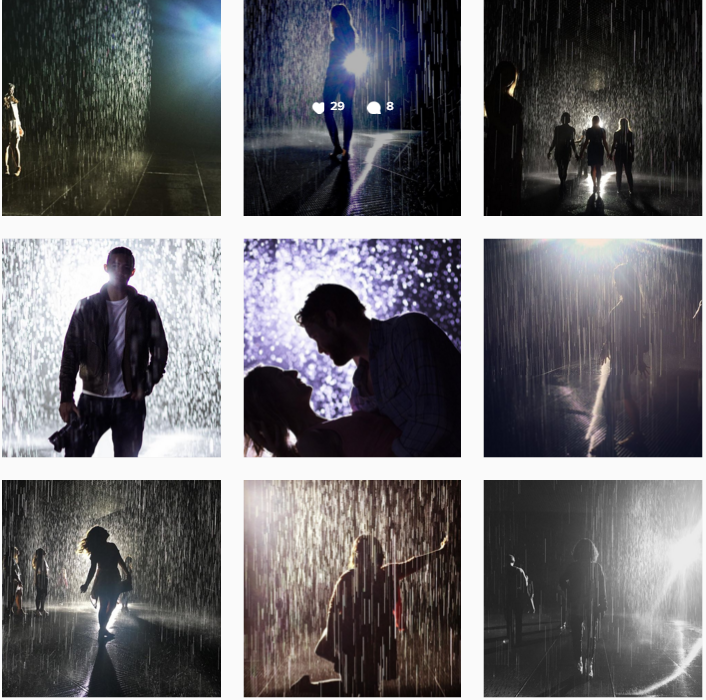
When you enter into the Rain Room at the Los Angeles Contemporary Art Museum (LACMA), you are overwhelmed by a sense of calm and serenity produce by the steady drops of water. As you move through the room, you magically remain untouched by the drops of water, but they continue to fall on all sides. You stick your hand out in front of you, but the rain seems as if it anticipates your motion and avoids contact with your skin.


The Rain Room, created and engineered by artists Hannes Koch and Florian Ortkrass, co-founders of the London-based art collective rAndom International has sold out exhibits at museums around the world. The Rain Room debuted at the London Barbican Center in 2012, but truly achieved “insta-fame” when it traveled to New York’s Museum of Modern Art (MoMA) in 2013. Only 7 people are allowed into the exhibit at one time, but it was estimated that over 1,000 people visited a day in the 11-week MoMA EXPO, sometimes waiting in line for 8 hours. Then, the exhibit was installed at the Yuz Museum in Shanghai, China and currently is on display at the LACMA in Los Angeles.

Last week during spring break, I had the unexpected privilege to attend a Q&A session with Koch and Ortkrass facilitated by LACMA CEO Michael Govan. After the presentation, I was able to experience the rain room for myself. After hearing the artists speak about their work, I had to stop myself from running into the exhibit – walking through the room was scary yet comfortable. It’s hard to describe the sensation of being surrounded by water without it touching you, so here’s a video that previews the experience (accompanied by a little explanation of creator Hannes Koch.)


The exhibit is housed in a 2,500 square foot room lit by a singular spotlight. Sensors and body mapping cameras allow visitors to move through the water untouched by the perpetually falling drops. Random International designed the room to be a self-contained system: it uses (and reuses) approximately 528 gallons of water throughout the entirety of the exhibit. This water is filtered through the LACMA’s main filtration system and is tested by sanitation professionals on a weekly basis to prevent potential health risks.

The creative minds behind the exhibit met during their college years in London, bonding over the California Light and Space movement, which took place during the 1960s. They soon collaborated in their artwork, focusing on architecturally innovative projects which cause the viewer to get outside of their comfort zone. They are eminent creators, whose desire to discover how technology, especially digital technology, impacts human behavior and social interactions.


Koch and Ortkrass spoke at length about the importance of the interactive relationship of the viewer with the art. The art installation allows the viewer to control the rain with their body movement, an interesting spin on integrating elements of nature with technology. They expected people to be scared to enter the room at first, but then become more trusting with time. What they did not expect was the “Instagram-ability” of their piece – it has been tagged on Instagram almost 40,000 times! To see how people reacted and posed for the pictures is a part of the modern nature of the piece; it’s a part of the world where people constantly pose, share, and comment on art and humanity through the screens of their cell phones.


Listening to the artists talk about their artwork, it was easy to identify Barron and Harrington’s core characteristics of creativity, especially their attraction to complexity and challenges (Barron et al.). The rain room began as a desire to observe the calming feeling of a rainstorm without the uncomfortable feeling of getting wet. Then, they wondered how this jolting experience would cause people to react. And so, their pursuit began.

At the end of the session, they previewed some of the future projects that Random International is working on. As co-founders of the art collective, they have collaborated in a way to inspire a greater cohort of individuals – they challenge the individual norm and inspire future creativity (Bennis 78). Similar to great technological advances of the past, like Apple, Random International excels in their creativity alongside the success of the technology available to them. Their studio prioritizes creativity through innovation and collaboration. They discussed their future plans to implement the rain room into an entire house or to even expand further outside of museum walls. Their perspective of the relationship of humans with technology sets them apart from many other creatives, who have strayed away from integrating science with their art. Their ability to examine and manipulate social behavior in scientific and artistic settings will be important in a world where technology is becoming an integral part of the human experience.

^ that's me!