Monday, November 6, 2017

Amanda Williams: "Color(ed) Theory Project"

Her Museum of Contemporary Art Exhibit: July 18- December 31, 2017

I stumbled upon an exhibit at the Museum of Contemporary Art by Amanda Williams, and this was her first solo museum exhibition, formulating a really up and coming local artist. Williams was trained as an architect, so she creates works that combine photography and sculpture to explore the themes of constant change in urban environments.

Williams grew up in Chicago, causing her art to really reflect her childhood and culture. She grew up in the Auburn-Gresham neighborhood in Chicago, so she uses her art to show the value of the city. Williams uses architectural elements as a microcosm for social, racial, and political issues, specifically creating stories about devaluation of Chicago neighborhoods.


In her exhibit at MCA, Williams uses images of houses to explain a bit about the people living in that neighborhood and the value they have in Chicago, as well as society as a whole. She focuses on certain neighborhoods, such as Englewood, but her artwork covers issues that really face many parts of the U.S. and even internationally. I would argue that she is somewhere between a little and big C creative because she focuses locally on where she grew up and what relates to her and locals, but her work addresses larger concepts that go beyond just the Chicago area.


Williams’ Color(ed) Theory project started in 2015, and was shown at the Chicago Architectural Biennial. She gathered community members and painted 8 houses in Englewood that were on the road to demolition using vibrant colors inspired by the South Side. The photographs of bright houses at the exhibit reflect the racial undertones of urban design and unfortunate decay. Williams further displays artwork in the form of sculptures by reusing the siding and brick from the painted houses that have been demolished, but whose memory will live on through her work. Williams’ work shows how demolition erases important things in the lives of urban citizens. The landscapes that Williams uses reflect invisible policies that have caused a downfall in inner cities. She was recently called to an Exhibition Design team for the Obama Presidential Center in Chicago.


Williams is a creative that, like Stephen King, noticed the meaning and possibilities in minute and mundane objects, such as a decrepit house on the South Side. She combines her knowledge from an excellent architectural education from Cornell with the street knowledge that she has of culture and conditions on the South Side where she was raised. This creative combination of fields to create photography, sculptures, and videos makes Williams a creative modern artist, explaining why her art is at MCA. Go visit her exhibit!!


https://3arts.org/artist/amanda-williams/

"Flyte" ~Fly, Light, and Float~


Movies such as Harry Potter, and many other Sci-Fi and mystical films have always portrayed such out of the box and different ideas that we wish could be turned into a reality. One notion in particular, levitation, is a type of a whimsical notion that Simon Morris took to the next level and allowed to become a reality. Simon Morris is the CEO and creator of “Flyte”. This company has taken many by storm, as it is a company that has now coveted the infamous gravity defying floating light bulb. This creative invention's idea came to fruition at a very young age, when Morris was fascinated by the “magic carpet” from Aladdin and wanted to find a way to make objects levitate. During his teen years, he took this mission very seriously and already began formulating ideas and techniques to convert this dream into a reality. He was first noted to create magnetic installations for Nike, which was where his name first became famous. Despite all of his success with them, for Morris, this was not enough. As he says, “Although I thought levitation was cool, I began experimenting on how this technology could be developed further and combined with wireless power.” 
 https://cdn.shopify.com/s/files/1/1000/7716/products/roy8_1024x1024.jpg?v=1502976348


It was due to this notion that he kept pushing boundaries and wanted to take this idea of levitation to the next level. After hours and hours of tireless work, Morris finally brought to life the “Flyte” bulb. This product is essentially a shatterproof bulb that uses very low voltage to be powered wireless. The base of this bulb, which is made of wood, is made to charge the bulb wireless and even more impressive is the length in which it can do this. The base is built to last for 50,000 hours, which to put into perspective is 11 years; 12 hours a day. This is unbelievable. It truly shows that Morris understood that if he is applying a hefty price tag on this product, the innovative idea isn’t enough, there had to be more. Therefore, one can see how this product’s battery life and longevity is what truly sells it and makes it worth every penny.

https://sapir.se/wp-content/uploads/2015/07/flyte-lampa-sapir-2-1920x1280.jpg


Based on The Four C Model of Creativity by Kaufman and Beghetto, I would argue that Morris is a Little C, Pro C, as well as a Big C creative due to the fact he was always motivated from a young age, then went on to take his passion into a professional platform and did extremely well, and is now considered a very imperative and influential innovative who is influencing today’s world and society. Time Magazine even recognized “Flyte” as one of the “25 Best Inventions of 2016”. This in itself speaks volumes.


One can also recognize how Morris can be seen as extremely intrinsically motivated as he wanted his dreams to come to fruition and make an impact on the world. Yet, with his success, he also became very extrinsically motivated, as many people began to really encourage his work, including his family, friends, and coworkers. Utilizing and harnessing both motivations in order to foster even more creativity is something that Morris has done an exceptional job of. He has shown that not only can one break barriers, yet they can do so in such a way that it will leave a very long lasting and influential impact on today, tomorrow, as well as many years to come. Simon Morris has already accomplished so much, yet for him this is only the beginning. It is because of this, one can see how the prospects to come in the future are truly exciting. 

https://imgs.6sqft.com/wp-content/uploads/2016/02/16203739/Simon-Morris-levitating-light-bulb-Flyte-7.jpg


Citations:

https://flyte.se/

http://www.slate.com/blogs/the_eye/2015/05/04/flyte_by_simon_morris_is_a_gravity_defying_battery_free_levitating_led_light.html

Two Minds are More Creative than One: The Story of the Duffer Brothers

Anybody who has a Netflix account or any sort of social media presences has no doubt heard about Stranger Things. For those of you have escaped the hype of the show, the first season of this Netflix original series follows a group of middle to high school students who are trying to find their friend who has gone missing and end up uncovering government experiments and secrets about another dimension. The show had such a boom of success after the first season, prompting the creation and recent release of the second season, Stranger Things 2. While the show and cast have become incredibly well known, the creative minds behind the show have somewhat less fame.


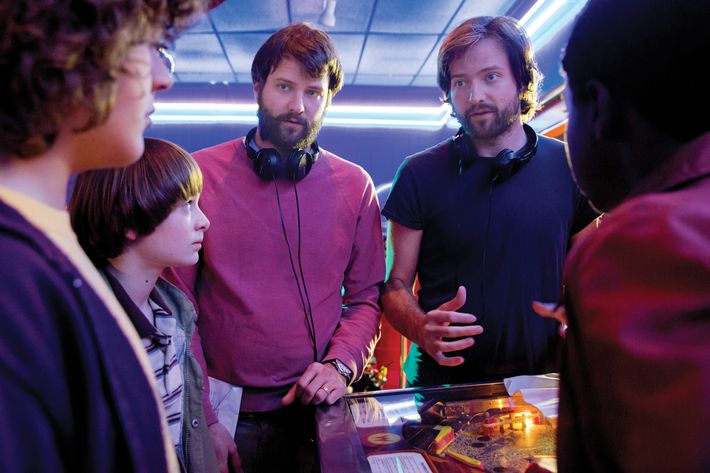
The Duffer brothers, twins Matt and Ross, are the creative minds behind the concept and creation of this hit series, although their journey wasn’t always this successful. After graduating from Chapman University in North Carolina, the brothers wrote a screenplay that was later bought by Warner Bros. They thought their fate in Hollywood was sealed, until the movie was put on the back burner by everybody but themselves and nothing came of the movie. They tried again by pitching a show inspired by M. Night Shyamalan to Shyamalan himself, who liked it enough to take it one and let the brothers continue writing for the show. But after season one, the brother decided they wanted to created something that was original and truly something they wanted to do. So comes the creation of Stranger Things.

Motivated to create a show that was true to themselves and their style, the Duffer brothers used the nostalgia of their childhood to create a show straight out of the 1980s but adapted to the modern world. They didn’t want to create a show that was reminiscent of the 80s but instead a show that was a reimagination of that era. The finished product of Stranger Things is a unique cultural experience that pulls iconic sound, visual, and image references from the 80s to combine them with the modern age of internet. The Duffer brother understand that internet and TV are becoming the new cinema and worked to create a show that is cinematic in its own right. The result is a show that draws from a multitude of inspirations and genres and intermingles multiple generations to set a new precedent for horror/sci-fi TV series.


As the Lehrer articles discusses, there is a way to learn from failure, and that’s just what the Duffer brothers did. They thought they had made it in Hollywood, and then they didn’t. They continued to write until they made connections. The beginning of their career was extrinsically motivated until they decided they wanted to created something that exemplified their style, and was truly for themselves. Little did they know their intrinsically motivated creation would become the most successful of their works.

Source: http://www.vulture.com/2017/08/the-duffer-brothers-upside-down-journey-to-stranger-things.html