Tuesday, October 1, 2019

Malala Yousafzai - Changing the Story of Education for Women


“I tell my story not because it is unique, but because it is the story of many girls.” - Malala Yousafzai

Malala Yousafzai, at only 22 years of age, has already done tremendous work towards the advancement of education for young women. Having received the Nobel Peace Prize in 2014, Malala continually stands up for and speaks out in favor of women’s right to education in countries across the world.

When Malala was 15 years old, she began to speak out against the outrage of prohibiting girls from attending school. The Taliban took over her town four years before and prevented girls from attending school. In resisting this injustice, she became a target and was shot on the left side of her head. This injury left her in the hospital, undergoing surgeries and rehab for months. After her recovery, she established the Malala Fund, which is “dedicated to giving every girl an opportunity to achieve a future she chooses.” Although Malala is incredibly talented in public speaking and educating those around the world, this talent is not what led her to desire to speak up about the importance of education. Malala was inspired to speak after that right was stripped away from her. Her passion to see all women educated motivated her to speak up and make a change in women's education.


Malala is now studying Philosophy, Politics, and Economics at the University of Oxford, refusing to give in to the violent attempts to keep her from education. She continues to travel, meeting with women and constantly working to establish a better community for women who desire education. Malala’s creative approach to building a better future for women has been seen throughout much of her life. Malala was separated from her classmates when she was just 11 years old, and quickly realized the importance of speaking up for their education. Despite the dangers of speaking up, Malala did not give up, even after being shot.

Malala established the Malala Fund in 2014. The work that is done through this fund is specific to each country the fund provides aid to. Malala is not taking a universal idea and applying it across the world. She comes to each country with a specific and unique plan to best fit the needs of women in that location. Malala is working to advocate for education in Afghanistan, Brazil, India, Nigeria, Pakistan, and the Syria region.

In Afghanistan, there is a focus on “recruiting female teachers and eliminating gender discrimination,” in India, on “expanding access to free secondary school through advocacy, mentorship programmes and re-enrollment campaigns,” in Pakistan, on “fighting for education funding, building schools for girls and training young women to speak out for their rights”. This individualized approach in each country shows how dedicated Malala is on working to truly achieve education for all women. Instead of sitting down and deciding on one creative approach to apply across every country, the Malala Fund looks at each country on its own and comes up with innovative solutions to fit the culture and climate of that specific location. The Malala Fund sees that only 7% of Nigeria’s budget is spent on education, and they help Kiki James advocate for increasing that percentage. In Brazil, however, the Malala fund focuses on the massive problem of sexual abuse and exploitation, supporting Denise Carreira in educating and training teachers on gender equality and reporting violence. In the Syria region, transportation to schools is a massive barrier to education. The Malala fund invests in technology which Nayla Fahed established to help refugee girls catch up on lessons, even without internet access.


This is a common theme throughout the work that the Malala Fund is doing – supporting, helping, and building up the people making a difference in these communities. Instead of coming in and taking over, they come beside and work with, a powerfully creative approach to change. It is all too easy to think we know exactly what needs to happen and how to make that change, but the reality is that those in the community know the culture and needs far better than an outsider or newcomer will. Malala desires to work with, not just for, the communities she enters into. Her creativity does more than inspire, motivate, and move individuals – it gives them an opportunity to create for themselves the future they desire. That is a power that simply cannot be undermined.

Works Cited:
https://www.malala.org

(You can also visit this website for more information on the work that the Malala Fund and to support the work being done!)


High Priestess of Awkward Phoebe Waller-Bridge

Image result for Phoebe waller-bridge
Vagina shots, guinea pig obsessions, sex with Priests, and feminist silent retreats with your sister. Actress, comedian, writer, and producer Phoebe Waller-Bridge isn't afraid to make you feel uncomfortable. In fact, that is the entire premise of her latest Emmy award-winning Amazon Original Fleabag (2016-2019). Using a combination of painfully grotesque situational comedy and the breaking of what's known as the "fourth wall," Waller-Bridge creates a universe where she can provide commentary in real time. In this bing-worthy sitcom, a woman known only to her audience as "Fleabag," played by Waller-Bridge herself, details the dramatic and often painfully awkward moments of life, always stopping to drop a joke or two for the camera at the expense of her friends and relatives. The beauty of this character is not only her detachment from social expectations and her sadistic love for making others uncomfortable, it is her ability to point out the meaninglessness of conventions of daily life. Simply put, Waller-Bridge entices her audience by saying what we are all thinking, or simply, breaking down that thinking all together.

Image result for phoebe waller-bridge fleabagTake this scene for example. Fleabag finds herself on a crowded London tube. The scene begins with a seemingly boring early commute, until you here the quiet opening of AWOLNATION's "Sail" in the background. As if choreographed, all of the passengers, with the exception of our protagonist, begin contorting their bodies in sync to the metallic riffs of the guitar. The viewer watches this scene play out with equal amounts confusion and awe. It builds with the music like a ballet of ordinary civilians until Waller-Bridges turns to the camera and brings it to a crashing halt. "I think my period's coming" Fleabag concludes and the motion stops.

This scene like many others needs few words to create an unforgettable moment. What's masterful about Waller-Bridges comedy is its lack of complexity and its provocation. Just by saying one line, "I think my period's coming," Waller-Bridge completely strips the performance of any symbolic meaning and defies every expectation of the viewer. That one line turns all of the beauty of the previous two minutes into absurdity.

These small moments are complimented by more serious plot lines. Through comedy, Waller-Bridge displays the complicated relationship between family members, grief after the death of a loved one, female sexuality, and the vulnerability of love. In the show, Fleabag grapples with the death of her mother and the recent "accidental suicide" of her best friend and business partner. Fleabag's fraught relationship with her "perfect, anorexic sister" helps her navigate through the reality of her situation: her business is on the brink of going under, she can't hold a guy for more than a couple of one-night stands, and at times, she feels completely and utterly alone.

Waller-Bridge admits that she draws on her own experiences while creating. Her character's are memorable for being complicated. They're not good. They're not bad. They defy categorization — a uniquely human quality. Her character may be a murderer, but she's the sweetest murderer you've ever met.

"I think a lot of time, I'm just writing my worst fears, of the idea of losing my mum or my best friend or doing something so terrible to somebody that's kind of deemed unforgivable, or having a really broken family." - Waller-Bridge

Waller-Bridge comes from a family who supported her artistic endeavors. In fact, several of her siblings work within the music and entertainment industry as well. Phoebe, herself, has always challenged convention. Beginning with her education at The Royal Academy of Dramatic Art in London, Waller-Bridge found herself frustrated with her course instruction. When they told her to be silent and expressive, she felt compelled to speak. When they told her to play a panther, she wanted to play a bat. In an interview with the New York Times, Waller-Bridge comments that life has always been that way for her. People try to place her in a box, and all she wants to do is get out.

“I’ve always wanted to be a bat,” she says, “but I’m expected to be a panther.” - Waller-Bridge

Image result for phoebe waller-bridge
After graduating in 2006, Waller-Bridge opened a Theater Company, Drywrite, with her business partner and fellow writer Vicky Jones. Her company was designed to push writers to create stories that made audiences feel uncomfortable. When she became dissatisfied by the characters being created, she decided to write ones for herself. What followed was both disturbing and terribly interesting, and I'm not even talking about her role on Star Wars.  


Waller-Bridge originally created Fleabag as a stage production, which debuted several times in New York. Her other creations including Crashing (2016), a sitcom detailing the lives of squatters in an abandoned hospital, and Killing Eve (2018), a romantic spy drama also received critical acclaim. Regardless of the fame these masterpieces have brought her, Waller-Bridge's ultimate fear is stagnation. She is never content to look backward towards her accomplishments, but wants to keep pushing herself and her audiences to think outside the box. Her star status as an actress does not concern her, rather, she has decided to focus on writing and producing much to the annoyance of many directors who have considered her for roles. Her partner, Jones, actually comments on Waller-Bridge's creative spirit, recounting Waller-Bridge's annoying habit of spoiling movies and productions by guessing and whispering what is going to happen next. Jones says this annoyance with predictability drives Waller-Bridge to "Phoebe-Proof" her own work, meaning the audience never knows what's about to happen. 

"You're allowed to bore your friends and family, but to bore your audience is unforgivable." - Waller-Bridge

That insatiable appetite for unpredictability can also make Waller-Bridges a difficult boss to write for. Often times writers on her various shows will giddily provide their new ideas for a certain character only to find out later that Waller-Bridge had already planned on killing that same character. However, the same goes for Waller-Bridge's own work. A perfectionist at heart, she is never satisfied with the first draft. In fact, Waller-Bridge once wrote her own character out of a production because she didn't think she could do that character justice. You can say what you want, but she is willing to make the hard decisions to provide the best quality.

That's exactly why Waller-Bridge has shut down the idea of a third season for Fleabag much to the dismay of fans and Amazon. According to Waller-Bridge, the story line has come to a natural end and she is ready to put Fleabag to rest. However, the same was said after the first season so fingers crossed.

For now, Phoebe Waller-Bridge is basking in the glow of her recent Emmy win and continuing to create some pretty depraved and masterful content. Waller-Bridge is set to star in live productions of Fleabag in New York until the end of April. The artist is also teaming up with HBO on a series titled Run, depicting a love story between two estranged friends whose time to call on a long forgotten pact has suddenly expired.

I, for one, can't wait to see what she comes up with next.

"I have a horrible feeling I am a greedy, perverted, selfish, apathetic, cynical, depraved, morally bankrupt woman who can't even call herself a feminist." - Waller-Bridges


Above is one of my favorite scenes from the series. Hair is everything.

References:
https://www.imdb.com/name/nm3564817/
https://www.nytimes.com/2019/02/14/theater/phoebe-waller-bridge-fleabag-killing-eve.html
http://www.bbcamerica.com/anglophenia/2019/05/10-things-you-never-knew-about-phoebe-waller-bridge


PewDiePie: Herald of the YouTube gaming revolution

When asked to think of Big "C" creatives, my first thoughts are of intellectual giants such as Nikola Tesla, Albert Einstein, and Neil deGrasse Tyson or of business moguls such as Oprah Winfrey, Jay-Z, or Mark Cuban. But I felt that I could not really relate to any of them, they seemed so much larger than life. Which brought me to my next question: do Big "C" creatives have to be these larger than life figures. Certainly, they did not have such prominence before their work, but after, it seems almost necessary for a Creative to gain such prominence. So I thought about this for a while, and I found a loophole in my thinking: YouTube celebrities. Although the most prominent YouTube stars gain the prominence of conventional celebrities, they are often a mere click away. Unlike, conventional celebrities, their content is largely personality based rather than based around a product they produce. Accordingly, each video represents a more intimate interaction between the creator and the viewer than music of videos of some sort. I knew what kind of person I wanted to do, but I was not too sure. I knew I couldn't just pick my favorite You Tuber because they might not hold the prominence necessary, so I picked the most popular You Tuber I could think of: PewDiePie.
Image result for pewdiepie
Felix Arvid Ulf Kjellberg (2019)

College dropout turned YouTube sensation, Felix Arvid Ulf Kjellberg joined the ranks of YouTube creators in 2010 - five years after the site opened. Felix had been a self proclaimed gamer all his life and had been interested in recording his videos for a long time. YouTube in 2010 was full of vloggers and sketch comedians (I'm sure we all remember Fred), gaming channels on YouTube weren't really a thing yet - but some did exist. Without a mold to adhere to, Felix was free to create his own material without much influence from other creators or fear of being unpopular for being different. He posted
"let's play"videos of himself playing horror games - and later Minecraft - which gained lots of views very quickly, but the crux of his popularity game from montage videos he created. It was in these videos where his goofy, energetic, and endearing personality was able to shine. Viewers couldn't get enough of it. By July 2012, he had 1 million subscribers, in 2013 he had 10 million, and reached 19 million near the end of 2013. He now sits at 101 million.

Image result for minecraft
Minecraft loading screen

Felix popularized gaming on Youtube, and changed it in a profound way. In 2016, he shifted from content driven posts to personality driven posts. That translated to less gaming videos and more "try not to laugh" videos. This shift from the content to the creator changed how YouTube was used and influenced every other gaming channel that popped up. Felix's channel became the blueprint for a successful gaming channel on YouTube influencing the type of games played and even how they are played. As a gamer, he knew that he could not always be the best at whatever game he played, so he didn't make it about him being the best. He made his channel about him being himself and just having a good time. Felix Kjellberg was among the first to create a brand based on his personality on YouTube and make millions off of it, recreated gaming on YouTube and influenced other creators, and gained international prominence and popularity in doing so,which is why he is a Big "C" creative.
Image result for pewdiepie channel
PewDiePie subscriber count

References:
https://www.youtube.com/watch?v=aopyONlY51k
http://www.inquiriesjournal.com/articles/1477/how-youtube-developed-into-a-successful-platform-for-user-generated-content
https://www.google.com/search?

rlz=1C1GGRV_enUS793US793&biw=1920&bih=969&tbm=isch&sxsrf=ACYBGNQngLw1RlH0BB2NoeoTnqUSajKbhQ%3A1569961533855&sa=1&ei=PbaTXdHwM8mosgWipIWwBg&q=pewdiepie&oq=pewdiepie&gs_l=img.3..35i39j0l9.180091.181802..182059...0.0..0.101.693.8j1......0....1..gws-wiz-

https://en.wikipedia.org/wiki/PewDiePie
Images:
img.......0i67.hHE5V3N36Us&ved=0ahUKEwiRg6W88vvkAhVJlKwKHSJSAWYQ4dUDCAc&uact=5#imgrc=-YoI-T0kj_RCoM:\
https://www.google.com/search?

q=pewdiepie+channel&rlz=1C1GGRV_enUS793US793&sxsrf=ACYBGNTWWfXp70voFMgwrxzgkb1ITJTY5w:1569961760787&source=lnms&tbm=isch&sa=X&ved=0ahUKEwjF57-o8_vkAhUsmuAKHdsGD74Q_AUIFCgD&biw=1920&bih=969#imgrc=hi0k9VUbVMeiBM:
https://www.google.com/search?

q=minecraft&rlz=1C1GGRV_enUS793US793&sxsrf=ACYBGNTqHJ73C8sowiT5XmKCkuki3AxYfQ:1569961745540&source=lnms&tbm=isch&sa=X&ved=0ahUKEwikmJ2h8_vkAhXBV98KHVQDBHwQ_AUIFCgD&biw=1920&bih=969#imgrc=qCGu62FOHXd78M:


Stephen Hawking and The Legacy He Left Behind

As I was trying to find my creative for this blog, I found myself searching through the biographies of prominent individuals I had never heard of before. Although what they had done was great, no one struck me as interesting enough to write a post about. While scrounging the internet for a creative to stand out, I turned to my friend to pick her brain for ideas, “Name the first creative individual to come to mind who has made major breakthroughs.” Without skipping a beat she said Stephen Hawking and my search began. A little hesitant at first, I soon found Hawking was the creative I was looking for. Not only did he make some of the greatest scientific discoveries of the late twentieth and early twenty-first centuries, but he also did it all with an ongoing, terminal disease called ALS for over 50 years.

The Disease
Hawking was first diagnosed with ALS at 21 years old while attending Cambridge after noticing signs of the disease while previously studying at Oxford. ALS, also known as amyotrophic lateral sclerosis, is a “progressive neurodegenerative disease that affects nerve cells in the brain and the spinal cord,” which results in progressive muscle weakness. Although he was only given a couple of years to live, Hawking lived well past that. As a result, the constant threat of his disease suddenly and rapidly progressing was just one of the factors that lead to his many scientific advancements. Hawking felt an overwhelming need to learn as much as he possibly could about the secrets of the cosmos before his disease would no longer allow him to. Over the many years, his ALS did progress and towards the latter half of his life, while he was still continuing his research, he found himself confined to a wheelchair and eventually communicating through the use of the technology that translated eye movements, and later cheek muscle movements, to words. Due to his disease, he experienced much isolation but it was the combination of isolation and drive to complete his studies and research that made him the great man we know him as now.

Stephen Hawking (image from biography.com)

The Work
Hawking is most famously known for his discovery that black holes are not the information vacuum scientists previously believed them to be. Instead, Hawking proved “that matter, in the form of radiation, can escape the gravitational force of a collapsed star.” Since I’m not well versed in scientific language, I’ll spare you the details by saying, Stephen Hawking created his own radiation theory by bringing new meaning and understanding to the workings of black holes, as well as the big bang theory, and ultimately, how the universe was made. His discoveries made him famous in the science world but also heard by everyone else as well. As a part of his efforts to share his discoveries with the world, Hawking wrote many pieces of literature in attempts to simplify his findings so that the everyday person could understand the significance of the material at hand. His contributions in cosmology, physics, and the field of general relativity brought him numerous exceptional honors and awards. Even a year after his passing, his theories on the universe's secrets remain very relevant and discussed in both the scientific world and mainstream media as well.

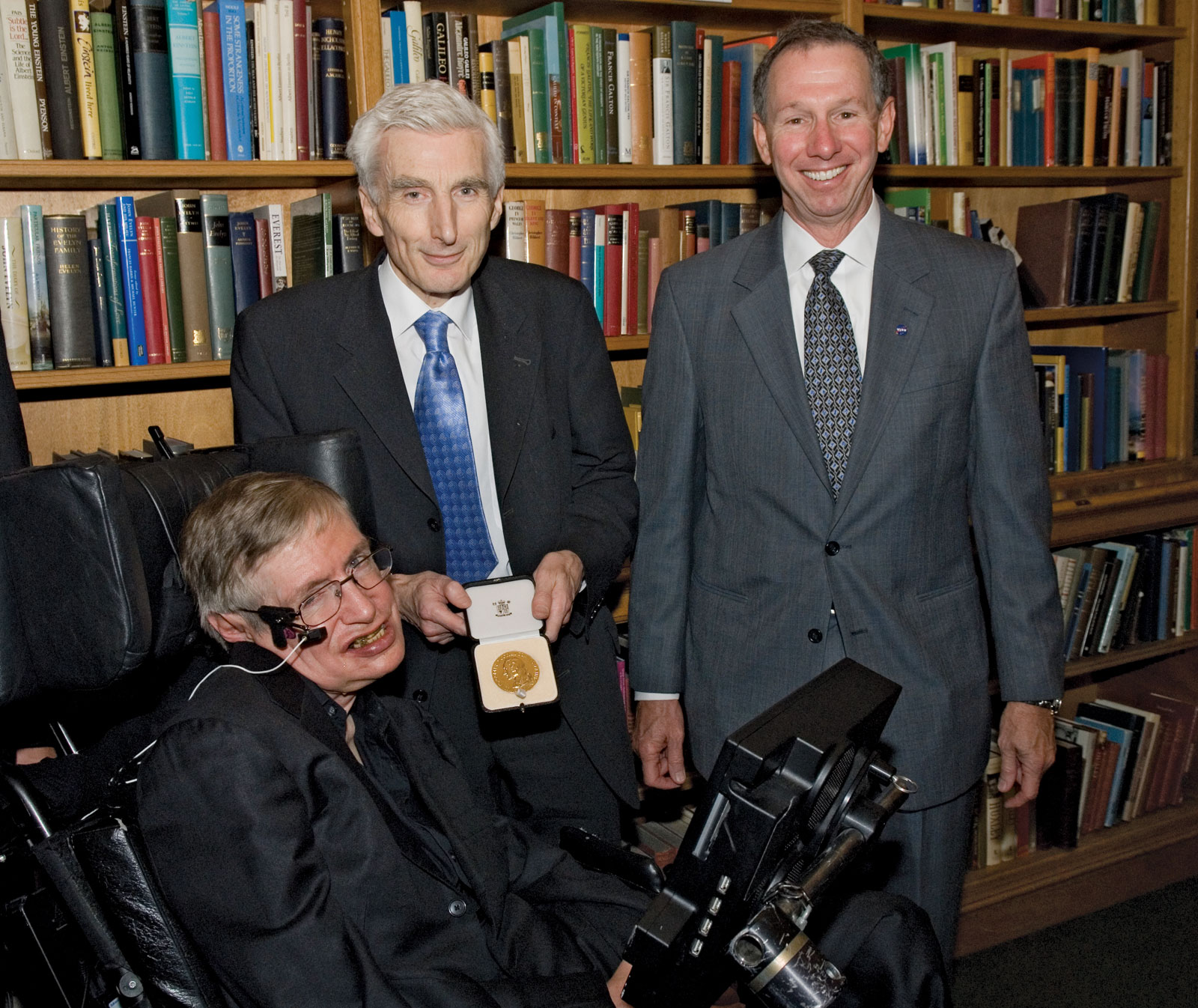
Stephen Hawking receiving the Copley Medal of the Royal Society, 2006 (image from britannica.com) 

The Impact: A Modern-Day Big-C Creative like No Other
Stephen Hawking can and should be named one of the greatest Big-C creatives of our era. He transformed the way we look at space, black holes, and the universe as a whole. When he was faced with the possibility of death, he was not held back or deterred from his work, but rather quite the opposite. Hawking recognized his calling and dove into the work that lied before him. Whether he was going to fail or not was not even a discussion, Hawking was driven not towards success of any kind, but rather knowledge. He knew that if his days were numbered, he needed to answer the questions that had filled him for so many years, he yearned for knowledge. He not only yearned for this knowledge for himself, but for the world. In the past 20+ years, references to and appearances by Hawking himself have been made in everything from cartoons to television series, from talk shows to movies, all because of the great scientific knowledge he has brought to the world. The impact Hawking has left on the past, present and future understanding of the universe is almost unmatched. Thanks to his many contributions, cosmology will be forever changed and as a result, Hawking has opened a door to numerous advancements that await the future of science.

Stephen Hawking with the star of Fox's The Big Bang Theory, Jim Parsons (image from biography.com)
Sources for information and images:

Monday, September 30, 2019

Trevor Noah and The Power of Language

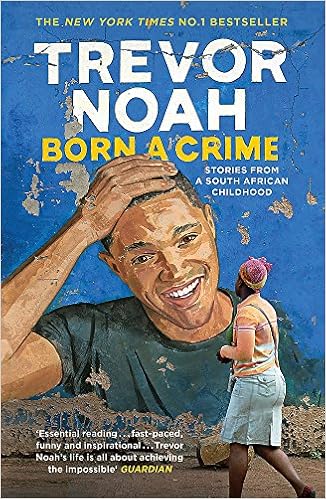
Oftentimes, it is a person's life circumstances that shape them into the creative individuals they are today. Trevor Noah, best known as the host of The Daily Show, is someone who demonstrates how your environment shapes you. Watching his work as a host on a liberal comedy show, you may find yourself wondering why a South African man hosts a show so deeply rooted in American politics. Furthermore, Noah has an ability and a tendency to not only mimic others’ languages and accents incredibly well, but it is also evident that he always tries to envision others’ perspectives as well. These tendencies and skills can be explained through reading his memoir, Born A Crime, where he details his life growing up in South Africa under the apartheid.

Image result for trevor noah born a crime

The title of “born a crime” is to be taken literally; “Where most children are proof of their parents’ love, I was the proof of their criminality,” Noah explains. He was born a mixed child to a white father and a black mother, in a time in South Africa’s history where relations between a white person and a black person was an act worthy of years in prison. Consequently, Noah grew up away from his father, and constantly hiding from authorities because they would take mixed children away from their parents. The broader consequence, and the one which I think impacted his uniqueness the most, was the fact that grew up an outsider. Neither black nor white, he did not blend in with either group, and he describes how he learned to understand others’ perspectives due to this.

Furthermore, he learned to speak a multitude of languages in order to both blend in with those around him and thrive in every situation. He speaks seven languages, including English, Zulu, Xhosa, Tswana, Tsonga, Afrikaans, and German, and mostly without any sort of accent; he compares his abilities to those of  “a chameleon.” It is not Noah’s abilities that make him unique; rather, it is his realization of how deeply his accents can impact perceptions:

“Language brings with it an identity and a culture, or at least the perception of it. A shared language says “We’re the same.” A language barrier says “We’re different.” … Racism teaches us that we are different because of the color of our skin. But because racism is stupid, it’s easily tricked. If you’re racist and you meet someone who doesn’t look like you, the fact that he can’t speak like you reinforces your racist preconceptions: He’s different, less intelligent. A brilliant scientist can come over the border from Mexico to live in America, but if he speaks in broken English, people say, “Eh, I don’t trust this guy.” “But he’s a scientist.” “In Mexican science, maybe. I don’t trust him.” However, if the person who doesn’t look like you speaks like you, your brain short-circuits because your racism program has none of those instructions in the code.”     

This concept – that language is yet another barrier people face with racism, but also a way people can possibly break, or at least challenge, the barrier – was extremely creative to me. People do not often discuss this viewpoint, and it is one that serves to add an additional facet to the concept of racism. Moreover, the idea that speaking to another in his or her native tongue breaks barriers and fosters understanding is also discussed in Accept Defeat: The Neuroscience of Screwing Up, albeit on an entirely different topic. Jonah Lehrer explains that solutions to problems are “rendered invisible by our small-minded brain. It is not until we talk to a colleague or translate our idea into an analogy” that we succeed in our endeavors. These both show the power of language as a tool for universality and connections across both disciplines and cultures. Trevor Noah is able to transcend cultures in his memoir, his stand-up shows, and in The Daily Show; Hence, Noah himself is an embodiment of this sentiment, which is evident in his incredible storytelling abilities.

Trevor Noah is a unique individual, with a perspective that brings unique discoveries and attributes. His success can be seen as inextricably tied with his individuality. Born A Crime was on The New York Times’ Bestseller List for 13 weeks straight, and Noah is seen as someone in comedy who provides incredibly unique and nuanced analyses of situations and individuals. His explanation of the idea that language is both a barrier and a means to break barriers is truly creative and reshaped my own ideas on expression though language. Critics claim that “Noah’s brand of intelligent outside comedy is winning over audiences in America.” In other words, Noah is a "little c" creative, one that is a creative within his own profession, forming his own unique brand of comedy.  

References:

Lehrer, Jonah. “Accept Defeat: The Neuroscience of Screwing Up.” Wired, Conde Nast, 5 Oct. 2018, https://www.wired.com/2009/12/fail-accept-defeat/.


Lister, Paul. “Trevor Noah's Memoir 'Born a Crime' Is an Insightful Read about Apartheid and Identity.” Medium, Medium, 18 Mar. 2017, https://medium.com/@paul.a.lister1/trevor-noahs-memoir-born-a-crime-is-an-insightful-read-about-apartheid-and-identity-4acf072f93ab.


Noah, Trevor. Born a Crime: Stories from a South African Childhood. Createspace Independent Publishing Platform, 2017.


Somers, Jeffrey. “5 Surprising Things You'll Learn from Trevor Noah's ‘Born a Crime.’” ThoughtCo, ThoughtCo, 6 Aug. 2018, https://www.thoughtco.com/trevor-noah-born-a-crime-4132424.


“Trevor Noah Says He Grew Up 'In The Shadow Of A Giant' (His Mom).” NPR, NPR, 22 Nov. 2016, https://www.npr.org/2016/11/22/503009220/trevor-noah-looks-back-on-childhood-in-the-shadow-of-a-giant-his-mom.


Rick Riordan: Bringing Back the Gods


My admiration for author Rick Riordan began when I was in middle school before I was 10, maybe 8. Now, I'm 20, re-reading his books for what must be the 2nd or 3rd time and drowning in the nostalgia; furthermore, only now do I realize the immense amount of research and creativity Rick Riordan puts in to his work, creating diverse characters that undergo tremendous otherworldly pressure while struggling through the ups and downs of young adulthood, much the same as all of us who were once high school students.


Rick Riordan is a New York Times Best-Selling Author who writes about mythology in the modern day. While he started out with the 5-book Percy Jackson series in 2005, which follows the son of Poseidon, Percy, as he comes to understand that everything in Greek mythology is in fact real. While he has branched off to include other mythologies, including Norse and Egyptian, he is most famous for his Greek-centric Percy Jackson series and Greek- Roman fusion series The Heroes of Olympus.

On his website, Riordan's biography says that he used to be a middle school teacher before becoming a full-time author. His son Haley would ask for bed-time stories at night and when he ran out of stories, he recalled a project he had his sixth grade students complete where they created their own Greek hero with their own quest. According to him, "[he] made up Percy Jackson and told Haley all about his quest to recover Zeus' lightning bolt in modern day America." Thus, based on his own previous experience with teaching children, the Percy Jackson series was born.

Riordan is creative in what I believe is little C; he took Greek mythology and molded stories and mythical beings into a modern day series that revolves around groups of demigod teenagers who risk their lives to save the world from evil beings and face their own destiny while dealing with the relationships of those around them, suffering from loss and the violence of war. Although these characters often possess supernatural powers, they encounter situations modern day teenagers have to face that could prove more dangerous than the powers of an ancient evil.


Official artwork from the Rick Riordan website 

What is most important about Riordan's creativity is the length he goes to include diverse characters in his series. The targeted reading age is 12-13, just as many children are going through puberty and learning more about themselves. As a school teacher, he wanted to represent marginalized populations and considered it essential to create role models children could look up to in his books. Almost all sons/daughters of gods —demigods— have ADHD or dyslexia, but Riordan stresses that although these children process differently, the way they think is not wrong; it is simply an adaptation. Beyond this, his characters have unique identities: one character in the Norse mythology series is deaf, another is transgender, and from the Greek-Roman fusion series Frank Zhang is Chinese-Canadian, Piper McLean is Cherokee, Leo Valdez is Hispanic, Hazel Levesque is African American, Reyna Avila Ramirez-Arellano is Puerto Rican, and one of the main characters who was in the Percy Jackson series, Nico di Angelo, is gay. This revelation was extremely important for the time (2014) as gay marriage had yet to be legalized in the U.S (2015) and this event cemented Rick Riordan as one of the most inclusive authors for his targeted demographic of children and teenagers.

There is no "right" or "wrong" to mythology, as most of it is a blank slate, or has been erased from society or transcribed into another culture (ex: the Romans adopting Greek mythology and making it their own.) Riordan even states "there are so many different versions of each myth" and for him to come up with such specific details on many obscure myths is why I think he is a little C creator. He builds on existing foundations and creates inspiring stories that spark creativity in all who read his novels.


Additional article:
https://www.theodysseyonline.com/gay-character-childrens-book-series

Sources:
Images from Google and Rick Riordan's website
http://rickriordan.com/about/frequently-asked-questions/

Wednesday, September 25, 2019

Mark Rothko: The Artist and the Character

My initial exposure to Mark Rothko was through a friend who recommended I read his favorite play, Red by John Logan. The play captures the interactions between Rothko and his assistant during the artist’s work on a series of murals for the New York Four Seasons Restaurant. As the relationship between the two men plays out over the two years Rothko worked on his murals, they challenge each other with questions about what the meaning of art is and what role it should serve in the world, while also analyzing the complexities of the relationship between creation and creator.


Mark Rothko the artist, born as Markus Rothkowitz, was born in Dvinsk, Russia to a Jewish family, and the family immigrated to Oregon in 1913. He won a scholarship to Yale, but he dropped out after two years and moved to New York to pursue a career in art. He began working with Max Weber at the Art Students’ League, changed his name to Mark Rothko, and created works influenced by Cezanne, Avery, and other painters he learned about in his studies. He tried his hand at surrealism, depicting ancient myths as universal symbols of human tragedy. Rothko was fascinated by the human experience, and this fascination intensified when he and his contemporaries read lots of Nietzsche and Jung during WWII. Host of the Art Assignment Sarah Green states that “Rothko and other artists of the time thought that following artistic tradition was not only irrelevant but irresponsible.” Rothko began creating large, geometric, abstract paintings consisting solely of rectangles of color. His paintings showcased color without any narrative structure, and color was “the elimination of all obstacles between the painter and the idea, and between the idea and the observer,” according to Rothko. The depth of his colors cannot be captured with images online, and I haven’t been lucky enough to see a Rothko in person yet. He was commissioned to create murals for a chapel in Texas as well as the aforementioned series of murals for the Four Seasons Restaurant. The paintings meant to go in the restaurant were going to be a wide array of reds, designed to make the consumers in the restaurant feel trapped and oppressed. Rothko ended up giving the paintings to a museum instead. He controlled the conditions in which his paintings were viewed to ensure that the viewer had a totally transcendent experience. Rothko was deeply troubled, and after a life riddled with mental and physical health problems, he shot himself in front of an unfinished painting. Today, he is remembered for pioneering abstract expressionism, and Kaufman might even call him a “big C” creative. 


Readers of John Logan’s Red encounter Rothko and his assistant Ken in the midst of his work on the paintings for the Four Seasons Restaurant. Rothko the character is prickly and temperamental, but the play provides incredible insight into his tortured creative process. Rothko the character obsessed about creating places within his paintings or within the context of his paintings viewed in conjunction because he wanted the viewer to remain in a space to allow the color to move. Rothko understands that art needs a viewer, asking glibly if his paintings “pulse” when they are alone. He resents the idea of his work being called beautiful, loudly proclaiming that “[he is] here to stop [our] hearts...to make [us] think…[he is] not here to make pretty pictures.” Rothko and Ken barrel into an argument regarding who is good enough to consume Rothko’s work, or even art in general. Rothko recognizes that art needs a viewer, but he laments that selling one of his paintings “is like sending a blind child into a room full of razor blades. It’s going to get hurt, and it’s never been hurt before, it doesn’t know what hurt is.” Ken quips that Rothko would gladly spend the rest of his days lecturing next to his paintings, but at some point the art must speak for itself. Rothko the character then strives ceaselessly for the power of his creation to go beyond the space and create an experience, confronting universal human tragedy and drama in its rawest forms.

In Rothko the character and the artist, we see the indelible mark the burden of the creative product leaves on the creator. He was frenzied, intense, and strong-willed and he wanted his creations to wholly envelop the viewers in an immersive experience. He did not title most of his paintings, finding words overly complicated and silence to be incredibly “accurate.” Rothko conveyed depth and profundity in his works. He argued that “a painting is not about an experience, it is an experience.” In the interplay between viewer and artist and creation (even simply readers of the play, indirectly consuming his art), the art finally speaks for itself in the place created among the three.

Works Cited:
https://www.youtube.com/watch?v=1v1mBepDlOw
https://www.nga.gov/features/mark-rothko.html
Kaufman, J. C., & Beghetto, R. A. (2009). Beyond Big and Little: The Four C Model of  Creativity. Review of General Psychology, 13(1), 1–12. 
Logan, J. (2011). Red. New York: Dramatists Play Service.