Tuesday, October 1, 2019

Good Omens (for Gaiman's Creative Eminence)

The ridiculously acclaimed and frightfully delightful author Neil Gaiman has had a profound influence on the contemporary literary world. His comic books paved the way for a new wave of enthusiasm for the industry, and his fictional works have been world-expanding and era-defining for many in the fantasy and science fiction realm.


Gaiman spent his childhood in Sussex, England, during which time he hung out very frequently at the local library. His passion for literature began early, especially genres that mentioned the fantastical, and he frequently mentions the incredibly helpful librarians who helped him hunt down more and more things to read. These experiences must have instilled in him a love of writing as well, since after finishing school, he became a journalist. In that position, he was able to connect with other literary and artistic minds; for example, he forged a close bond with author Terry Pratchett and artist Dave McKean, both of whom he collaborated with on later literary endeavors. Gaiman has used some of his own personal and childhood experiences as inspiration for his fictional works, most notably in The Ocean at the End of the Lane, which centers on a boy who confronts emotional and physical monsters of sorts (I don’t think the physical magic is based on Gaiman’s life, but I suppose you’d have to ask him to find out for sure).

Gaiman, with friend and artist Dave McKean, worked on a mini-series for DC Comics called Black Orchid, which was part of a larger wave of dark adult comics gaining attention in the late 1980s. From there, Gaiman and McKean began the award-winning DC series, The Sandman, focused on Morpheus, the king of dreams. As the monthly comics gained greater attention, Gaiman embraced his opportunity to explore complex themes and characters, which only engaged the audience further. His unique stories that spanned spaces and times had a bigger impact than he expected -- the Sandman series outsold Batman and Superman, and, what’s more, drew in a new and excited population of comic book readers. Gaiman, with McKean working on the cover art of the issues, helped usher in a new era in the comic book industry. Gaiman’s especial impact on the genre was solidified when he implied that once he was done writing for The Sandman, the series should end. This was relatively unheard of with successful comic series, which would typically bring a new writer in as soon as the first left. Gaiman eventually convinced DC that this norm should not be followed, and they relented; so he not only helped rejuvenate the comic book industry, but also shook up systemic commercial practices within that industry to preserve his work’s integrity. These revolutionary acts make me believe that Gaiman may be eminent enough to be considered a contemporary Big-C creative.


Gaiman has also contributed greatly to the genre fiction community, as well. He has released dark fantasy and science fiction works for adults, teens, and children, with settings ranging from 19th-century English countryside (Stardust) to a Wonderland-like world underneath contemporary London (Neverwhere) to a weird house and museum in Wisconsin (American Gods) and a pantheon of iconic characters that includes everything from fallen stars and old witches (Stardust) to bantering angels and demons (Good Omens, co-written with Terry Pratchett) to children raised by ghosts (The Graveyard Book) and little girls exploring terrifying alternate worlds (Coraline). He has won more literary awards for these works than can reasonably fit in this blog post, but go to his website (www.neilgaiman.com) and you can see just how acclaimed this man is. He has played an active role in adapting several of his works into movies (Stardust and Coraline) or television series (American Gods and Good Omens), dipping his toe in and leaving his unique fantastical touch on several artistic media. Based on the wide-reaching support from critics in his fields as well as his expansive fan base, his hand in revitalizing the comic book industry, and his ability to successfully cross over into several different fields, I would make the claim that, though only time will tell if this comes to pass, this pro-C author could one day reach the cultural eminence of being considered truly big-C creative.

Sources:


Nadya Okamoto and Period Power

Nadya Okamoto is one of the most accomplished 21 year olds today. Not is she a published author, Chief Brand Officer of Juv consulting, founder of Period: The Menstrual Movement, and a celebrated Ted Talker, she also ran for an elected position for Cambridge City Council in 2018. Through all of her work, she is a Creative for the way that she utilizes social media to elevate the voices and concerns of those around her. She utilizes her platform in a way that makes her stand out. 

Okamoto grew up in a half Taiwanese, half Japanese household in New York City. At 9, Okamoto's mother won sole custody of her and her sisters and moved to Portland, Oregon where they experienced a lot of housing instability. At 16, Okamoto was inspired by her own situation, and the struggles faced by other homeless women in addressing how to deal with periods when you can't afford to buy period supplies. Okamoto believes that period equality and access to menstrual hygiene products is not a luxury, but a human right. She saw an issue, where homeless women were forced to use trash and cardboard as period products, and she did something about it. In 2014, Okamoto founded PERIOD.org, a non-profit to end period poverty and period stigma through service, education, and advocacy. Okamoto's aggressive, modern marketing campaign paid huge dividends. Within four years, PERIOD.org had addressed over 560,000 periods, registered over 360 campus charters, and grown to be the largest youth-run in women's health. 


Okamoto created a movement 

In 2019, PERIOD.org took their mission to end period poverty to the national level, working to end the "luxury tax" on tampons, and by fighting for all schools and prisons to carry menstrual hygiene products. Okamoto's vision for PERIOD has only expanded after hearing the needs and concerns of menstruators across the country, and even the world.


Even if Okamoto was only handling PERIOD.org, I would consider her to be a Pro-C, if not Big-C Creative. Astonishingly though, Okamoto is also involved in the largest youth run consulting firm in the US: Juv Consulting, has written a book, gives talks to major companies across the nation, has run for a government position, and is a current college student at Harvard. Talk about a tough schedule. 
Since PERIOD.org started, Okamoto has utilized her social media presence to advocate for others. On Instagram, Okamoto has over 30,000 followers and constantly features the voices of other youth activists across the nation. I think that one of the qualifications of being a Creative is taking risks to further your passion and that is exactly what Nadya Okamoto is doing. 

Resources:
https://www.period.org/nadya
https://www.huffpost.com/entry/nadya-okamoto-menstrual-movement_n_5b76f06 ce4b05906b 4133 6f4
https://www.instagram.com/nadyaokamoto/?hl=en
https://www.makers.com/videos/5ced90128c3ae828f84ba95f
https://www.vitalvoices.org/people/nadya-okamoto/

Billie Eilish- Not Your Typical Teenage Pop Star

Billie Eilish refuses to be what people usually think of when imagining a seventeen year-old pop star, and she prefers it that way. 

No two songs of hers sound the same. Constantly crossing the threshold of different genres and moods throughout her albums and individual songs, Eilish loves keeping her fans on their toes and wondering what she'll release next. 


Born in 2001, American pop star Billie Eilish is changing the way people think about music, and stereotypes about young female singers. An LA native, she began singing when she was very young, with her single "Ocean Eyes" becoming a hit on Soundcloud when she was only 15. Since then, shes released two albums, Don't Smile at Me (2017) and more recently When We All Fall Asleep, Where Do We Go? (2019). The songs on these albums are impossible to categorize into any one genre, and that has only boosted her success, with her second album debuting on the Billboard Top 200 and going #1 in the UK, Canada, and Australia. Musical talent seems to run in the family as well, with her brother Finneas also having hit songs, with only a few real fans knowing their relation. 


Billie has been the center of lots of attention on social media, with her announcement of an Eco-Friendly World Tour, her success at such a young age, and particularly her style, and why she dresses the way she does. Eilish recently confessed that she wears baggy clothes to avoid being judged by other people for the way she looks: “Nobody can have an opinion [on my body] because they haven’t seen what’s underneath. Nobody can be like, ‘she’s slim-thick,’ ‘she’s not slim-thick,’ ‘she’s got a flat a**,’ ‘she’s got a fat a**.’ No one can say any of that because they don’t know.” This led to an uproar on multiple social media platforms, with thousands of people, especially girls who related to her story of feeling hyper-sexualized at such a young age. 

One of her projects that have been particularly interesting to me was Eilish's "immersive experience" following the release of her most recent album. The museum-like event featured an exhibit for every song on the album-- a way to physically experience what Eilish was meaning to convey in her own songs. She created the event as a way to share and reflect on her synesthesia, which makes her see colors or smell sounds when she listens to music. Eilish said, “I wanted to take my synesthesia and give it to the world and show everybody what it feels like." This project of hers absolutely astounded me: the fact that every song could be an experience within itself, and she was able to manifest that experience physically is simply awe-inspiring. Of course, influencers flocked to the event in order to get cool pictures and support Eilish, but the message behind the event sparked immense interest in her creative process as a whole.

Eilish's creative process goes all the way back to her prestigiousness as a young child, always showing a clear talent for music; she is quite similar to Picasso and other big C Creatives of the modern-day. In an interview with MTV, Eilish talked about her songwriting process: “I like to write in characters a lot, and especially me and my brother. Sometimes we’ll just sit down and be like: ‘Let's think about someone and then think what they’re seeing. What are they thinking? What are they thinking about doing?’ It’s a fantasy-like world, and I feel like the cool part about music is that you can tell the truth, 100%, and nothing but the truth, or you can completely lie.” Eilish is able to completely immerse herself in a world of a character in order to write a song from their perspective-- a lot like what she presented in her own art installation for her album. On the category her songs fall into, she said: “All I try now is just make sure it’s not categorized. If it is it’s under alternative, and like, I’m not though? I’m really not, I’m not pop, thank you. I’m not pop and I’m not alternative, I don’t know what I am." This refusal to be placed in any one genre of music is something that I think makes Billie different than any other artist around right now. She's new, she's different, she's and individual, and she knows how to really look inside herself in order to be the best creative she can be. 


More Than Microsoft

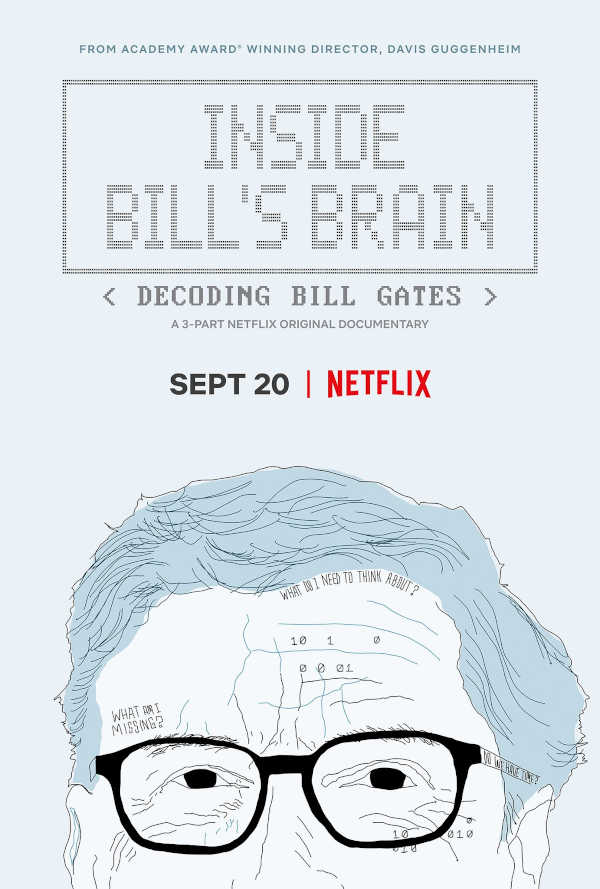
Upon getting assigned this blogpost I kept racking my brain to try to find the perfect creative to write about.  I spent days trying to figure out the right person but I could not figure it out.  Then when I was browsing Netflix I came across the documentary called Inside Bill's Brain: Decoding Bill Gates by Davis Guggenheim.  After watching the documentary, I decided to write about Bill Gates for my blogpost using information I learned while watching it.
Image result for inside bill's mind

The first part of this documentary focuses on the Bill and Melinda Gates Foundation.  Specifically the toilet they helped create for African countries in hopes of minimizing the deaths due to diarrhea.  This documentary does a great job of trying to explain Bill's creative mind.  When watching it I could not help connecting almost everything that was said to class.  One of the things that stood out to me was what he does when he is faced with a creative block.  He plays tennis, sometimes up to 8 hours.  This acts as incubation where his conscious mind is preoccupied with playing tennis while his subconscious processes the issue at hand.

Image result for inside bill's mind tennis
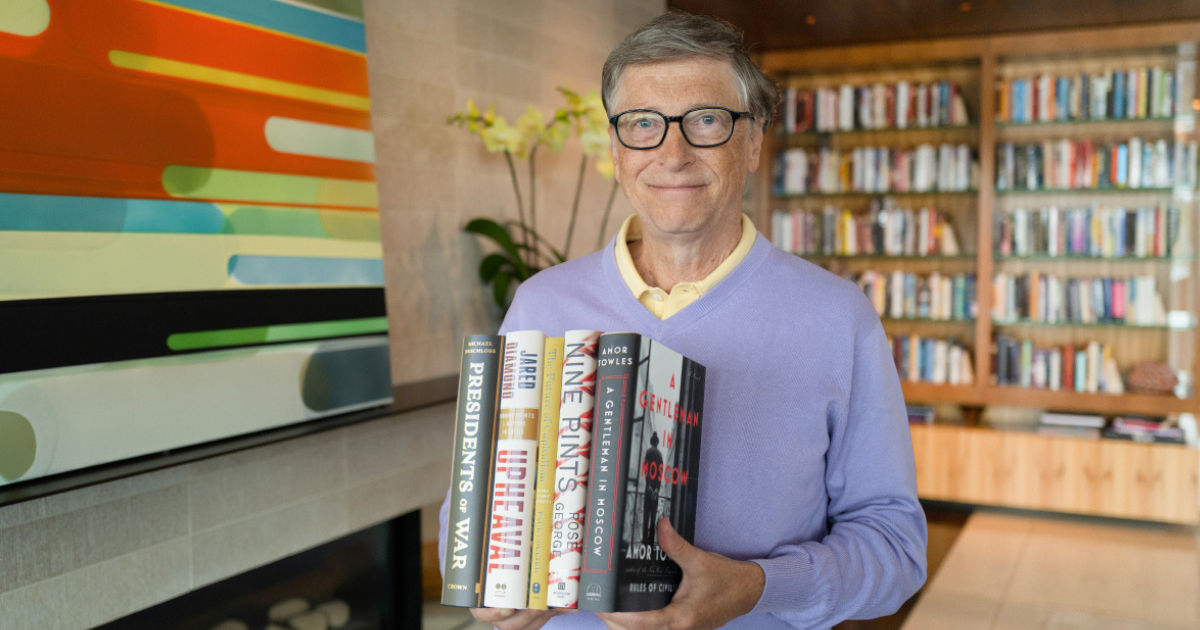
The documentary also makes it a point, through several testimonies, that Bill Gates reads a lot.  To me, this is a form of collecting.  In class we talked about how creatives collect information and experiences.  This extensive amount of reading definitely appears to be a form of collecting experiences and information that fuel Bill's creative mind.
Image result for bill gates reading
Another thing that should be taken into account in regards to Bill's creative process are his motivations.  The first part of this documentary shows that Bill's mother and wife are a big motivators in his humanitarian work.  All through his life, Bills mother always reminded him to give back to others.  His wife also motivated him to assist the people in Africa because she brought the septic waste issue to Bill's attention.  Melinda not only brought this issue to Bill's attention but expressed how it was their duty to help these people.Image result for melinda gates
Image result for bill gates mom
Bill had many obstacles that made it difficult for him to achieve his goal of reducing the death due to diarrhea.  Perhaps the biggest one was cost.  The governments of these African countries cannot afford to install typical waste treatment facilities.  So he needed to devise a system that can cheaply be installed and still be sanitary.  This toilet needed to "remove germs from human waste and recover valuable resources such as energy, clean water, and nutrients, operate without connections to water, sewer, or electrical lines, and cost less than .05 cents (in US dollars) per user per day" as stated on the Bill and Melinda Gates website.


Image result for bill gates toilet
Even though Bill figured what features the toilet needed to possess he still needed to engineer it.  This is, in my opinion, his creative product.  Bill made a contest amongst many engineering companies from around the world to see who can build the best product and they did this all for free.  Bill Gates had some of the world's most brilliant engineering minds construct toilets that followed the parameters he created free of charge.  Only a creative genius like Bill Gates would be able to devise a solution to such a complicated problem.

The Mind Behind The Makeup

I thought that the first time I had ever heard of Ve Neill was when I was watching a tv show called Faceoff. I had been watching a few episodes and she was one of judges who evaluated the prosthetics and makeup created by the various contestants. It wasn't until the show provided some background information on each judge that I realized I had seen Ve Neill's creations a million times before. Ve Neill is the brilliant mind behind the faces in Beetlejuice, the amazing transformation of Robin Williams in Mrs. Doubtfire, the iconic look of Captain Jack Sparrow in Pirates of the Caribbean, the elaborate characters from The Hunger Games, and countless other characters and monsters. I had seen her work in numerous movies, but had never known who the creative mind was behind the characters.

Ve Neill had known she wanted to create monsters since the age of 5. After she watched Frankenstein for the first time, she was constantly dressing her cousins up and putting makeup on them with whatever products she could fine. Unfortunately, very few women worked in the industry at the time, so she turned to fashion instead. Quickly realizing this was not what she wanted to do, Ve Neill left the fashion industry and began doing makeup and designing costumes for rock and roll bands in the 70s. It wasn't until she went to a science fiction convention when she was 18 that she realized her potential as a makeup artist. At the convention she met a man named Fred Phillips, most famously known for his work on the makeup in Star Trek. Fred Phillips took her under his wing and began mentoring her. He even gave her one of her first jobs working with him on Star Trek. After that, she began working her way up and became the lead makeup artist on numerous films, earning awards for her art. She continues to work on films, but also teaches classes and judges on Faceoff.


I believe Ve Neill would fall under Kaufman's description of a pro-C creative. Although she is the one who is physically creating the monsters and characters, Ve Neill describes her work more as helping to make the directors' visions come to life. The process for her creativity involves working closely with the directors to understand their ideas and working with the actors to see how their personalities will be emphasized by the makeup. Her creativity stems from collaboration with others and constantly learning new techniques for application and blending. I think Kaufman would describe her as a pro-C creative because she didn't create a new form of art or completely revolutionize makeup art, but she is advancing the industry by teaching others the various techniques and constantly perfecting and learning new ones for herself. Ve Neill was once asked why she didn't do traditional movie makeup, and she responded with, "anyone can do that. That part's easy. I wanted to do this other stuff." I think this is why she is creative. She had the passion for creating monsters at such a young age and, even though this form or movie makeup was much more difficult, especially for a woman at the time, the difficulty and want to bring someone else's ideas to life and learn new skills along the way are what motivated her and her creativity.

Resources:
https://hello-sunshine.com/post/the-storytellers-ve-neill
Ve Neill - Director of Education ...cinemamakeup.com
FX makeup artist Ve Neill ...pinterest.com