Tuesday, November 5, 2019

Professional Stupidity™


Youtube is a digital platform for a variety of creators. Amongst the many “YouTubers,” from Los Angelos, London, and other cities, is the one and only Sushi Ramen Riku. Horiuchi Riku is a college-aged Youtuber from Tokyo, Japan. He posted his first video back in 2013 and has since continued to produce content worth viewing. Horiuchi named his channel Sushi Ramen after his two favorite foods: sushi and ramen. His video content includes pranks (mainly on his grandma which his grandpa supports) and random do-it-yourself projects. However, Horiuchi Riku is mostly known for his “experimental” youtube videos where he conducts seemingly useless experiments where he tries to make his inventions work. 
Horiuchi’s experiments are sometimes done for fun and other times are done to solve situations he deems problematic. According to Csikszentmihalyi’s definition of the creative personality, creatives must be able to find problems and then attempt to solve them. Riku’s problems come in many forms: providing entertainment, proving to himself that his designs work, and overcoming random challenges. Just like artists and musicians, Riku’s digital space solves a need for entertaining specifically through experiment videos. According to his Youtube statistics, Sushi Ramen Riku has over four million subscribers and almost a billion views. The majority of these views come from his experiment videos according to Shun Maruyama for the JW magazine and Sushi Ramen Riku’s popular uploads playlist
Creatives also need to be able to balance between a “combination of playfulness and discipline, or responsibility and irresponsibility” (Csikszentmihalyi). While Horiuchi does hurt himself in most of his experiment videos, he always tries to wear safety gear. Although in some of his older videos he does not have access to much safety gear. Thus, while completing experiments that are irresponsible in many ways, Horiuchi is always prepared to take responsibility for his actions. For example, in one video Horiuchi set off a firework inside of a house. The house was built by Horiuchi and his team in an open area reserved for explosion testing. The fire department was also called in just in case the explosion caught something on fire unexpectedly.


Even though Horiuchi is aware of the importance of his safety, it takes a backseat to his loyalty to science. In his second most viewed video, “Flying in the air with an UMBRELLA,” Horiuchi risks his life to test the power of a fan and flying ability. Although he placed gym mats to cushion the probable fell, the fan was too powerful. As a true scientist, Horiuchi approaches the problem in multiple trials. He tests different directional approaches such as walking in front of the fan, running straight at the fan, and jumping in front of the fan. He also tests his ability to walk in front of the fan using different props such as a “balloon costume,” a balloon, and an umbrella.


This Japanese Mythbuster is the epitome of stupid creativity. He is a creative who brings me and many other people laughter and joy. Horiuchi Riku continues to ask questions and attempt to conduct seemingly useless experiments while pranking his grandma (with help from his grandpa of course) and creating amusing do-it-yourself projects. Please like and subscribe for more Bob the Tomato content.


Csikszentmihalyi, Mihaly. “Chapter 3.” Creativity: Flow and the Psychology of Discovery and Invention, by Mihaly Csikszentmihalyi, HarperCollins Publishers, 2013, pp. 51–413.

Emma Watson: From Actor to Ambassador

Emma Watson is one of our generation’s most renowned actors. Not only have we watched her literally grow up on screen through the decade-long span of the Harry Potter movies, but we’ve also seen a variety of her movie roles as well as shifts in her career from an actor to a college student at Brown University to a United Nations goodwill ambassador. In order to be such a versatile artist, Watson has allowed her creative process to grow and evolve as she has. 
In many interviews, Watson talks about how her audition for Hermione was her very first audition ever — I don’t think there’s another actor with such luck as she has. Because she played the role of Hermione during such a critical time in her childhood, she often says she sees a lot of similarities between herself and the character. In a TIME interview, she said, “I feel as though I spent a long time trying to pretend I was not like Hermione. … And, of course, I was rather like Hermione; I’ve finally come to accept the fact.” It seems to me a lot of her creative process in this role came from tapping into her own personal experiences, and really trying to become Hermione herself. In an interview where she was talking about what it was like to kiss Harry Potter co-star Rupert Grint, she said it was definitely weird to be kissing such a close friend of hers, so she really had to imagine the situation as Hermione kissing Ron Weasley. It sounds like a big part of her creative process is mental imagery, where she really tries to imagine herself as a character to be able to give the most genuine performance. 
Watson has also said uses art as a way of introspection, to be able to find out things about herself. In an interview with Rookie Magazine, Watson said, “Playing Nicki in The Bling Ring gave me such insight into myself — parts of me that I’m uncomfortable with, or that I don’t like. I realized through playing her that I can be so judgmental in a way that I wish I wasn’t. And I found things that I had in common with her, which was difficult as well.” It seems like she motivated in her art not only by an intrinsic love of the work, but also extrinsically by the reward of self-reflection and self-discovery. She also categorized herself as a collector. She said in the same magazine, “I’ve always kept and collected things, and I’ve always been interested in the idea of diaries. I must have 10 different personal diaries. …  They’ve given me a place where I can try to figure myself out, because those kinds of ideas feel too personal. … It allows me to get things out of my head and work them out in a way that feels safe, which is really helpful.” She uses the tidbits from her collection of journals to hone her introspection and help her refine her creativity. 
Furthermore, some of Watson’s creative works sounds like they came to her naturally — arguably by a stroke of insight. In one case, when she first read the script for the film The Perks of Being a Wallflower in which she played the role of Sam, she told the Rookie magazine interviewer: “nothing had really resonated with me in the same way. It was just on my brain, it was on my mind, I couldn’t stop thinking about it.” She went onto describe how much the film sparked her creativity in the role. It’s clear to me as soon as she found out about the movie, it wasn’t even a question of whether or not she wanted to do it, she just knew it felt right. 

Similarly, Watson has lately stepped outside the bounds of acting to pursue a different realm of creativity — education and activism. In the summer of 2014, Watson was given the title of a UN Women Goodwill Ambassador, meaning someone who advocates for a certain cause — in her case, that cause is feminism and women’s rights. Watson launched a campaign called He for She, in which she is trying to motivate boys and men, and well as girls and women, to advocate for women’s rights. From childhood actress to international activist, Watson has greatly stepped out of her original domain. She has used the experiences of her past creatives in order to launch forward a project that is expected to have widespread ramifications. Because of this transcendence, I would call Watson a Big C creative because of how pervasive her creative works are. Not only are her movies some of the most well-known films of this century, but she’s also managed to work her way to the highest stage in the international political arena. 

Debussy: The Musical Painter of the 19th-20th Century

Claude Debussy (full name: Achille-Claude Debussy) was a French classical composer whose musical pieces had strong affinities with the visual arts. I personally love that his unique compositional techniques allow me to illustrate beautiful images with my mind as I listen to his music.

Image result for debussy
Image: Portrait of Claude Debussy.

EARLY & MIDDLE PERIODS
At 9 years old, Debussy demonstrated skill in piano playing. He began studying piano and composition at the Paris Conservatory in 1873 (when he was 11 years old). Years later, in 1884, he entered his cantata L'Enfant prodigue (The Prodigal Child) into the Prix de Rome, a competition for composers. He won a prestigious art scholarship which allowed a young French artist to study at the Académie de France in Rome.
During his youth, he was able to travel around Europe with Nadezhda von Meck, a supporter of Tchaikovsky who hired him to teach piano to her children. Additionally, he acquired various musical and cultural experiences during his time in Russia.
Though the scholarship allowed him to study in Rome for 3 years, he fled the Villa Medici (which housed the Prix de Rome winners) 2 years into the program -- he wasn't too satisfied with the conditions there. He fled back to Paris to be with Blanche Vasnier, a beautiful, young married singer who he fell in love with. However, he was also involved with other women. One of his mistresses and his first wife both attempted suicide. Debussy himself became overwhelmed with suicidal thoughts. It has been said that hardships like these contributed to his early style of music, and the style is evident in one of his most well-known compositions, Clair de lune.

Image result for clair de lune
Image: Depiction of Clair de lune.

INSPIRATION, ASPIRATIONS, & CREATIVE PROCESS
Debussy found himself to be inspired heavily by German composer Richard Wagner. According to Lockspeiser on Encyclopedia Britannica, "Wagner fulfilled the sensuous ambitions not only of composers but also of the Symbolist poets and Impressionist painters... [he] encouraged artists to refine upon their emotional responses and to exteriorize their hidden dream states" (2019). This idea of exteriorization came to be known as the Wagnerian technique.
Debussy's aspirations thus involved wanting to paint images with music. Throughout the course of his career, he explored other artistic domains, particularly painting and poetry. In addition, he was amazed by a Javanese gamelan (a traditional Indonesian instrumental ensemble consisting of bells, gongs, xylophones, etc.) at the 1889 Paris World Exposition. With this, Debussy incorporated components of the gamelan as well as the aforementioned Russian musical styles into his works.

Rather than writing music on a desk or outside, as most artists would, he came up with music as he played the piano. Thus, Debussy's pieces consisted of improvisation and spontaneity -- it was evident that he simply played what he felt. Léon-Paul Fargue, a poet who observed Debussy's piano playing, described Debussy's process as "[giving] the impression of delivering the piano of its song... like a mother of her child" (Hough, 2018). And, as Hough very well puts it, "the cascading arpeggios [in his music] are like liquid running through the fingers, all shimmer and sparkle" (2018). Particularly, in one of his piano suites titled Children's Corner (1908), he demonstrated having an "acute insight into the child mind", and one can quite imagine children's toys in a room when listening to the suite (Lockspeiser, 2019).

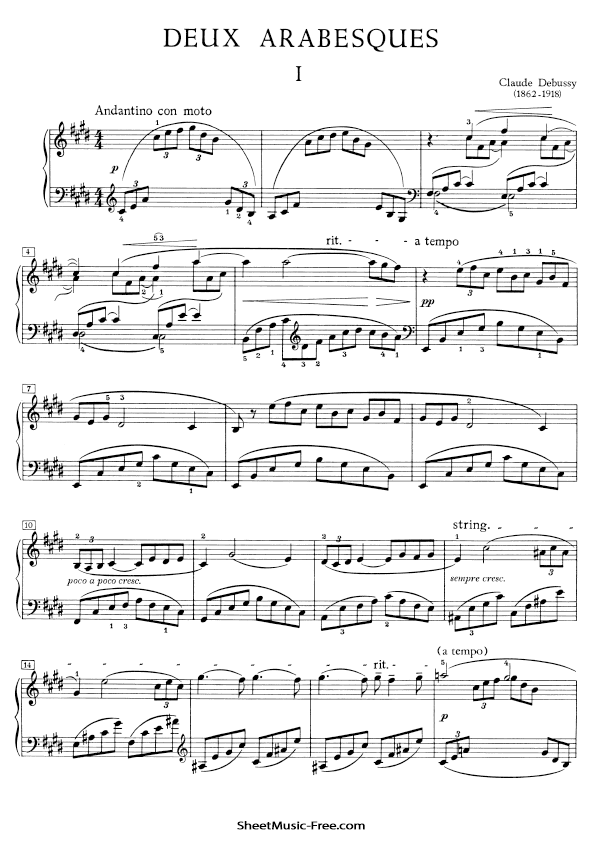
Image result for arabesque debussy
Image: Debussy's Arabesque No. 1, which is known for its beautiful, free-flowing arpeggios.

ANALYSIS
Overall, I would say that Claude Debussy is a big-C creative, for his musical works serve as a foundation for the works of other musicians even to this day. He was among the first to incorporate "illusions" into his pieces, making him the founder of musical impressionism. It is also important to note that his modes of composition "later [on became more] developed in the styles of Stravinsky", a classical composer who Howard Gardner believes to be suitable to support the musical-rhythmic component of his Multiple Intelligence Theory (Lockspeiser, 2019). Debussy also challenged stereotypical harmonic procedures during his time and the traditional orchestral usage of instruments. For example, his Cello Sonata involves a bass instrument taking the role of a violin, flute, and mandolin. In other words, Debussy saw potential in every instrument and believed that they're not limited to playing classical music.
As for motivation, it is not clear as to whether he was extrinsically motivated -- there was likely a combination of both. He was encouraged by Madame Mauté de Fleurville (who was associated with Frédéric Chopin) to start taking piano lessons in the first place, but there was no indication that he later on only sought fame through his musical career.

---
References

Lockspeiser, E. (2019, August 18). Claude Debussy. Retrieved from https://www.britannica.com/biography/Claude-Debussy

Biography. (2015, April 22). Claude Debussy Biography. Retrieved from https://www.biography.com/musician/claude-debussy

Hough, S. (2018, March 2). 100 Years After Debussy's Death, He Remains the First 'Modern' Composer. Retrieved from https://www.nytimes.com/2018/03/02/arts/music/debussy-stephen-hough.html

Image sources:
https://en.wikipedia.org/wiki/Claude_Debussy
https://mymemorymatters.org/clair-de-lune/
https://sheetmusic-free.com/arabesque-sheet-music-debussy/

Nick Kroll is Still Going Through Changes


“I got pantsed as a child… a child named Jenny, I’ll just say her first name… she pantsed me, and I was wearing silk boxer shorts and those slid right down too, so I got pantsed in front of this girl Lizzie, who was my childhood crush, and it was very traumatic and now I’m a comedian.”

The timeless, lovely anecdote above belongs to Nick Kroll, co-creator, writer, and voice actor of Netflix's adult cartoon hit Big Mouth. He and his co-creator, Andrew Goldberg, grew up together in an affluent New York suburb and have been friends and collaborators ever since. The pair, drawing on personal experiences from their own childhoods, set out to capture the essence of the dreaded years of puberty.


Why revisit puberty, a universally embarrassing facet of the human experience? Kroll offers that there’s a lot to be explored within the awkwardness: “It’s incredibly awkward, but also the stakes are really high.” The fact that the show is animated allowed the creators to personify and externalize the features of puberty, something divergent in the field of hormone humor. The kids in the show commit various irrational acts, egged on by their own personal Hormone Monsters, followed by a swift comeuppance delivered by the Shame Wizard. This is the unique perspective Big Mouth brings to the tween years. Rather than leave it at bawdy humor, they boil puberty down to its essence. It’s through this that they tap into the relevance of puberty across time.


Kroll and his team face a lot of criticism due to the explicit nature (and downright disgustingness) of the show. In defense of his creative product, Kroll says that he ignores claims that his show is too dumb or gross to be of any real quality. “It’s a very dirty, it’s a very big hard joke show, but right underneath that is a lot of heart and sweetness and emotional honesty.” He credits this balance with the success of the show and does not seem willing to slow down any time soon. Being sure of himself is a trait Kroll has apparently harbored all of his life; when asked what young Andrew and Nick would have felt about their life story becoming a hit TV show, Goldberg responded by saying, “I would’ve been like, ‘Get the **** out of here,’ and Nick would’ve been like, ‘Of course.’”


Aside from working with Goldberg, Kroll’s cast of characters include famous actors, comedians, and writers whom he has worked with personally throughout his career. He reveals that recording sessions usually occur with all of the actors in the scene present so chemistry can develop and actors can improvise. Many of the actors and writers, like Maya Rudolph and Fred Armisen, have worked together extensively in the past, but the ever-evolving plotlines of the show usually mix and match characters with ease, leading to a variety of actors working with one another. Kroll has assembled what Uzzi and Spiro would describe as can an excellent collaborative team: one where most of the players have good working relationships but is kept from being stagnant by rotating the cast.


Kroll has a methodical creative process. When discussing how to incorporate the Shame Wizard in season two, he describes incorporating the plot development, assessing with the writer's room the implications of that development, and rinse and repeat until a coherent story takes shape. Character relationships are important to him as well. He describes a visual manifestation of this by saying, “I have all of the characters on the wall behind me in the writers room so that I am sort of looking around and seeing who would be fun to play within this scene.”


The third of Csikszentmihalyi’s Ten Dimensions of Creativity is the duality of playfulness and seriousness. Kroll’s personality embodies this, cracking jokes during passionate discussions of his work. Describing his personality through an anecdote about his niece, Kroll elaborates:

 “She goes, ‘Well, it’s because Uncle Nick lives a child’s life.’ And I was like, ‘Yeah, fair enough.’ I lead a very privileged life in a number of ways. I am old enough to know how the world works and to make a living, but also young enough that I get to be a little rascal and run around and do whatever. But it’s hard to explain to your niece that it’s also hard work. Yes, Uncle Nick lives a child’s life, and he works constantly and has constant rashes from stress.”

Perhaps this is why Kroll felt drawn to rehash his teenage years. The complexity of puberty is eternal. He’s still going through changes.


Sources:


https://www.imdb.com/title/tt6524350/fullcredits

The Little Brown Girl: Liza Koshy


Elizabeth Shaila Koshy, better known to the world as Liza Koshy, is an American actress, television host, comedian, and YouTuber. Koshy is a self-made star that started on Vine and is now a host of the game show "Double Dare" on Nickelodeon, starred in various television shows, partnered in successful campaigns with brands like Nike or Beats by Dr. Dre, executive producer and star of her own show Liza on Demand, and has even interviewed former President Obama in 2016.


Koshy began her career on Vine in high school positing six-second-long video clips. In 2015, she created a YouTube account where she expanded her platform. Later that year, she left the University of Houston, where she was studying marketing, to Los Angeles to pursue her career. At 19, she signed with the Creative Artists Agency to build her brand and "put some strategy behind the funny".


She describes that her work is "making content to make people feel content", extrinsically motivated to deliver content that would make people feel better. In 2018, Koshy took a 10-month break from YouTube. In January 2019, she uploaded a video on her second channel explaining why she decided to stop back. Koshy explained that she was dealing with mental health issues and creative burnout that were affecting the videos that she was making. She stated, "I don't care about the quantity of videos that I post, I care about the quality. That's why I stopped making them, because I wanted to ensure good content. I lost myself, and I didn't want to document the process."

Even though she never went into detail, she did state that she was faking her happiness a lot and it didn't feel right to keep posting at the time. She stated that she "Read things online that weren't the nicest things, I started being even more judgmental and not so nice in my head." She also said that she was proud of what work she had done on herself at the time and emphasizes the importance of self-love. As she was looking back at her career, Koshy admitted that she "fell out of love with that. And slightly with myself...I began to cater to what I thought people wanted to see from me." Now, she is doing what she loves no matter what others are saying. She is more intrinsically motivated to put out content that is related to what she wants to put out rather than what other people want to see.

                                     Image result for liza koshy

Liza Koshy's unconventional yet inoffensive humor has made her a little c creative. Now with almost 45 million followers across her platforms, YouTube has 16.3 million subscribers and 2.5 billion views alone. Her success has placed her on the Forbes 30 Under 30 list for 2019. She has the ability to help influence an entire generation of young individuals and has encouraged them to be more politically active. During her interview with former President Barack Obama, he stated that "young people are gonna be the people who make the biggest impact in this country, and this is the way to reach them, And you're doing a great job talking to them about some of the things you guys care about."


Images:
https://m.media-amazon.com/images/M/MV5BYzNjMjhiN2UtZDJiYS00MjVjLThiOTgtOTAzMDZiZWI3NDI2XkEyXkFqcGdeQXVyNzk5NjY0MjI@._V1_.jpg
http://cdn.realscreen.com/wp/wp-content/uploads/2017/08/Headshot-Liza-Koshy.jpg?13c9b8

Sources:
https://www.caa.com/caaspeakers/liza-koshy
https://www.createcultivate.com/blog/cc-100-content-creator-liza-koshy
https://www.youtube.com/watch?v=D6oqS4_Qoww&t=4s
https://www.thelist.com/95198/untold-truth-liza-koshy/
https://www.eonline.com/news/1083389/how-youtuber-liza-koshy-learned-to-ignore-internet-pressures-and-be-her-true-self

Monday, November 4, 2019

Good Eats and Good Education: The Creativity of Alton Brown

Whether it is cooking a simple Kraft mac and cheese or creating a Bolognese sauce that takes 7 hours to stew, a thought may cross your mind of “How and why does this food taste delicious?”. You may consider that what you are creating has a whole history of people throughout the ages perfecting its technique or experimenting to understand what flavors pair well with others and why. You may also wonder what form of chemistry you are doing in the kitchen because when it boils down to it, every food recipe is a chemistry experiment. Well you are not the only one who wonders this and Food Network’s TV Show host of “Good Eats”, Alton Brown, has spent the last 15 years of his life chasing those answers.  

Alton Brown’s famous Good Eats show formed from these questions and a feeling that the food shows he was seeing were not answering these questions adequately or simply ignoring them to focus on more superficial aspects of cooking. Alton Brown originally went to school for cinematography but decided to enroll again at the New England Culinary Institute to pursue creating a show that would be innovative, but also educational to the culinary world. I would argue that Alton Brown’s creation of Good Eats is a “Big C” creative because of how innovative it is and the legacy it left behind for future cooking shows and instructional videos. 
Good Eats is a show that will make you feel like you are back in your grade school days when a science teacher did not want to teach for the day. Alton Brown has even declared a few of his inspirations for the show were Mr. Wizard and Monty Python, one a scientist like Bill Nye, the other a comedian trope of absurd sketch comics. However, despite its juvenile front, it is a refreshing approach to cooking shows that is full of information that will make you both understand food better and become a better cook. Alton Brown uses sketch comedy, props, dramatic scenes, and a cast of characters in each episode that usually touches on a common household recipe or a general theme such as “steak” or “ancient grains”. With all the methods mentioned above he not only discusses the history of the recipe, but also the science behind each cooking method.  
Alton Brown states that there are two big reasons for him making the show focused heavily on comedy and science. For comedy, he believes that comedy makes people absorb knowledge better. Going off his schooling experience of mundane lessons and watching boring cooking shows, he did not want to give his audience that experience. He believes it is counter-productive to the show because you are not ingesting the information if you are not entertained. The other aspect, the science and education in his show, is due to wanting to give his audience the power and confidence to cook. Alton Brown states in interviews that culinary school showed him he was not a good cook, he was not a naturally gifted cook. Rather, he became a talented chef by learning and understanding the processes of recipes and methods. He states that he wants to give that to his audience: an understanding of the intricacies of cooking because he does not want people to feel like they are watching Alton Brown cook, but rather learning how to make themselves a better cook through the science and chemistry. It is something he states he never saw before on television, and he wanted people to feel less intimidated by cooking, rather see it is as easy as a middle school science lesson. 

Alton Brown’s creation of Good Eats is a Big C creative in the food television and videos industry because of its new approach and discussion of information. We can thank Good Eats for Bon Appetit’s Test Kitchen videos and Buzzfeed’s cooking instructional videos. Alton Brown’s decision to put comedy and careful cinematography into Good Eats started this genre that makes cooking shows refreshing, fun, and approachable. It is no surprise that Food Network has asked Alton Brown to return Good Eats on the air. With how cooking videos are now, Good Eats seamlessly fits into the 2019 demographic when before it was pushing cooking shows boundaries and was an outlier compared to generic shows. 

Sunday, November 3, 2019

Boho Beautiful Brings the Creativity

This week I would like to introduce everyone to Boho Beautiful. Boho Beautiful is a YouTube channel run by a husband and wife couple, Juliana and Mark. They provide the world with 20 minute yoga, pilates, and meditation classes. Their passion in life is fitness. And I believe they are creative for many different reasons. They are creative in the fitness world, video editing, and marketing.

Image result for boho beautiful

First let’s briefly explain why I think they are creative. They have revolutionized yoga practice. Juliana was one of the first fitness instructors to post yoga videos on YouTube. Not only was it innovative to post yoga classes on YouTube, the videos themselves are creative. She always does her yoga in stunning outdoor locations: anywhere from Turks and Caicos to Tibet. Mark is the creative force behind the brand’s video editing. Mark beautifully and seamlessly edits the videos, creating beautiful shots while having a simple view for participants to understand the yoga poses. They also are creative in their marketing. They don’t sell only yoga. They sell a lifestyle. They promote vegan diets, wellbeing tips, and travel. Here’s a snapshot of what their classes are like and what they sell.


Now let’s talk about what I can gather from their creative process. They have an incredible amount of intrinsic motivation. They dropped their life in a cozy home in Canada to become wanderers. They now live in a van and travel the world constantly. They gave up the security of their 9-5 jobs and house in Canada to follow a dream that they weren’t exactly sure was gonna work. That is some intrinsic motivation. Mark recently said in one of their videos that no one tells them to do this. They are entrepreneurs. It is up to them and their own motivation to create content. They have no boss telling them when to get up or what to do. They are their own boss, further proving their intrinsic motivation. Now that their channel has hit over 1 million subscribers, extrinsic motivation is playing a larger role in their creative process. They get sponsorships from major companies like Fabletics. They are YouTube famous. This extrinsic motivation has grown over time but their initial motivation and the motivation still at the core of Boho Beautiful is intrinsic.
This team is a great example of what we talked about is class this week: collaboration. Personally, I am in awe of their collaborative ability. As we saw in the example of Tversky and Kahneman, creatives working together can often see conflict and arguments, some of which may do permanent damage to their creative relationship. Juliana and Mark have found a perfectly maintainable creative relationship. They can be creative together while also preserving their marriage. They play off of each others strengths to create premium content. Mark provides video editing and film making skills while Juliana creates the fitness content.

Image result for boho beautiful

Juliana must experience insight. Her philosophy is one of love, yoga, and being in the moment. She promotes meditation and focusing on breathing. She derives inspiration from nature. I bet she experiences a lot of insight from her yoga practice: noticing what her body needs and what her subscribers might want. Meditation clears the mind which can lead to flow states, which probably spark her creativity.
What I love the most about their YouTube channel and their creative process is that you can see a clear development of their creative capacities. If you watch a video that they posted 4 years ago versus now, there’s an incredible difference. The quality of Juliana’s instruction has developed and the video production has changed in amazing ways. I feel that it is important that they haven’t taken their lesser quality videos down. It shows that creativity has to be worked on and developed. Maybe a creative person has a great idea and weak execution but that doesn’t mean that the dream is over or that creativity is burnt out. It means that it just needs some development. 

All in all Boho Beautiful is a fantastically creative yoga YouTube channel. I highly encourage everyone to try one of her videos and get a glimpse at the creative force behind the fitness movement. Here's the link to their page: https://www.youtube.com/channel/UCWN2FPlvg9r-LnUyepH9IaQ