Sunday, February 20, 2022

Claire Saffitz - A dessert person!

    Throughout my childhood, I was always really into baking. I had a passion for baking desserts and consuming content about baking whether it was on Food Network or in a magazine. Today as a 21 year old who actively has to cook for herself, I gained a love for popular youtuber baker, Claire Saffitz. 

    Originally gaining a following from the youtube channel, Bon Appetit, Saffitz became well known for the show Gourmet Bakes which showcased her ability to taste a candy or snack and reverse engineer it to create her own from scratch. This show required non-stop problem and innovative methods to expertly recreate these candies/snacks, which demonstrates her affinity for openness. Having since left from Bon Appetit due to the company's unfair treatment of BIPOC employees, Saffitz created her own youtube channel and has even gone on to write her very own cook book about her favorite desserts—Dessert Person.

    While brainstorming the book, Saffitz wanted to emulate the idea that everyone can be a baker despite the common belief that one is either a cook or a baker. She writes on her website that, "I wrote “Dessert Person”, my first cookbook, to celebrate and defend my love of desserts. The recipes represent my attempt to demonstrate just how versatile and flexible baking can be (which is why you’ll find an entire chapter on savory baking as well)." She believes that baking is a celebration and that anyone can bake—lessons that she hopes readers gain from reading her cook book.


Thursday, February 17, 2022

#IsolationCreation - A photographer's pursuit of beauty during lockdown

 “A photograph is a moment in time from a compilation of experiences I had in my personal life; you can have it too if you stop and look at the world around you.”


In a time of immense anxiety, fear, sadness, and panic, Jamie Beck, an American photographer living in France, was determined to make the most of the recently mandated COVID-19 lockdown. When the pandemic made its way to her rural residence in Provence, all of Beck’s scheduled work came to an abrupt stop. Not knowing how to fill her days, she set out to capture a photograph every day of lockdown, however long that may continue. France entered lockdown on March 14, 2020 marking the day of her first image, a beautiful portrait of arranged red and pink flowers.


Her project set in action, Beck decided to upload the photos to her instagram and use the hashtag #IsolationCreation on each post. With the support of her husband, she began to print and sell her work. A fraction of the sales from this project would then be donated to the Foundation for Contemporary Art’s COVID 19 Emergency Grants Fund. Her creativity in a time that seemed hopeless launched her into overnight fame, and as the lockdown dragged on many more people looked to her for a bright spot in their long, monotonous days. Finally, on May 12, the lockdown protocols were lifted marking the 60th image in her newly produced collection. 


I learned of Beck’s lockdown art through my mom who had become an avid subscriber to the daily doses of beauty on her instagram feed. Quarantine was claustrophobic, lonely, and at times seemingly hopeless which is why these photos spoke to her as they did to so many others around the globe. My mom ended up purchasing “day 1”. For her, this photo represented unity and an unwavering strength that got our family through those, so commonly noted, unprecedented times. Beck’s incredible work has resonated with people around the world as these daily photos represent something unique to each individual. Maybe this day reminds you of a loved one, the date of a postponed wedding, a birthday, or just serves as a reminder to keep dreaming. 

“I felt an urge to dance with creativity”


Before the pandemic, Beck was acknowledged as an expert in the field; working for Armani, Chanel, and Oscar de la Renta, but the lockdown forced her to change her focus of inspiration. She now needed to look inside her own home and find beauty worth capturing. Her expertise in photography had prevented her from pushing the bounds of the field. The pandemic prompted her to turn her attention inward, and to stay creative even if locked inside. She took the limitations lockdown placed on her and used them to expand her creative thinking. Beck notes the way these restrictions influenced her work saying, "The series is bound by constraints, defined by them, but it is through limitations that I discovered a world of splendor".


What sets Beck apart is her willingness to have an open mind during these circumstances. Her innate openness to experience allowed her to see this lockdown for more than it was; a chance for her to showcase beauty and clearly focus on the purity of the moment. In multiple interviews discussing her creative process, Beck always points out that she never had a plan, “As I gazed each morning outside my window pane, I was forced to be completely open to what that day had to offer and how I was going to capture it through photography”. 


#IsolationCreationPartDeux

On October 30th France mandated the second lockdown of the year. Without skipping a beat, Beck continued her project but this time with an adjusted hashtag. For this followup season, Beck was challenged to look deeper at all the invisible things trapped within the walls of her home that were begging to be photographed. Regardless of the situation, Beck’s determination continued to bring about inspiring images. I specifically found inspiration in day 69, November 7, the day America elected its first female vice-president. I breathed a sigh of relief, I felt proud, I knew it was a great day for the world, and her image of golden roses beautifully captured all of my emotions surrounding this day. 


Jamie Beck created 107 days worth of images spanning the long 107 days spent in isolation. Her project sparked creativity around the world. Now her hashtags have been used by more than 300,000 people to tag their own quarantine creativity. She has raised over $20,000 for struggling artists and shipped images to over 65 countries worldwide. Beck inspired others to find creativity in anything as shown by her use of “an old poster board as a flag, [her] body to create shadows,  and a pot lid as a reflector”. Beck unapologetically let her imagination run wild, allowing her to commit to the creative process however unconventional her methods may have been. Her passion is infectious and her message is clear that the pursuit of creativity should never be abandoned even in the most uncertain times. 


I have linked her website, instagram and interviews below. I highly encourage you all to browse her work and find a day that speaks to you. 


Instagram: https://www.instagram.com/jamiebeck.co/?hl=en

Website: https://jamiebeck.co/collections/isolationcreation-gallery-exhibition


Sources:

https://www.harpersbazaar.com/culture/features/a32216214/jamie-beck-photography-isolation-creation-coronavirus/

https://www.marthastewart.com/7837240/jamie-beck-isolation-creation-coronavirus-project

https://womencreate.com/what/jamie-beck/

https://jamiebeck.co/collections/isolationcreation-gallery-exhibition


Wednesday, February 16, 2022

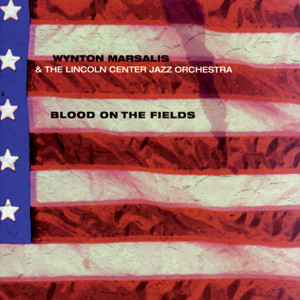
“Blood on the Fields:” Examining a Difficult Topic Through a Unique Lens


Wynton Marsalis, a trumpet player originally from New Orleans, is one of the most prominent creative minds in music. He is a jazz and classical trumpet player, and has won nine grammy awards for his compositions and performances. He is the only artist to ever win Grammys in both the jazz and classical music styles. My personal favorite work of Wynton’s, and the focus of this blog post, is his remarkable, nearly three-hour-long oratorio titled “Blood on the Fields.” The composition was intended to shed a unique light on the horrible practice of slavery, its immediate aftermath, and the effects it still has on the world today- particularly, on African- Americans. 

“Blood on the Fields” was composed in 1997, and is the first ever jazz composition that has ever won a Pulitzer Prize. It tells the story of two African people (brought to life in the original release tour by singers Cassandra Wilson and Miles Griffith) who are captured and brought to America to be sold as slaves. A performance of “Blood on the Fields” requires a full 15- piece jazz orchestra, two violinists, and three vocalists. My first exposure to the work came through my trumpet teacher, Roger Ingram, who played lead trumpet on “Blood on the Fields,” as well as on many other Jazz at Lincoln Center performances and recordings. I feel very lucky to have been introduced to such a monumental creation by one of its main contributors. 

After I first listened to “Blood on the Fields” in its entirety, I realized that its reception of the first ever Pulitzer Prize awarded to a jazz composition is indicative of Marsalis’ willingness to speak plainly and uniquely through music about the horrors of slavery that are often overlooked and/or diminished in many historical accounts. This realization prompted two main thought processes in my mind, and incited me to attempt to break down Wynton Marsalis’ creative process regarding his creation of this particular record. 

The first insight I had was that, while Wynton has published and recorded several historical- based compositions, “Blood on the Fields” is arguably the most notable due in large part to its inclusion of spiritual chants, plantation hollers, and other abnormal vocal elements that are not typically found in jazz, or any ensemble- based musical forms for that matter. These vocal elements are performed both by the vocalists and by the band members. I see this inclusion as a direct insight into the “Illumination” step of Marsalis’ creative process. These unique vocal aspects are one of the main things that sets “Blood on the Fields” apart from other commentary- intended musical works. Additionally, unlike most previous extended works written for jazz bands, multiple movements of “Blood on the Fields” serve as standalone movements, separate from the rest of the work. At first, this fact seems odd and unnecessary, but upon hearing the entire work put together, it makes sense in a way that is difficult to convey with words- it is almost like an accumulation of experiences the listener has with the music that have an additive effect on one another.

My second thought process came in the form of a connection made between Wynton’s blunt yet sensitive examination of slavery, and principles which Stravinsky elevated in his explanations about his own creative process. In class, we have discussed/been assigned readings about the involvement of political elements into creative works. Gardner speaks clearly on this topic, saying:

“...Stravinksy illustrated a different point through his own life: the extent to which the making of music is not possible without the externally rigged factor of politics. All creative individuals- especially all musicians- must deal with a set of associates who not only help creators realize their vision but also eventually, with a wider public, determine the fate of the creators’ works” (Gardner 188).

While “politics” are not explicitly expressed in “Blood on the Fields,” the principles of Marsalis’ and Stravinsky’s respective works mirror each other. Both provide commentary on societal occurrences/circumstances that are often avoided due to their complexity and sensitive, painful nature. 

Overall, I love “Blood on the Fields” because to me it demonstrates Wynton Marsalis’ insanely creative method of taking polar opposite characteristics and combining them into the same creative idea. In other words, I find “Blood on the Fields” to be jubilant yet painful, unique while still exhibiting essential elements of big band jazz music, and incredibly moving despite its exhaustive nearly three hour runtime. I highly recommend “Blood on the Fields” to everyone, regardless of any musical preferences. It is truly a moving, haunting experience.


Sunday, February 13, 2022

I'm My Own Soulmate: Lizzo


I can remember the first time I heard “Truth Hurts.” It was being played on the radio hundreds of times and, because of that, I feel like it’d be difficult to find someone who hasn’t heard it. Even if someone hasn’t heard the song, they definitely know Lizzo. While “Truth Hearts” came out in 2017, Lizzo’s meteoric rise to fame happened in 2019, when she was named Entertainer of the Year by Time Magazine and the BBC went so far as to say she defined 2019. On top of this, Lizzo ended up becoming the Grammy’s most-nominated artist the year after. How did someone gain this level of recognition so quickly? I’ll give you a hint, it’s more than just the music.

Her first globally popular album “Cuz I love you” peaked on the top five of the US Billboard 200 and her previous hits “Truth Hurts” and “Good as Hell” put Lizzo on the map to show the power of music in spreading messages and fostering global change. 

“I just took a DNA test, turns out I’m 100% that bitch.” If you had to explain that lyric in one phrase it would be self-confidence. Lizzo has grown to be an international sensation by finding deeply rooted problems within our current-day society and spreading awareness and love. For Lizzo, this problem is body image within and without the music industry.

Views of body image espoused by Hollywood are of extreme importance because of its far-reaching influence on television, music, and social media. Before Lizzo, and for most of my elementary school and middle school life, stars would joke about bigger artists and most people would sweep these jokes under the rug or not acknowledge it. Even when Hollywood began its “body-positivity” campaigns, these were led by people who would still be socially seen as on the skinnier side.


Lizzo’s entrance onto the global stage was done with many commenting on her weight, her state of health, etc. Instead of letting that go to her head and abandoning the industry, Lizzo faced her haters head-on to create music that exudes inclusivity. In doing so, she has shown the beauty of body inclusivity and acts as a role model for millions around the world, including me.

While many call Lizzo “body-positive,” she has noted that, for her, the term is rather lazy. She instead wants to be body normative. To make people’s bodies normal. She says she calls herself fat. When her friends tell her to not say that she responds, “why I am fat and I am beautiful.” Her body-normative outlook makes it so that she fosters change in those who are unable to shed the pounds, and in those who are happy as they are.

Her body-normative stance further emphasizes her views on self-love. My favorite Lizzo song is "Soulmate." In this song, she talks about how she has learned to appreciate the beauty that is in the mirror and love herself. Lyrics like "I'm a mary me one day," or "True love happens when you're by yourself" focus on the idea of finding your inner soulmate being more important than the romantic search for someone who completes you.

Now you read this blog and think, what's creative about that? She sings songs about self-love, a lot of people have done that. What makes Lizzo creative is her ability to transmit that self-love through her music utilizing lyrics, choreography, and fashion. It is also in her ability to take words like fat, which have been used for hate and wear them on her sleeve. Through and through Lizzo has proven to the world that love is not only for the skinny white rich people in Hollywood. Finding self-love should be a struggle, there will be days when you don't love yourself. What is important is that everyone realizes the beauty within themselves because they can be their own soulmate. 


Sources:

https://www.mlive.com/life/2020/01/detroits-lizzo-wins-3-grammy-awards-performs-and-pays-tribute-to-kobe-bryant.html

https://www.vogue.com/article/lizzo-october-cover-story-body-positivity-inclusivity

https://parade.com/933452/alexandra-hurtado/lizzo-faced-poverty-homelessness-and-self-doubt-to-become-a-master-of-music-and-self-love-youre-not-supposed-to-be-happy-all-the-time/


The Beautiful and Terrifying Worlds of Hidetaka Miyazaki

    Game designer Hidetaka Miyazaki today is the president of the world-famous studio  FromSoftware, director of several of the companies most famous games, with some winning the Game of the Year Award, and weeks away from releasing a highly-anticipated title co-written by author George R. R. Martin. As a child, however, Miyazaki would have never imagined being one of the most influential names in the gaming industry. 

    In his childhood Miyazaki loved to read and was always borrowing more books from the local library. Eventually more and more of the books he read were above his level, forcing him to use his imagination to fill in the gaps where his young mind couldn’t understand the story. This part of reading became one of his most enjoyable, and he was excited by the possibilities of shaping the worlds in the books and manga he read. His family was also opposed to him playing any videogames until he was old enough for college. It might seem that Miyazaki was disadvantaged compared to his contemporaries in other game studios, but this gave him a unique opportunity to explore different elements of game design that were not available in the gaming technology at that time. Table-top games like Sorceries and Dungeons and Dragons enthralled Miyazaki in their freedom to create characters, imagine and explore complex worlds, and battle all kinds of creatures. While this would become a key element in his game design, as a child he never considered himself ambitious or felt a strong pull toward any dream. This led Miyazaki to mindlessly majoring in social science and working under a U.S. IT company, Oracle Corporation. 

    While working for this company, Miyazaki was introduced by two college friends to a new videogame called Ico. In playing the game Miyazaki loved the fantastical setting as it reminded him of the games that highlighted his childhood. After playing, at the age of 29, he decided to change careers completely and pursue game design. He had trouble finding places to take him because he was too old for graduate positions but too inexperienced for higher-level jobs. Eventually FromSoftware hired him as a coder, but when he heard about the game Demon’s Souls starting to fail, he found his opportunity to let out all of his creative ideas. Deomn’s Souls attracted him so much because he seen ot as an opportunity to express his creative vision in a low-stress environment, since the game was already failing. The result was the beginning of what some would call a new sub-genre of videogames. All the information he had collected over his past helped him in creating the medieval fantasy world of Demon’s Souls and its later sequels, the Dark Souls trilogy. 

Dark Souls Remastered Boss guide: how to defeat every boss and emerge  victorious | GamesRadar+    

Gaping Dragon boss from Dark Souls, designed by Hidetaka Miyazaki     


    In his games, Miyazaki uses a complex, interconnected world design with few and far between checkpoints. The player must navigate through the different levels collecting weapons, armor, and items all while avoiding enemies that have been strategically placed to cause as much trouble as possible. At the end of each level is a much, much harder boss enemy whose defeat is necessary to progress. One of the first things fans noted of Demon’s Souls original release was its intense difficulty compared to other fantasy action role-playing games out there. The heightened difficulty reflects Miyazaki’s desire to create a game that was conceptually different from most others at the time. Avoiding the industry-wide trend of  simplifying games for the player, Miyazaki’s games include complex fighting-mechanics, detailed level-design, and an endless number of enemies all with different fighting styles. His games represented a shift from the traditional fast-paced action and rewarded players that used patience and cunning to progress through the levels. 

    The other central component to all the games Miyazaki designs is the fragmented yet deep lore told through bits and pieces as the player progresses. The plot lines to the games seem confusing and disorganized at first, but as the player puts more pieces together their role in this fantasy world starts to become clearer and you get a sense of the backstories behind the other characters in the game. This information is gathered in some short cutscenes, but mostly collected from item descriptions, visual details, and conversations with NPCs that sound more like riddles. In many ways it reflects the ways that Miyazaki fell in love with reading as a child. Like his child-self, the player often won’t understand parts of the story and must use their imagination to come up with connections, relationships, and historical details that connect the larger plot points. Keeping in line with this method of storytelling, many of the detail are left unexplained or ambiguous on purpose. Miyazaki affirms that there is no concrete “happened exactly this way” story to his games because he loves to see players use their imaginations to create their own theories, just as he loved doing with the books and games of his childhood. 
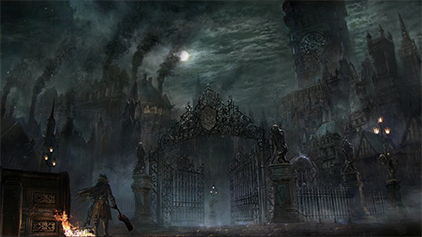
Yharnam - Wikipedia   

Art showcasing the city of Yharnam from FromSoftware's Bloodborne, directed by Hidetaka Miyazaki 

    Miyazaki’s creative process follows a principal he calls “Total Direction.” He takes full accountability for every detail in the game, and therefore he is responsible for designing every detail. This includes character and enemy design, all text and names in the game, all item and enemy locations, level design, story and lore, artwork, and background music. To include his team members in the process he has conceptual and philosophic conversations with them to give a sense of his vision. While he maintains a central role and the bulk of the responsibility, having a team is a necessary component to designing games and Miyazaki still maintains lots of collaboration in the process. He also has been known to collaborate with other outside entities. The hit 2015 game Bloodborne was the result of a collaboration between Miyazaki and Sony wanting an exclusive for the upcoming PS4. This gave him the opportunity to create a game that was fundamentally different than the Dark Souls series. He took the DNA of those games with their overarching structure and level design, and applied it to a horror, Victorian age setting based around a hideous plague that has inflicted the city of Yharnam. His upcoming game Elden Ring is another collaborative project with fantasy author George R. R. Martin. Elden Ring is yet another new development for Miyazaki because it is his first open-world setting game where the player has completely free roam from the beginning. These collaborative opportunities have given Miyazaki new ways to explore his creativity and implement his core elements of storytelling and world design into different types of games. 

    Although he humbly denies it, Miyazaki has undoubtedly left a large legacy in the gaming world. He reminds anyone involved with video games of the endless possibilities when it comes to world building and game design as a whole. 


Sources: 

https://www.theguardian.com/technology/2015/mar/31/bloodborne-dark-souls-creator-hidetaka-miyazaki-interview

https://www.ign.com/articles/2015/02/05/inside-the-mind-of-bloodborne-and-dark-souls-creator-ign-first

https://web.archive.org/web/20210227090913/https://www.knowll.com/e/117/how-active-is-hidetaka-miyazaki-in-game-design

Hozier Cries Power

Andrew Hozier-Byrne is quick to credit his influences. Known professionally as Hozier, the Irish rock musician was raised on rhythm, blues, and classical Irish poetry. His parents instilled a love for the arts in him at a young age, and his Quaker upbringing informed his views on social justice and civil rights. All of this is synthesized in his body of work, where he echoes and even name-drops the artists and activists that directly inspired his work. 


In “Nina Cried Power,” an ode to protest songs which features the powerful vocals of acclaimed gospel singer and civil rights activist Mavis Staples, Hozier credits artists including Nina Simone, Curtis Mayfield, Billie Holiday, and Marvin Gaye as having spoken truth to power through their music and activism during the civil rights era and beyond. His song “Almost (Sweet Music)” is similarly chock-full of lyrical references to the music of Duke Ellington and Ella Fitzgerald. 


As an artist working in the genres of blues, rock, and soul, he is diligent in paying homage to the Black artists that pioneered the genres before him, both in and outside of the lyrics he pens. He also credits his father, a gig musician, with his love of music as well. 


“I think the earliest memory I had to do with music was as a very, very young child,” he told MTV in 2014. “My father was a drummer, and he played blues music in Dublin. So I remember quite early on, somewhere between walking and crawling, being at one of his gigs at a very young age.”


When asked about other lyrical influences in the same MTV interview, Hozier cited famed Irish poets and writers including Oscar Wilde and Seamus Heaney. “I love a lot of Irish folk music and Irish folk songs. Lyrically, there’s a lot of Irish writers who inform some of the themes and inform some of the language as well.” 


In an interview with Nylon Magazine, Hozier explained that while some songs can be written in a few minutes, others take months or years to come together. 


“With the case of “Take Me To Church,” I had ideas for those specific lyrics for years before I actually recorded them. I feel like if you don’t have a home for those words, a real home for those lyrics, or a place to put them in a meaningful or worthwhile way, then they just stay in limbo until the time comes.”


Here he exemplifies the collection and incubation mechanisms of creativity, as he pulls from disparate sources of inspiration and holds on to them until the pieces come together the way he wants them to. He seamlessly blends rich blues and rollicking rock music with traditional Irish poetry in a way that suggests Nina Simone may have had more in common with W.B. Yeats than meets the eye. 


Creative process aside, one of the reasons I wanted to discuss Hozier’s work is that he’s an incredible musician and lyricist. I highly recommend checking out both of his albums, but if I had to pick just a few, I’d recommend “Jackie and Wilson,” “Work Song,” “No Plan,” and “Sunlight.” I’ve also linked the music videos for “Nina Cried Power” and “Almost (Sweet Music)” so you can hear them for yourself. 


Sources: 


Almost (Sweet Music):

https://youtu.be/JJ9IX4zgyLs


(Nina Cried Power):

https://youtu.be/j2YgDua2gpk


http://www.mtv.com/news/2029578/hozier-interview-irish-bog-people-sex/ 


https://www.nylon.com/articles/hozier-interview 


https://genius.com/Hozier-nina-cried-power-lyrics 


https://genius.com/Hozier-almost-sweet-music-lyrics 


J.R.R. Tolkien: The Father of a World and its People

    Certainly, at this point an introduction is not needed; however, I will give one, if anything but to satisfy my conscious bias.

John Ronald Reuel Tolkien (1892-1973) was an accomplished scholar of the English language and critically acclaimed author of The Hobbit (1937) and The Lord the Rings (1954).  While Tolkien did have his successes in the academic realm of literature such as his lecture “Beowulf, the Monsters and the Critics”, the more renowned side of his career (and much cooler in my opinion) were his above-mentioned book and trilogy. His works have inspired countless ideas across the realm of fantasy storytelling and have gained high praise from fans around the world and across generations.

    Having studied and later taught at Oxford University one could say that Tolkien quite literally breathed ink and paper rather than air. Even from early childhood, Tolkien expressed a love for language, having mastered both Greek and Latin whilst creating his own languages for fun. He kept this fascination for language his whole life, learning 35 different languages and featuring many of his own created ones in Middle Earth. It was said that Tolkien created Middle Earth around his languages, so they had people to speak them.  

    Now, as for whether Tolkien is a big C or little C, I would have to say that he is unquestionably a big C. The main reason for this is that Tolkien revolutionized the way fantasy storytelling is done and continues to do so until this day. Very few works of fiction have the depth and world building that Tolkien has curated and put into Middle Earth. Not only has he created own individual languages for the elves, orcs, and dwarves but he has also created centuries upon centuries of lore and history for Middle Earth. His book The Silmarillion is a collection of stories spanning Middle Earth's history that delves into great detail about its people (stories not including what is already told in The Hobbit and The Lord of the Rings). To borrow from C. S. Lewis, it is as if Tolkien stepped through a wardrobe and found himself in a world waiting to have its story and history chronicled for all to see.


Second Lieutenant Tolkien (WWI)

     As for where all this creativity came from, two sources have been found. The first is that Tolkien surrounded himself with colleagues of similar nature such as Messrs Coghill, Charles Williams and C. S. Lewis (one of his best friends). This group of fellow scholars acted as Tolkien’s early critics as they often shared literature and created an environment for which creativity could thrive. Ideas would have been bounced back and forth, allowing for one’s own failures to fuel their next iteration of creative writing. The second source is from Tolkien’s own life. Having served in the first World War and later writing The Hobbit at the beginning of the second, it is easy to see that real life themes bled into his writing. The theme of good vs evil is most apparent. In real life, it was the allied powers fighting injustice and corruption across Europe, stopping the axis. In Middle Earth, it was the unification of the free peoples (Dwarves, Elves and Men) to stop the spread of Sauron’s darkness. Even Tolkien’s own love life took the form of creative inspiration in his “Legendarium”. In this tale he writes of two elf lovers, LĂșthien and Beren who are the fictional versions of himself and his wife Edith. Their respective elf names are even inscribed on their gravestones where they are buried together. 

    In conclusion, Tolkien devoted his entire life into creating a fantastical world that is as believable as the one we currently reside. It is as if Tolkien wanted to create something that was so real that if his books were picked up by a future human that they would have to think twice about which world is the real one, Earth or Middle Earth. 


sources:

https://www.tolkiensociety.org/author/biography/

https://www.dw.com/en/how-j-r-r-tolkien-became-the-father-of-fantasy/a-60316037

https://www.mprnews.org/story/2015/03/31/books-bcst-question-tolkien-languages

 (I had a problem with the editor so sorry for the white background)