Andy Yang is a visual artist who is wellknown for the controlled chaos of his paintings and the use of soundscapes as an extension of his work. He uses his paintings as a form of communication. He is not just a painter; he was once in a band. His creative process is a mix of spontaneity and a collection of everyday life experiences that spark creativity. In the beginning of his career, Yang would improvise a piece of music and then place it on a loop while he painted. The painting would come from the music, how he felt would be plastered on the canvas. His work, Misty. Morning Drew, which was made in 2019, is a perfect depiction of controlled chaos. The painting started as pure chaos and was created by chance. His tools for this work were an airbrush, a hairdryer, and a leaf blower. The piece started with chaos, and then he went back to using traditional tools to create fluid stokes, creating a sense of controlled chaos. Andy Yang suffers from insomnia and has a restless personality, so his imagination ran wild. His art, while it looks chaotic, is created in a state of calm and focus.
One of Yang’s most recent works is at bus stops in Singapore. Bus.Stop. Art is a public art exhibition, and its goal was to bring joy to the everyday commute. These works came about during the pandemic to bring light and hope to a time of much uncertainty.
“If you know your enemy and know yourself, you need not fear the result of 100 battles.” This was one of the most important quotes from the most important book in warfare worldwide, The Art of War. The author of the book will live forever in history. His name is Sun Tzu. Written in the 6th century BC, during the Zhou dynasty of China, The Art of War concerns warfare primarily, and strategy holistically. It has been used in China for military testing since 1080 AD by Emperor Shenzong. It was first translated into French in 1772, and then English in 1910. It has influenced the course of history tenfold, and has been consulted by leaders such as Douglas MacArthur, Norman Schwarzkopf, Mao Zedong and countless others. General Douglas MacArthur specifically mentioned using Art of War in his Pacific campaign against the axis powers. The creative process behind the Art of War, comes from its ability to turn weaknesses into strengths for its user, and strengths into weaknesses for those it comes up against. It also introduced the world to indirect conflict, something that has been widely adapted in politics and business as well. By exploring the different forms of conflict whether militarily or personal, it has a wide breadth of applications. This divergent level of thinking is what elevates Sun Tzu above countless other great creative people. In fact, Art of War is still being used even in the digital age. Cybercrime and cyber warfare are just new tools in which the art of war can be extrapolated onto. Specifically, chapter 13 looks at espionage and information gathering, something that has become paramount in our 2023 world. This creates almost a family tree of creatives who have taught variations of Art of War to their pupils. “Hence the use of spies, of whom there are five classes: (1) Local spies; (2) inward spies; (3) converted spies; (4) doomed spies; (5) surviving spies,” is the building block for all espionage and intelligence gathering in the world.
This open-source style of learning has allowed for other people to adapt art of war for their own purposes. This can be as simple as finding out if someone you're romantically attracted to is interested, or as complicated as robbing Fort Knox. Art of War is a blueprint, allowing for others to make it their own. It is the ultimate creativity manual, and in my opinion should be required reading for all high school seniors.
David (Dave) Burd may not be exactly like most of the popular rappers people know. He's skinny, and awkward, and grew up in an upper-middle-class neighborhood in Philadelphia. Although it may seem like he likely lacks material for popular rap songs, he uses his look and people's expectations of him to his advantage. Despite living in a loving family, he grew up with great amounts of insecurity which he incorporates into his songs. A lot of his insecurities surround the state of his penis, due to a condition in which his urethra tangled around itself and required multiple surgeries. He uses that pain and shame to create songs that highlight his insecurity and poke fun at the emphasis people put on shallow things like appearance, money, etc.
The rapper got his start in 2015 by posting a video on Youtube entitled "Ex-Boyfriend." It garnered over 1 million views in 24 hours and his career took off after that. He has created one album, and many music videos featuring A-list celebrities.
In addition to his rap career, he has transferred his creative ideas away from music and now is focusing on his FX show, DAVE, which tells his story. The show gives a behind-the-scenes look into the life of a struggling then finally successful actor.
Dave says that he's not an "infinite good ideas guy," and that he has a good idea "once every 10 years." This quote shows how Dave is not as interested in putting out more quantity and less quality material. He is always following his own path and is intrinsically motivated, doing what he does because he believes it is important and means something to him. He is not creating content to just appease his fans or record label.
Some fans are questioning whether Dave can consider himself mainly a rapper now because it has been quite a while since he has put out music, but his show just aired a new season. It may be too difficult for him to balance both of these jobs and it seems as though he is prioritizing the show right now. In both domains, I believe he is a pro-C creative because he has gained enough following on both of those fronts to be considered a professional C creative.
Three Paintings by Miro (Left to Right): The Farm; Women at Sunrise; Horse, Pipe, and Red Flower
One of the most creative individuals of a century full of creativity, the Spanish-Catalan artist Joan Miro i Ferra helped to redefine the world of modern art, breaking the boundaries of defined styles like expressionism to create art that reflected his inner unconscious self and what he considered the true spirit of artistic creativity.
More commonly known just as Joan Miro, he was born in Barcelona, Spain in 1893, and grew up in a family of talented craftsmen in the middle of Barcelona's medieval Barrio Gotic. His father, a goldsmith and watchmaker, enrolled him in private school in his childhood, where he took drawing classes and fell in love with painting. He enrolled himself in a fine art academy at age 14 and had his first solo show at 25, showing a great deal of drive and artistic talent from an early age. Before he committed himself entirely to art, however, he also studied business, working as a clerk until a nervous breakdown in 1912 convinced him to pursue art exclusively.
Joan Miro early in his career
Despite (and probably due to) his groundbreaking style, his work was ridiculed and even defaced at his early shows. Combined with pressure from his parents, who tried to discourage him from pursuing painting as a career, he faced serious opposition to his aspirations as an artist, but was intensely intrinsically motivated and refused to abandon his career or his unique personal style.
Miro continued to work even despite these setbacks, and moved to Paris in 1920 to join the community of avant-garde modern artists there and keep pushing his work forwards. His early work form this time was heavily influenced by the work of the artists around him in Paris, especially the Cubist and Fauvist schools of modern art, but it always maintained a distinctly Miro flavor, reflecting his upbringing and Catalonian pride alongside the French modernist influences.
A piece from his time in Paris - The House with the Palm Tree, 1918
Through his time in France he quickly grew in popularity and global acclaim, and his work began to reflect an even more personal take on modern art as he continued to mature and develop as an artist, growing more modern and surrealist as he used his paintings to explore his mind and the vivid imagery he saw in his dreams. One of his paintings, The Farm, was purchased by Ernest Hemingway, who described it as a masterpiece comparable to James Joyce's Ulysses in its imagery and symbolic power.
The Farm, 1921
In 1924 he joined the Surrealist group led by Andre Breton, who sought to create social change through art and were defined by a rejection of society and established artistic tradition. From this point onwards, Miro's art would explode in creativity and self-expression, turning from stylized landscapes and farming scenes to vivid, chaotic depictions of the subconscious. He used bright, bold colors and automatic dream-drawing techniques loved by Parisian surrealists to create art that was distinctly surreal, but wholly reflective of his inner self.
The Tilled Field, 1923 (left); The Hunter (Catalan Landscape), 1924 (right)
The Reaper, 1937 (bottom)
Despite unofficially joining the surrealists in the 1920's, Miro refused to be pinned down to a single style, and continued to develop his own brand of modern art. In his over 70-year long career as an artist, he moved in and out of styles and collaborated with boundary-breaking artists from all over the world in his pursuit of creating art that reflected his inner imagination. His art grew more representational and less surreal through the 1930's as his work became more political. One of his most important works, The Reaper, was painted in 1937 as an anti-war protest but was destroyed by a bombing raid during the Spanish Civil War, driving him to include even more political messaging in his work.
During the 1940's he was forced to move across Europe to avoid the fascist takeovers of his homes in both Spain and France. After the fascists won the Spanish Civil War in 1939, he moved to France full-time before being forced to flee back to Spain by the Nazi invasion of France in 1940. The violence of the 1930's and 40's led his art to take on explicitly political meanings for the rest of his life, including both anti-war and Catalan nationalist messages.
The Hope of a Condemned Man II, 1974 (left); The Great Carnivore, 1969 (right)
As he continued to develop his work, he also adopted new mediums and techniques, incorporating sculpture and writing into his already extensive stylistic repertoire. He continued to work until his death in 1983, and produced a huge amount of paintings and sculptures at the studio in his adopted home in Palma, Spain, including over 250 illustrated books. He never settled on a singular style to place on his art and included elements from all over the changing artistic landscape in his work, from the Cubism, Fauvism, and Surrealism of his early career to the styles of expressionism, lyrical abstraction, and color field painting that emerged after he was already firmly established in the field.
The Caress of a Bird, 1967 (left); Dona i Ocell, 1982 (right)
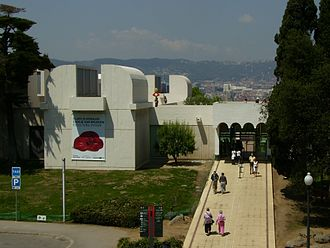
By the time of his death in 1983, he had grown increasingly radical in both his style and his political theories, calling for the "assassination of painting" to free art from being dominated by "bourgeoise art" and the use of paintings by the wealthy to promote propaganda and cultural identity. His styles at this time grew more and more theoretical as well, creating concepts like four-dimensional painting and gas sculpture, but by now he had long surpassed the critics that had torn his work to shreds in the 1920's, and these radical proposals only served to increase his fame and international acclaim. Dozens of major museums, from the Tate Modern in London to the National Art Gallery in D.C. and the MOMA in New York have hosted huge exhibitions of his work over the last four decades, and an entire museum in his native Barcelona, the Fundacio Joan Miro, was built in his honor.
Fundacio Joan Miro, Barcelona, Spain
Despite his colossal success, international acclaim, and prestigious awards in his honor, Miro's life was marked by deep struggles with mental illness that sometimes left him bedridden. Miro struggled with depression for most of his life, first writing about it in 1911 when he was 18, but instead of his mental health hurting his artistic output, it provided him an outlet for his emotions and a way to find clarity when he was at his worst. He was first inspired to paint as a career due to a nervous breakdown in his youth and it remained a driving factor in his work for his entire career. Painting gave him a way to take charge of his mental health and redirect his destructive emotions towards creativity, bringing him mental calm and the focus needed to deal with his darkest thoughts and feelings.\
At the end of every year, I check my Spotify Wrapped to see who and what we listened to the most. Without fail, ever since discovering him in 2019, Still Woozy has been at the top of the list for my most listened to songs and artists. Sven Eric Gamsky, better known as singer and songwriter Still Woozy, makes what has been described as “psychedelic bedroom-pop” with the purpose of helping people, in his own words, “get a little break from yourself or whatever you need.” For those uninitiated, this description is very apt. Still Woozy is best known for his hit “Goodie Bag” which embodies “getting a little break” with its lazy electronic melody and lightly sung lyrics.
One of the things that drew me to Still Woozy, besides his music, was the art on his albums. The colorful, strange, shaky drawings somehow perfectly encapsulated the feel of the music as a whole and each single they were attached to. The artwork is actually done by Gamsky’s fiancé, Amiya Jahn-Tietz. In an interview for Ladygunn Magazine, Gamsky said that sometimes he’ll see a drawing his fiancé has done and will write a song about it, but other times he will already have a plan in mind. He noted that he has a similar approach when writing music where he doesn’t always start with the same instrument. Varying approaches make for a more dynamic album where the songs sound like distinct entities.
Like many creatives, when Gamsky is intrinsically motivated, he finds it easier to be creative. Due to his success, Gamsky spent a lot of time on tour, giving him less time and motivation to create. However, during the pandemic, Gamsky was free to spend more time on new music. While he is signed to a label, Gamsky is his own producer so he is able to make the creative choices for his music. This allowed him to experiment with new, genre-bending sounds that suit his specific style. Gamsky has known he wanted to make music since he was seven, and now his dream is a reality. Still Woozy's passion for making music and cultivating a safe and calm space for the listener permeates into each song. The positive intention behind the lyrics and the music sets Still Woozy apart.
Jean Paul Gaultier is a French fashion designer, specializing in haute couture and ready-to-wear fashion. His work pushes social boundaries, blurring the lines of the gender binary, using undergarments as statement pieces, and casting everyone from staff members to people right off the street to walk the runway.
Gaultier's interest in design started very early. His grandmother introduced him to the world of fashion at a young age, and from then on he was hooked. He is an ESFP on the Myers-Briggs scale, which is often referred to as the "Charm Person" type. ESFPs are social, outgoing, and have an inherent desire to be able to express themselves, which makes sense when considering his boundary-breaking work. In his youth, he was nervous to express his sexuality, but felt more confident in himself after learning that many fashion design icons were also gay or bisexual.
Gaultier has a long and established career, but my favorite project of his has to be his work on Luc Besson's The Fifth Element. He began working on the idea long before it was released -- the movie had many different forms (with one starring Julie Andrews and Prince), and Gaultier hit the ground running as soon as he read Besson's script. He did more than 100 sketches before the project was seemingly scrapped. "I didn't know the film industry well, or the fact that a project can take years." he said in an interview with Vogue. "In fashion we go from season to season without any pause." I found this quote really interesting regarding the creative process of the film -- Gaultier was used to back-to-back projects, but was inadvertently forced to take an incubation period due to the production having to be postponed for multiple years.
Gaultier is open-minded by nature, and this open-mindedness reflects in his creative process. One of the most iconic costumes from the film, main character Leeloo's one-piece cutout bandage bodysuit, was in Gaultier's own words "a bit of a last-minute creation." He's also happy to work outside of his own style as a designer. Even though he alone was tasked with designing the film's wardrobe, he referred to the process as a collaboration. "I try to do Gaultier, but in the service of the story and the director," he said, praising Luc Besson's tastes in set and costume design.
Gaultier's enthusiasm for collaboration didn't mean less work for him. He created outfits for every single character on the show, extras included. Shockingly, he doesn't seem to think of this process as very extraordinary or express a desire for praise -- when talking about the process, he said that "it was a lot of work, but whatever."
Because the world of the movie is so diverse, the costumes are designed to showcase the differences in the various groups and main characters of the world, which only enhances the attention to detail in the script's world-building. The film's closet features futuristic priest robes, retro metallic blue flight attendant uniforms, and a skintight head-to-toe leopard print bodysuit, among so many other iconic looks. The Fifth Element is a glimmering example of what happens when a costumer and a director truly understand each other, and the end result is just excellent.
This is the phrase that starts nearly all of Leigh Ellexson's YouTube videos: a silly and heartfelt moment of connection with her viewers, and a simple glance at Leigh's colorful work proves that this adage is genuine. Leigh's work showcases a kindness, a gentleness, and a general joy for life that often feels starkly absent in our increasingly minimalist and colorless world. In contrast, her art is bright and bubbly, and she is careful to never stray towards the overwhelming.
Looking through the numerous posts on Leigh's Instagram, her work can feel almost effortless in its variety, from careful landscapes to simple, almost story-book-like renderings of colorful animals. But stepping from the curated land of Instagram into the more personal world of YouTube reveals the process behind the magic, and struggle Leigh has taken to get there.
"I always have a little bit of failure in all my art-making, that's just kinda how it is."
This quote, from one of Leigh's more recent YouTube videos, is one that feels familiar to most artists, even those who deal in such joy as Leigh does. In this video, she shows how she recovered from a period of creative slump following the reopening of her online shop, from which she makes part of her income. Like many small artists today, Leigh makes art mostly for the individual consumer, the person perusing the internet in search of a bright piece to grace their living room walls or a silly sticker to put on their water bottle or phone case (all uses Leigh herself expects from her art). And these YouTube videos play to that market as well. Leigh's personal address to the camera is familiar, friendly, and her candid voicing of her struggles as an artist makes her relatable, even to those who might not consider themselves creatives at all.
These videos are also a great look at Leigh's creative process, and as they are narrated by herself, one feels as though they are getting a personal window into her head. For example, in the same video as mentioned above, Leigh detailed the steps she took to get out of the slump she found herself in. She set herself a "homework assignment," as she calls it, grabbing a new sketchbook from her studio. "It's a good first step for me to try a fresh new sketchbook because I feel just like more inspired and like I'm ready to start something new." She then set the challenge for herself: to fill as many sketchbook spreads as possible before she had to walk home for lunch. The video then records this process, while Leigh narrates over the video to discuss more of how this "art block" affects her process. "I don't always have the luxury of waiting around for inspiration to hit. I have deadlines within my job for art, so when art block hits it makes me a little panicky...So I usually choose to just push right through the block like everything's normal."
Here Leigh refers to her Patreon deadlines, a monthly pledge site which makes up the bulk of her income. She creates a work of art for her Patrons each month, and missing that deadline means missing out on a month's pay. But she admits that this brute-force approach isn't always helpful, and typically results in pieces that only please her audience, not her own creative ambitions. So Leigh does take incubation periods as much as she can, admitting that this is what most often "cures" her of her art block. She also switches mediums frequently, from markers to colored pencils to pastels to digital art programs, the constant change contributing towards a renewed spirit of creativity.
Ultimately, Leigh does end the video having created a piece she is happy with, a digital art set of still lifes. But she states that the struggle is not over: despite the effortless look, her art takes work. "I don't think that making bad art is bad, and I don't feel like it's a failure...My goal instead of curing my art block is to just give myself a little bit of gentleness, a bit of grace." And this shows through in her art—by taking this time, this incubation, her art becomes better for it.
Leigh is considered a little-c creative, as her art tends to circulate only within the online community that she has built, and it has yet to affect the larger society. But this does not devalue her work; rather, I believe her work is meant to exist on the small scale, to touch people individually, and to inspire them to care for themselves, even with something as little as drinking water.