Banksy, who, I am sure, most people are at least familiar with, is an anonymous English street artist. He has been active for over thirty years, creating art as a political and social statement. One of his most famous works is "Balloon Girl", which is a stencil that depicts a young girl reaching out to a red balloon, which happens to be the only color throughout the artwork. Banksy’s painting of "Balloon Girl" was sold at an auction in 2018, and right when it was sold, the picture frame started to shred the painting. This was the first artwork to be created live during an auction. Banksy did this in protest of the commercialism in the art world, which did end up backfiring because the painting was then worth even more.
Most of Banksy’s work all has some message to it. "Balloon girl", for example, symbolizes the lost innocence that children in conflict and war zones experience. Others include “Love is in the Air,” which depicts a protester with a mask on, throwing flowers instead of something harmful. This represents the choice to turn violence into peace. There are many more powerful artworks that Banksy has created; however, those are the ones that are most well-known.
In Culture Care, Fujimara mentions how we have done little to cultivate the soil of culture for the next generation and how efforts made to plant seeds culturally will most likely not yield any significant results for some time. He does then go on to mention how, when under the right conditions and care, “rapid regeneration” is possible after a major disaster. Fujimara uses the example of volcanoes and forest fires. Banksy’s work is a good example of how regeneration is possible. His work has a clear message and has reached a lot of people. His work didn't necessarily happen as a result of a major disaster, but more as a result of a buildup of tensions, politically and socially.
In August I got the opportunity to see My Chemical Romance in concert at Soldier Field and was absolutely blown away by the band’s musical talent, stage presence, and performance. All of these were things that I expected from the band yet still stood in astonishment at being able to witness it live. While I could go on and on about the performance aspects and musicality of the band there is a less spoken feature that I wanted to dive into: the storytelling and art.
Album cover art done by Way for Three Cheers for Sweet Revenge
Gerard Way is the lead singer and frontman of My Chemical Romance. It was his idea to create the band in response to the events of 9/11. Something special about Way that sets both himself and the band apart from others is his background in visual arts. Way attended the School of Visual Arts in New York City and graduated with a Bachelor of Fine Arts in 1999. Outside of the band, he is an accomplished comic book writer and artist with his most notable series being The True Lives of the Fabulous Killjoys and The Umbrella Academy, the latter gaining a Netflix adaptation in 2019.
The band members as their characters
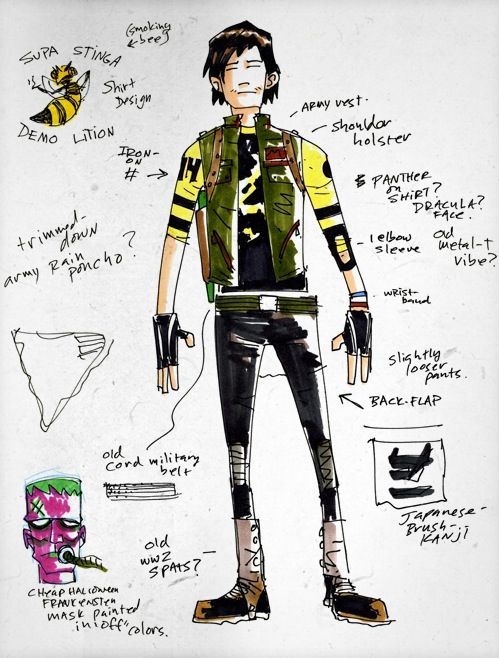
Way’s comic talent has played a huge part in My Chemical Romance from his illustration for their Three Cheers for Sweet Revenge album to creating a distinct storyline and visuals for their Danger Days album. Way has stated that he takes strong inspiration from comics such as Grant Morison’s Doom Patrol, Katsuhiro Otomo’s Akira, and Neil Gaiman’s Sandman. When creating the characters and storyline for My Chemical Romance’s Danger Days album, Way gave each of the members a character that tied into the world of his comic series The True Lives of Fabulous Killjoys making the album a kind of prequel to the events in the series. Way would create the sketches for costumes, props, and sets of the album’s photoshoots and music videos which would then be brought to life by a creative team. Even the songs of the album are coherent to the world that Way has created with the members having written the lyrics for the songs while consulting with Way’s creative vision.
Way's sketch for guitarist Frank Iero's character "Fun Ghoul"
Augustin Fuentes’s The Creative Spark discusses aesthetics and symbolism which is found all over Way’s art for My Chemical Romance. On page 9, Fuentes writes “We humans have the distinctive ability to think about times and places in the past and the future and to convey the information via language and symbol”. This ties in immensely to Way’s art and writing for Danger Days as it is a story set in a future dystopia where creativity is dulled by an overlord company called “Better Living Industries”. The concept provides commentary on creativity, self-expression, and humanity in a futuristic lens. Along with this there is heavy metaphorical and literal symbolism in the album as Way created distinct symbols to represent each of the band member’s characters. Way’s multidisciplinary approach enhances the band’s music and welcomes fans to a world where sound, story, and visual art collide.
Opening in June 2022, the AIDS Garden Chicago serves as both a public monument and a place of reflection, honoring the early days of Chicago's HIV epidemic and the countless individuals whose lives were affected by it. The Garden stands as a tribute not only to those who were lost but also to those who continue to fight for awareness and prevention today. One of its most striking features is Keith Haring's Self-Portrait, a vibrant and dynamic sculpture that marked the completion of the Garden's first phase when it was installed in 2019.
The piece was donated by the Keith Haring Foundation, reinforcing the artist's lifelong commitment to using art as a tool for advocacy and social change. By including Haring's work at the Garden's entrance, the installation bridges art and activism, reminding visitors of the intersection between creativity, community, and resilience.
Gaining popularity during the 1980's New York art scene, Haring became a prominent figure whose art was deeply intertwined with the social and political issues of his time. He used his creativity not just for aesthetic purposes but as a powerful medium for communication and resistance. Through his murals, subway drawings, and public installations, Haring responded to urgent global concerns, including the AIDS crisis, the fight to end apartheid in South Africa, and the struggles against drug abuse.
Rather than confining his work to galleries, Haring chose the streets of New York City as his canvas, believing that art should be accessible to everyone, regardless of class or background. He said, "This was the first time I realized how many people could enjoy art if they were given the chance. These were not the people I saw in the museums or in the galleries but a cross-section of humanity that cuts across all boundaries" ("Five Things to Know: Keith Haring"). His dedication to public art reshaped how people experienced creativity, transforming everyday city spaces into inclusive environments for dialogue, joy, and awareness.
The faceless figure in Haring's Self-Portrait captures the essence of his artistic philosophy. The simplified human form can be interpreted in multiple ways: perhaps marching, dancing, stomping, or protesting. This ambiguity invites viewers to engage with the piece and project their own emotions and experiences onto it.
Originally conceived as a small cardboard maquette, the sculpture was later scaled up into the full-sized version that stands today. Its transformation from a modest model to a monumental artwork mirrors Haring's rise from underground street artist to internationally recognized cultural icon.
Within the context of the AIDS Garden Chicago, Self-Portrait stands as a lasting reminder of Haring's legacy. An embodiment of hope, solidarity, and the enduring power of art to inspire change.
During the grunge movement of the 90s, Chris Cornell rose to fame as the lead singer of the band Soundgarden until it dissolved in 1997. After, he did solo work and formed a new band, Audioslave, in 2001 alongside former members of another 90s rock band, Rage Against the Machine. Cornell is considered one of the most influential figures in grunge and 90s rock as a whole, thanks to his unique songwriting and singing styles.
Typically when musicians write songs, it’s common to stick to a singular key because it contains all the notes and chords to make a good melody. In Black Hole Sun, a famous Soundgarden song, Cornell upends this by making many key changes within a short time frame, creating the surreal sound which earned the song its fame. He wrote the song after he thought he heard a weatherman say “black hole sun”, and decided to write a song to match the visual. Cornell’s vast vocal range of almost four octaves allowed him a greater degree of creative freedom when writing, and he sometimes incorporated yells and vocalizations in his vocal parts. Additionally, his vocal style incorporates inspiration from many different genres including belts characteristic of soul music.
Apart from singing in several major bands and having a solo career, Cornell also collaborated with other artists, notably singing vocals for Alice in Chains’ “Right Turn” on their 1992 EP, Sap. An acoustic solo song titled “Seasons”, which he contributed to the movie Singles from the same year, beautifully captures the feeling of being stuck in an ever-changing world throughout the progression of the song. Written for a movie focusing on the Seattle grunge scene which he was a part of, it’s easy to hear the passion and authenticity in his singing.
In The Code Breaker by Walter Isaacson, he writes about Jennifer Doudna’s preference for experiments that aren’t rigid and don’t require a strict protocol. This is the type of creative thinking which helped her develop CRISPR gene editing technology. Similarly, Cornell’s rapid key changes show his preference for not following typical music-making practices. His vocal range allows him more options when writing songs, and he doesn’t let those options go to waste by restricting himself to one key. In both of their fields, unconventional thinking has led them to new and fruitful ideas.
Cornell tragically died by suicide in 2017, but his iconic vocals and contributions to grunge cement him as one of the greatest rock musicians of all time. In recognition of this, he will be inducted into the Rock and Roll Hall of Fame as a member of Soundgarden later this year.
Kenneth Anger is best remembered as a bold, envelope-pushing director, confident in the forms of occult imagery and taboo avant-garde. His film Fireworks is often cited as one of the first experimental gay films.
A young Kenneth Anger
Filmed in 1947, when the director was still just 20 years old, Fireworks is a strange, cacophonous mirage of homoerotic imagery, accompanied by men in naval outfits, grotesque explorations of the body, and a staggering encounter with a Christmas tree. Regardless of how incredibly ahead of its time the short film was, it is also incredibly creative and resourceful. The film was created in his family's basement over a weekend, and he used guerrilla methods to cast his fellow college-aged actors, sourcing them from UCLA film classes he was sitting in on. It's clear when watching this film, That Anger worked from a point of inspiration over necessity, prioritizing originality and a novel vision over being palatable.
A still from Fireworks (1947)
While the plot of Fireworks is difficult to follow, the artistic merit of the piece comes from its unabashed creative confidence. Even today, nearly 80 years after its release, people who I have shown this film to comment on how they have never seen anything like it. It feels like peering into someone's mind; a dark train of thought or a narcoleptic nightmare. Personally, I am a big fan, and I hope if you're reading this you'll give it a watch:
Fireworks – Kenneth Anger (~15 min)
In regards to the focus book I'm reading, The Code Breaker, I was reminded of Kenneth Anger when I read this guiding principle of one Dr. Jack W. Szostak: "Never do something that a thousand other people are doing". Above all other aspects of creativity that we have talked about in class, I find originality and novelty to be some of the most valuable. Both Jennifer Doudna and Kenneth Anger embody this by choosing to invest in fields of creation often overlooked, while simultaneously being important to their personal interests.
Once more, genuinely, I encourage you to give Fireworks a watch, and consider to what extent you weigh originality over other aspects of what makes art and creativity valuable.
Adele has been known for her music
and her powerful voice. She was born on May 5, 1988, when she grew up in London
and went to BRIT School for Performing Arts and Technology. Adele started
singing at four years old, which is where she started to become interested in
singing. She had her first album, 19 released in 2008 and was UK’s bestselling
debut albums. Which she then proceeded to do another album 21 in 2011 which was
an international success and where you get the songs “Rolling in the Deep” and “Someone
like You”. Then in 2015, she released another album 25 which had record
breaking first week's sales including the song “Hello”. The piece that I will be
sharing is the song “He Won’t Go”.
“There
will be times
We'll try and give it up
Bursting at the seams, no doubt
We'll almost fall apart then burn the pieces
So watch them turn to dust
But nothing will ever taint us”
Relating to the book, he talks a lot
about trying things and not giving up, which is what is described in this set
of lyrics. During the song, it focuses on working to try to take risks and help
the person. In the book, Rick talks about taking risks and an example of a risk
that he took was when he stated his appendix burst that he did not get it
removed because he read that we should not trust doctors. It should be like both
Adele and Rick’s creative process is about taking risks. Adele was talking
about taking risks in her song and then Rick talks about taking risks within
his book. By creating the song, Adele went through relating it to her own
experiences and then adding on to that since the song is about close friends
where one helped the other get over their heroin addiction. Overall, both of
these people are very creative in their own ways, but they also have similar
ideas with how they are talking within their art.
References
Rubin,
Rick. The Creative Act: A Way of Being. Penguin Press, 2023.
When being an artist means sharing the very essence of yourself with the world, losing sight of your identity can feel catastrophic.
In 2016, Marina Diamandis, at the time going by the moniker Marina and the Diamonds, felt like she had lost her true self and her love for music along with it. Marina's music before her hiatus had frequently employed criticisms of the Hollywood machine, how it tore artists down to remold them into a more popular and palatable image, and now she herself was facing those intense external pressures. As she put it in an interview with Mark Savage for the BBC,
I had such a fractured sense of who I was because so much of my identity was attached to music - and if I didn't want to do that any more, then what can I contribute to the world? What am I good at? What's my purpose? What makes me feel happy?...I just didn't know. I had no idea. (2019)
In The Creative Act, A Way of Being, Rubin (2023) discusses how a creative might remedy incessant outside voices that become so internalized that they affect an artist's self-expression. In "Tuning Out (Undermining Voices)," Rubin says,
Any pressure you feel around the work - from the inside or outside - is a signal for self-examination. The artist's goal is to keep themselves pure and unattached. To avoid letting stress, responsibility, fear, and dependence on a particular outcome distract. And if it does, it's never too late to reset. (p. 255)
So, Marina went on hiatus in an effort to rediscover her identity and what it meant to truly be herself. One major step she took with this goal in mind was to drop "and the Diamonds" from her moniker, simply going by her name: Marina. Although many fans did not like this at all (as "and the Diamonds" was taken to mean her fanbase), she saw it as a way to draw appropriate boundaries between herself and her fans, to not "give them any illusion that they have any kind of entitlement" (Dazed Magazine, 2019). In doing so, she created a healthy sense of detachment from herself and the fans that consume her work, instead of letting outside pressure consume her.
One might expect that an artist going on hiatus is using all of those years as a creative retreat to create their next big thing. For Marina, a large part of her hiatus was abandoning music entirely. Instead, she chose to study psychology at Birkbeck University of London. Ironically, this clean break from music was the key to rediscovering peace within herself. Those years spent studying became meditative, and she realized that "once [she] allowed [herself] to quit, [she] felt like [she] opened up inside" (Savage, 2019).
Rubin (2023) writes about experiences similar to Marina's discovery in "Right Before Our Eyes." In this chapter, he encourages the reader to "think of an artistic impasse as another type of creation," and to surrender to that blockage instead of trying to think their way out of it. He reasons that, "Each time we surrender, we may come to find that the answer we seek is right before our eyes" (p. 263-264).
Such was Marina's experience with her hiatus, and in 2019, she returned to the music scene with her album "Love + Fear." Influence from her hiatus is strong in this album, particularly in the theme of the album itself, inspired by this quote from Swiss psychologist Elizabeth Kubler-Ross: "All positive emotions come from love, all negative emotions from fear…there is only love or fear. For we cannot feel these two emotions together at exactly the same time" (Kaplan, 2019). One song in particular, Handmade Heaven, references her past acceptance that she had to step away from music, and I think it is important to recognize that this song was not on the "Fear" part of the album, but rather part of "Love." By letting go, she learned to trust in herself and the strength of her identity, fully embodying Rubin's ideas of letting the boundless creativity of the universe flow through us and embolden us.
"I could no longer ignore / The ivy growing tall / This life don't suit me anymore / The writing's on the wall"