Sunday, April 10, 2022

All's Well That Ends Well: The Journey of Taylor Swift's Ten Minute Song


Red (Taylor's Version) album photoshoot 

Since its initial release in 2012, the song “All Too Well” has widely been considered Taylor Swift’s best song, by fans and critics alike. The wistful and nostalgic tone, as well as the vivid imagery of the song, chronicles the bright spots of a relationship before its tragic, yet the almost poetic end. In particular, the bridge (a specialty of Swift’s) of this song stands out - with lines like “Time won’t fly / It’s like I’m paralyzed by it / I’d like to be my old self again / But I’m still trying to find it.”


Over the years in interviews and social media posts, Swift has alluded to the original version of the song - which was ten minutes long. (Swift even joked that the song’s original lyrics are lost somewhere in her house.) This captured the imagination of fans - the notion that there is a missing version of this song, that already is so vulnerable, specific, and heartfelt. In order to fit the ten-minute ballad on her Red album, she worked with songwriter and collaborator Liz Rose to adjust the lyrics to fit the album. Even with the revisions, the song ended up being five minutes and thirty seconds. 


In 2021, nine years after the release of the album Red, Swift once again revisited All Too Well, when she released a re-recorded version of her album in an ongoing project of re-recording her back catalog to ensure creative control over her music. Through this experience, Swift was able to revisit her old work, and release songs “from the vault” - combining her old lyrics and song ideas with her current collaborators and musical development and growth. This highlights Swift’s creative process, and how foundational songwriting, while also collaborating with other musicians, writers, and producers is essential in her process of forming an album. The last song on Red (Taylor’s Version) includes the mysterious ten-minute version of All Too Well. 


Draft of lyrics for All Too Well included in one of Swift's journals


Since Taylor Swift announced that she was re-recording her old music to gain creative control of her work, I have been looking forward to the release of Red, which is one of my favorite albums. "All Too Well" has been a song I’ve loved for years, and I looked forward to having the chance to hear more of Taylor Swift’s songwriting through the longer version of the song. But there was honestly no way I could have predicted what listening to the ten-minute version of the song was like - it completely changed how I viewed the song, the album, and Swift’s songwriting as a whole.


While there are many similarities to the original version, the ten-minute All Too Well begins with a low, thrumming sound in the production - which only intensifies through drums throughout the course of the song. This shift in production shifts the overall tone of the song, which is heightened by the added lyrics. While the original song sings of a relationship marked by “singing in the car getting lost upstate” and “dancing around the kitchen in the refrigerator light,” this innocent and positive tone shifts with the longer version of the song. The additional lyrics provide more light on the circumstances of the relationship, and the negative emotional toll and repercussions it had through the actions of the person in the song. This includes (a particularly heartbreaking, in my opinion) line: “There we are again when nobody had to know / You kept me like a secret but I kept you like an oath.” Here, Swift reflects on her own dedication and commitment to the relationship, while her partner did not carry the same amount of reverence for their connection. 


Scene from the All Too Well shortfilm, directed by Swift and release in 2021

The main reason I love the ten-minute version of "All Too Well" so much is is that it truly is her version - where she expresses her full range of emotions and feelings as the sole songwriter through her music, without the restraints of record labels and expectations of how long a song should be. While the original "All Too Well" is nostalgic, wistful, and sad, with moments of frustration, in the ten-minute version, Swift showcases the emotion of anger - and her anger is taken seriously and valued in the song. This includes the perceptive and biting line about her ex-partner: “I was never good at telling jokes / But the punchline goes / I’ll get older but your lovers stay my age.” Swift expresses her experiences of being undermined and belittled in the relationship freely in this song throughout the ten minutes, in a way that extends beyond the scope of the song's release in 2012, adding nuance and perspective to her words.


Ultimately, I see the ten-minute All Too Well as a remarkable opportunity for a songwriter to revisit a beloved song and add depth and context to a piece of art that already meant so much to people’s lives. Nine years later, this song has changed how people view Swift’s songwriting and creative choices. (The ten-minute version includes a detail of how Swift’s ex-partner did not attend her 21st birthday party - which gives more context to why the upbeat pop anthem “22” immediately follows "All Too Well" on the Red tracklist. Because her 21st birthday was marked by heartbreak, Swift wanted a joyous 22nd birthday celebration.)  As someone who has listened to Taylor Swift’s music for years, there are many aspects of her songwriting and creative process that I could write about. But "All Too Well (Ten Minute Version)" is, and I believe will remain, one of the most fascinating and innovative creative pursuits of Swift. (It also is, and will remain, my top-played song on Spotify.)


Swift performing All Too Well (Ten Minute Version) on SNL


Lana Del Rey and her Pinterest Board Perfect Music


    Lana Del Rey– born June 21, 1985 in Manhattan, NY, as Elizabeth “Lizzy” Woolridge Grant– is an American singer and songwriter. Lana is most well known for songs with themes like tragic romance, glamour, and melancholy. Much of her music, despite being modern, contains 1950s and 60s American pop culture references. Listeners can easily feel transported to a different time and place when listening to her music. 
    Lana’s first popular song was “Video Games”, which she originally performed under her real name, Lizzy Grant, and created her own music video for. She later leapt into stardom in 2012 with the release of “Summertime Sadness”. Although Lana’s career has been successful and rewarding, having sold millions of albums and two releases hit No. 1 on the Billboard 200, her entire life has not been necessarily rosy. Shortly after her birth, her family moved out of NYC and into the small town of Lake Placid, NY. There, Lana attended Catholic school for many years, but as a teenager began drinking heavily and her parents sent her off to Kent boarding school in Connecticut. Thankfully, by the time she graduated she was sober, but did not immediately attend a university. Rather, she went to live with her aunt and uncle in Long Island where her uncle taught her how to play guitar and she formed a love for performing. A little while later, Lana attended Fordham University to study Philosophy, but music remained her passion. After entering a singing competition, a judge helped her create the demo that would kickstart a career that has influenced a new era of “trashy-glamour” aesthetics in the music industry. 
    Lana’s first popular song was “Video Games”, which she originally performed under her real name, Lizzy Grant, and created her own music video for. She later leapt into stardom in 2012 with the release of “Summertime Sadness”. Although Lana’s career has been successful and rewarding, having sold millions of albums and two releases hit No. 1 on the Billboard 200, her entire life has not been necessarily rosy. Shortly after her birth, her family moved out of NYC and into the small town of Lake Placid, NY. There, Lana attended Catholic school for many years, but as a teenager began drinking heavily and her parents sent her off to Kent boarding school in Connecticut. Thankfully, by the time she graduated she was sober, but did not immediately attend a university. Rather, she went to live with her aunt and uncle in Long Island where her uncle taught her how to play guitar and she formed a love for performing. A little while later, Lana attended Fordham University to study Philosophy, but music remained her passion. After entering a singing competition, a judge helped her create the demo that would kickstart a career that has influenced a new era of “trashy-glamour” aesthetics in the music industry. 


    Lana Del Rey has talked about her creative process and compared it to a sentient creature with a mind and timing of its own. She does not sit down to write music– it just comes to her in a-ha moments. She spends much of her time sitting in coffee shops, speaking with other patrons, and absorbing others’ life stories. Since these stories often find themselves interwoven throughout her music, one can possibly say she is a collaborative artist who works with strangers to create music that everyone can enjoy. Like many artists, her music is heavily intrinsically motivated since she does it for the sake of the love of it, but because of this particular style of content creation, Lana is also extrinsically motivated to create music for others. 


    I admire Lana’s distinct style of performance and the influence she has on Pinterest boards around the world. Her music paints vivid pictures of Art Deco glam ("Art Deco"), the struggles of women who just want to be loved ("Honeymoon"), and 60’s Hollywood legends ("Born to Die"). Her music is timeless and, I imagine, will be enjoyed for a very long time.


Art Deco: https://www.youtube.com/watch?v=QbLGjeR9bvI
Honeymoon: https://www.youtube.com/watch?v=oPU8XJcA__k
Born to Die: https://www.youtube.com/watch?v=QJwEMJabbZA
Video Games: https://www.youtube.com/watch?v=Qi5ppQAozIM
Summertime Sadness: https://www.youtube.com/watch?v=TdrL3QxjyVw

Creativity. CREATIVITY! What *is* Creativity??


Internet Historian in his video "architecture."

Internet Historian is a YouTuber who creates videos that cover a wide array of topics and styles. From dramatized, yet very accurately detailed and well-informed, reenactments of real world events such as the Costa Concordia disaster (pictured below), to comedically edited and entertaining conversations with friends about mundane topics such as food (also pictured below), Internet Historian's (or IH as he is often shortened to) creativity seems to have no bounds and he consistently finds new ideas that never fail to entertain.

Thumbnail for his main channel video "The Cost of Concordia"

Thumbnail for his second channel video "food."

IH started his channel off with videos covering internet specific topics such as greentexts and tumblr/4chan nonsense. Though, the thing that set him apart from other channels was his iconic voice and detailed editing, always finding and including extensive videos or images of whatever topic the video was on, creating a documentary-like style of video for extremely absurd and mundane topics that normally would never receive anything like a documentary. This was how he made his start, but as time went on he steadily developed his unique and highly polished yet simple editing style of overlaying stock images and videos on to each other to create a more personified feeling and sense of life to his content. A style that added even more depth and entertainment to his videos.

Screenshot of his second channel video "fashion."

While he rarely, if ever, posts personal videos detailing his creative process, there was a segment in a Q&A video in which he details why his videos take so long to produce and how they're made (here is a timestamped link to said part of the video, I highly recommend watching it as it does a good job giving an idea of both who IH is, what he does, and how impressive his team's and his editing is). This only details his process for videos on his main channel however. In actuality, he has a wide array of channels each with their own function and style, but for the sake of focus I will mainly exemplify  his creative process for videos on his main channel. 

Screenshot of his main channel page

He (and presumably his friends/team) starts by using divergent thinking to find a topic for a video to focus on. For his main channel it can be about anything, so long as it's interesting (his shtick of only internet history topics is more or less abandoned). Though, to me, it seems his videos are centered on topics that: are or were talked about a lot but not in detail (e.g., Kony 2012, Y2K, Balloon Boy, Fyre Festival, and the Costa Concordia); memes (e.g., Brad's wife, friendship ended with Mudasir, planking); or things that are not very well known by the general public at all (e.g., failed marketing attempts by big businesses, the details of No Man's Sky's failed launch, various niche interest conventions). Then, once a topic is chosen, they converge and incubate their thoughts into a video and either structure it with an underlying theme or segment it into subsections. An example of a video where it was structured with an overall theme would be his video on the Costa Concordia. In this video, he told the story in a Titanic like fashion, opening with someone about to regale the viewer with a retelling of their story and transitioning into a dramatization of the events that make the viewer feel like they were there. An example of a video that just segments details into sections would be his video on failed marketing schemes, in which he details several different attempts from corporations to reach audiences via the internet. Exactly how they decide on this themes/styles is not explicitly known, but he's said that they experiment with ideas and if they don't work they put them on the backburner or scrap it. Most importantly, throughout this entire process they make sure to do their research, finding articles and cross examining information to determine what was true and what isn't. Their research is so extensive that they sometimes have to include corrective annotations over footage of news reports/articles that reported false or misleading information. And it is especially this level of care that makes his videos stand out.

Screenshot of his video "The Swedish Job | Sundance Rejects" with a citation pasted at the bottom

IH is a beloved creator and one who never disappoints. He seems to be intrinsically driven by the joy of editing but he also has clear extrinsic motivations to make quality videos for his audience. I always look forward to new videos on any and every channel of his because I know I'll be entertained. Almost every video has seemingly endless rewatch value due to how much detail is put into them. I love every taking every opportunity I get to show friends and family his videos because out of all the topic's he's covered there seems to be something for everyone. I only found out about him a few years ago but his channel started five years ago (though there's a nostalgic air to his videos that makes it feel as if he's been on YouTube since the start). While I don't expect anyone to start watching his videos after reading this blog, I hope that more people can recognize his name and the effort he puts into his content.

Hiroyuki Sawano: A Master of Symphonies


If you’ve seen popular anime such as Attack on Titan, The Seven Deadly Sins, or Guilty Crown, you have heard the music of Hiroyuki Sawano. Born on September 12, 1980, in Tokyo, Japan, Sawano is best known for his role as a music composer for many action anime. He owns a Spotify and Youtube channel you can listen to that features many of his best songs: You See Big Girl / T:T from Attack on Titan, Dora Gong4n from The Seven Deadly Sins, and Bios from Guilty Crown.


Hiroyuki Sawano’s style of music is very distinct. Once you hear his unique style, it’s very recognizable regardless of what genre he composes for. His music is what many can only describe as “epic,” typically featuring orchestral music mixed with electronic sounds. With Sawano’s music, he evokes the very emotion he is aiming for. Whether it may be despair, hope, or valor, many of the works his music is featured in perfectly encapsulate the emotion of the scene. His music covers a wide variety of genres in the anime industry. His soundtracks have been featured in sci-fi (Mobile Suit, from the Gundam franchise), fantasy (Dora Gong4n from The Seven Deadly Sins), and zombie-horror genres (Kabanerioftheironfortress, from Kabaneri of the Iron Fortress).


Hiroyuki Sawano says he draws influences from many different genres and many different composers. One of his biggest influences was encountering Joe Hisaishi and Yoko Kanno back in high school, both of which are talented individuals in the anime soundtrack industry. He was also inspired by Chage and Aska, a popular j-pop music duo at the time when he first started. He pursued music and debuted as an anime composer in 2006. He also recalls Danny Elfman and Hans Zimmer as a large sources of inspiration. With regards to his style, Sawano has stated “I’m not very conscious of my own style, but I think that my pursuit of my favorite sounds, chord progressions, rhythms, etc., may be what makes people feel that way” in an interview. While Sawano may feel he doesn’t have a style, his music is unique and distinguishable to the point where he has his style. Sawano uses the idea of collaboration in many of his works. He draws inspiration from contemporaries and past influences to create a new style. Sawano demonstrates a high level of convergent thinking, able to just take sounds and combine them in such a way to produce an epic piece of music. He states that the human connections are what draw him to produce these pieces for projects.


    If you haven’t already, I highly recommend listening to some of his music. I find myself listening to many of these tracks while I work out. These tracks are best appreciated on the big screen alongside the scenes they were made for. 


https://hiroyuki-sawano.fandom.com/wiki/Hiroyuki_Sawano

https://www.imdb.com/name/nm2417890/

https://myanimelist.net/people/8509/Hiroyuki_Sawano

https://www.japantimes.co.jp/culture/2021/02/12/music/hiroyuki-sawano-soundtrack/

Manjit Thapp: Using art to express her mental health

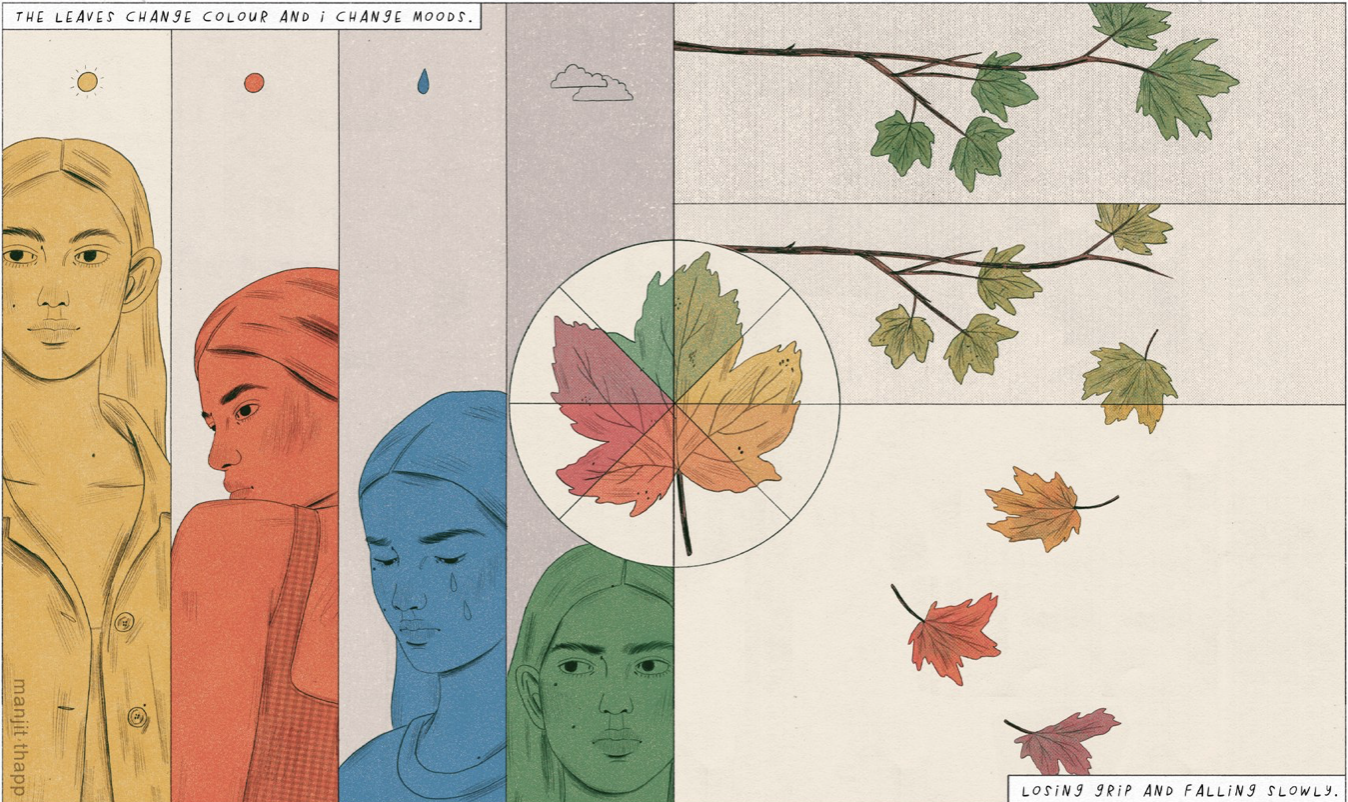
Manjit Thapp is a United Kingdom-based illustrator with a wide range of artistic expressions including murals, movie zines, children’s illustrations, fashion illustrations in stylist magazines, and more! When speaking about her creative process, she emphasizes her focus on representing herself and the female experience of being a South Asian woman. Growing up she would rarely see herself represented in art, so when she creates art she draws from her culture and mental health. In our class discussion during Week 10, we focused on mental illness and creativity and how a person’s mental illness/wellness is impacted by being creative and vice versa. She explains, “I really wanted to put a lot of myself into the work, especially in terms of the way that I feel, but I also want to make it open enough for the viewer to kind of see themselves in the work and interpret it in their own way.”


She released her first graphic novel, Feelings: A Story in Seasons, in March 2021 which is described as “an illustrated journey through one woman’s year of emotions from the saturated highs of early summer to the gray isolation of late winter.” When she was beginning as an artist she didn’t expect to have art become her career but her passion for art led her to where she is today.


Manjit Thapp displayed some of her art at her first solo show at NOW Gallery in London which was open from July 23 to October 31, 2021. Her show, My Head is a Jungle, featured prints, mirrors, tapestries, murals, and animation all formatted in a maze-like setting. Her gallery focused on representation and the importance of East and South East Asia (ESEA) Heritage month. She is most comfortable creating 2D art, but she moved outside of her comfort zone into 3D art as represented in her first gallery. She spoke about her desire for South Asian girls and women to be reflected in her gallery. 


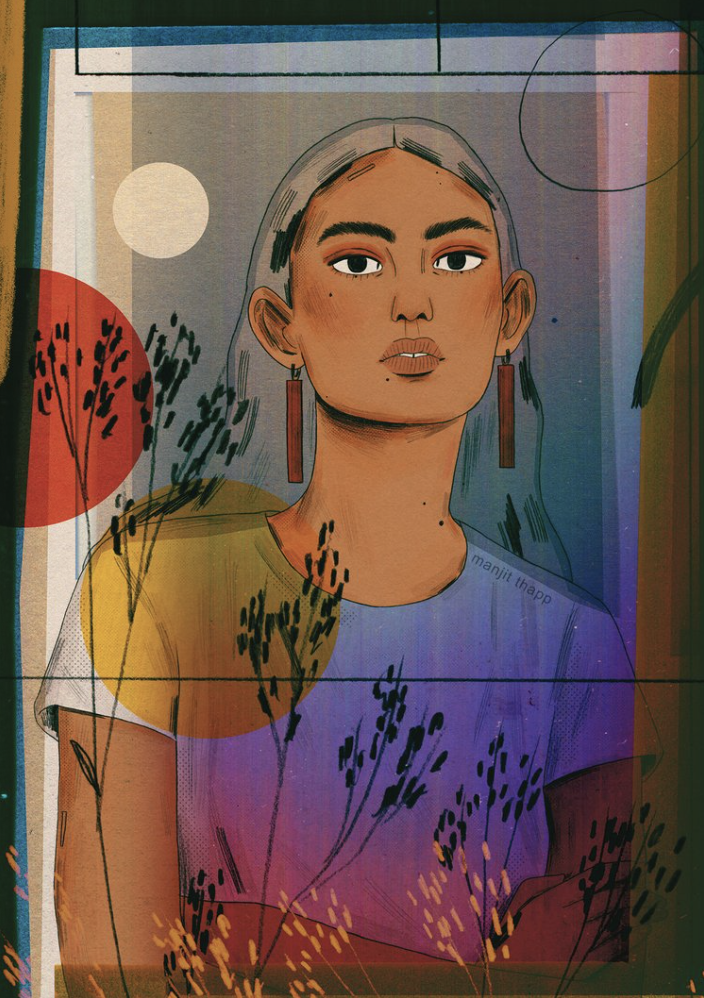
Manjit Thapp also creates personal and fashion illustrations. Some of her pieces are shown below:


To learn more about Manjit Thapp:

Website: https://www.manjitthapp.co.uk

Instagram: @manjitthapp


Sources:

The Collaborative Nature of Japanese (actually Korean!) Breakfast

     One of my favorite bands is Japanese Breakfast, a pop band headed by Korean-American musician and author Michelle Zauner. The group has been active since 2013 and has released three albums: Psychopomp, Soft Sounds from Another Planet, and Jubilee. Jubilee is their most recent release, and as the title suggests, it is an album about pure joy—a concept that is ironic given its publication during the pandemic. 


The album, Jubilee

    Jubilee was crafted primarily by Zauner and her band member Craig Hendrix. The two described their collaborative process in the album as working as one, in an "insular experience" of playing all of the instruments together while working together in Craig's studio for a month. This beautiful, and ever important, aspect of collaboration is precisely how Japanese Breakfast was able to produce the variety of music on Jubilee and demonstrates the trust that the two musicians reportedly built up with one another over years of working together. Hendrix describes how, "the one thing Michelle and I have in common is that we look at the song first, as an individual piece of art." This like minded approach to the creative endeavor of music making allowed the two to create a variety of "sonically" similar music without being bound to the structure of a thematic album. Personally, my favorite song on the album has consistently been "Be Sweet", which I highly recommend. 


Michelle Zauner and Craig Hendrix

    Although Zauner is well known for her music, she also an author. On April 20, 2021, her memoir called Crying in H Mart was published, discussing her upbringing as a Korean-American woman and is dedicated to her mother who passed away from cancer; the title is a reference to the Asian supermarket, H Mart. The reception of her memoir has been quite successful, and Zauner has received great feedback on her first publication and has even landed her on the New York Times nonfiction best seller list. In contrast to the collaborative process of her music, she describes how writing this memoir required less collaboration. That being said, figures such as her husband, her editor, aided her albeit insular creative endeavor of this memoir. Writing this memoir during the thick of the pandemic, Zauner describes how the isolation of the lockdown granted her the time to completely devote herself to her writing. 

Friday, April 8, 2022

Sophie Sandberg’s Creative Response to Street Harassment

 (CW for gender-based harassment) 


For many women and girls, feminine-presenting people, and queer people, walking to work or school brings with it an inherent risk of being harassed. It’s a disheartening fact of life that becomes difficult to combat when responding can escalate a dangerous situation, and many of us simply accept the risk and go about life as usual. However, recent NYU graduate Sophie Sandberg started a creative and unique public art project in 2016 to bring awareness to street harassment in her city. 


Walking through New York City, you might notice colorful chalk writing on the sidewalks and streets, and upon a closer look, see that it’s vulgar and upsetting. This is Sophie’s project to show the public exactly what street harassment looks like. 


She accepts stories from different people who have experienced street harassment and writes harasser’s quotes in the exact locations where they were said. Passing pedestrians can see concretely (no pun intended) what takes place in their community, and Sophie posts photos on social media to further spread awareness. In 2018, I joined Sophie for an afternoon to help her chalk, and I was surprised by the number of people who stopped to watch or even to talk about the project. Especially after watching Sophie talk to pedestrians with a wide range of thoughts and opinions on street harassment, I think her project is a really creative way to engage the general public in difficult conversations and get them thinking about a topic that is often too dangerous to confront in-the-moment. 


In rewatching Hannah Gadsby’s Nanette for class, I thought a lot about how storytelling can bring about change by challenging people who haven’t experienced certain types of oppression to consider them. I was struck by Gadsby’s ability to confront her audience in an art form that is typically expected to be lighthearted; her directness and passion were really impactful. It seemed to me like her motivation in writing the special was to tell a story she hadn’t been able to tell in full and really make her audience sit with her reality. I think Sophie’s project draws on a lot of the same creativity that Gadsby’s special does. The harassment and hatred Gadsby experienced weren’t palatable for audiences, so she didn’t share it for years of her career. Similarly, as Sophie explains in a New York Times interview, “a lot of people say they haven’t told many people about this before and that they’ve kind of just dealt with it and gotten used to it.” By giving people a platform to share their experiences with street harassment in a way that the public must see, Sophie is helping them claim their own stories in much the same way Gadsby does on stage.