Sunday, October 19, 2025

Structured Creativity: Detroit Pistons Basketball (1989 &1990)

     When we discus creativity, we tend to focus on the arts; things we can all identify as abstract and inventive even if we have limited knowledge about it. This sets a precedent pushing us to ignore that creativity can show up in many circumstances, it just takes a more expert level eye to identify it. This can apply to the arts as well; for people to notice more creative nuances in a sculpture or song if they have an involved background, but I believe fields like natural sciences, engineering, and even professional athletics have their own expressions of creativity as well. 

    I want to focus on a specific moment in athletic history in discussing this concept: the 1989 & 1990 Detroit Pistons.  As someone from a former basketball player Michigan, this team has a very profound influence on the basketball style and culture in state to this day. Throughout the history of the sport of basketball, stylistically, the game has changed many ways; perhaps one of the most significant ways being the rule changes in the NBA after this program won back-to-back national championships. A lot of different things we at play here to push the organization to these decisions, but one was the implementation of their stylistic creativity. Before this program, the professional world of this sport was very offensively oriented; people focused a lot more on scoring points than stopping the other team from scoring points. Something that brought to soar above the rest was their willingness to be defensively passionate as well as aggressive. Similar to when people make potentially lief changing scientific discoveries that go ignored or disrespected, people did not like the idea of the game shifting in that way. It made the winner of games less predictable. The creative approach to structure game plans around defensive skill set and focus on offensive skills second was unheard of and generally not supported. This team proved that it was possible to use this structure and win. A defining moment for them was in a game against the Chicago Bulls, where they strategized their defense as team around Michael Jordan and ended up winning, this strategy referred to in the Bad Boys documentary (a must watch if you are interested in basketball or the intersectionality of sports) as "The Jordan Rules". 


    The whole concept of a sport that comes with a very specific structure of rules and necessary knowledge also having room for creativity seems very impractical, and yet, it persists in other contexts as well. In the book The Code Breaker, the idea of scientific creativity is discussed, which I think has unseen similarities to the world of athletics. The concept of scientific discovery is considered creative because scientists take the confines of the information we know and use it in innovative ways to learn something new. This is the same in professional athletics. Similarly, in the story told about Jennifer Doudna's lab, it is discussed how she structured her lab meticulously to research CRISPR and several different people played a role in the discoveries. This also persists in professional sports, as team owners, managers, coaches, assistants, and several others have direct impact in not only how they choose to structure their team, but what that team does on the court; in example in this Pistons program being Jack McCloskey (general manager), Chuck Daly (head coach), and Isaiah Thomas (starting point guard) working together to structure the 1990 team starting lineup. 
    Generally, there are unseen forms of creativity in almost every field, that it may sometimes take a trained eye to find. This creativity can also present it from several different places within a lab or a program because creative collaboration is a strategy for success. I think it is important to keep an eye out for creativity in every place, but especially those with more structure because it might  present itself in ways that change the scientific field or sport entirely. 
    If you are interested in knowing more about the Bad Boys documentary, it is available on Disney Plus and the link is presented below: 


Claude Monet's Water Lillies

Mysteries of Water Lilies by Claude Monet | DailyArt MagazineThe first time I saw a piece made by Monet was in the MoMA and it was one of his famous Water Lilies. Growing up, I was never into art museums and looking at paintings as I found it boring and redundant. I remember going into the MoMA with low hopes, not really finding an interest in these places. When I saw the exhibit of Monet, it really took me by surprise. I was in awe of the way his unique style caught my eye, the liquid landscapes full of color and soft forms. It was the first time I really appreciated a painting and his art has stuck with me ever since. 


Monet was a painter from France who found interest in drawing scenes of the outdoors around him from a young age. He is said to be the father of impressionism, an art form that involved painting “on the spot” rather than in a studio from sketches. He is a very intentional artist, putting his all into every piece of work and never settling for anything less than his best. A quote by him states "I'm never finished with my paintings; the further I get, the more I seek the impossible and the more powerless I feel," showing how he is always striving to capture moments as perfectly as possible. He was also said to have often painted the same scene over and over again under different lighting from the different times of day to fully capture what he was seeing. Through his ability to immerse himself into his work in this way, he could explore the effects of changing light and color which lead him to some of his most famous works. 


Reproduction of Water Lilies II by Claude Monet – Galerie Mont-BlancDaily art story: Monet's Water Lilies | Museu.MS


His paintings, Water Lillies, consist of a series of 250 paintings full of displays of his creative process. As an artist that focused on capturing landscapes that he found particularly beautiful, he was moved by water flowers and ponds. The way he painted water lilies throughout the years is also apparent of his creativity shifting, as his first paintings were much more clear depictions of flowers and reflections, and later on his lilies became more blurry and abstract. This shows the shift his art took, changing his approach to show the essence of nature and how it made him feel rather than just displaying what he saw. His use of quick and light brushstrokes with a variety of hues matching the light changing throughout days come together in each one of his pieces. Monet invites viewers to see the world through his lens, and is an incredible creative that still impacts many to this day.


Although Monet and Doudna are creatives in very different fields, they still share some similarities in their creative process and drive to create. They are both very influenced by nature and the ways they perceive the world around them. Monet displayed his perceptions of nature physically in his painting, capturing the light and colors around him. Doudna perceived the world in a unique way as well, working at a molecular level and seeing RNA as a puzzle that can be studied and used to create new technologies. They both focused on experimental procedures in creating their art as well. Monet would switch between canvases and times of day to fully capture the visuals he was seeing, and would experiment with new colors and styles to make his final pieces. Doudna as a researcher obviously used experimental processes in her creations and focused on adaptation and collaboration in her CRISPR research. Overall while both creatives worked in vastly different fields, they both shared some of the same motivators in their creative processes.


Judy Chicago's The Dinner Party

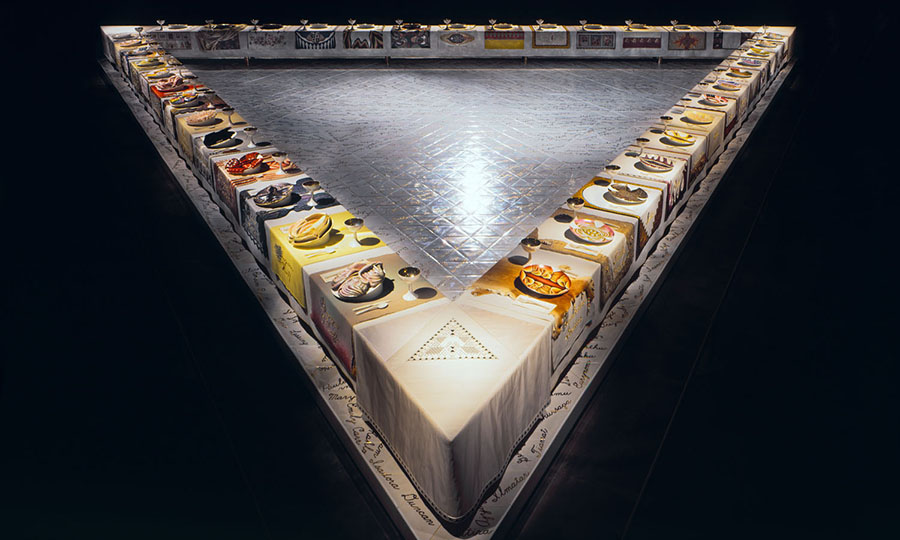
 Beginning in 1974 until 1979, Judy Chicago created a monumental feminist exhibit titled The Dinner Party. Chicago herself was a pioneer feminist in America who notably changed her last name to Chicago to create her own identity, separate from her deceased father and husband's names. Her work was influential in the 1970s feminist movements and The Dinner Party struck great attention and conversation. 

Judy Chicago: Revelations • The Grand Tourist


The Dinner Party is an installation type of art that is currently displayed in the Brooklyn Museum in New York. The piece is a large triangular shaped table that stretches almost 50 ft on each side, and holds 39 place settings and plates dedicated to notable women in history. Each spot includes ceramic silverware, a gold chalice, gold embroidered name place mats, and most notably intricate plates painted or sculptured in vulvar or butterfly forms and shapes. 


Judy Chicago Hits Back at 'Dinner Party' Criticism | Frieze


Araks - Judy Chicago ~ The Dinner Party at the Brooklyn Museum of Art


Chicago’s motivation for this art piece came mostly from extrinsic values. She believed that it was important to bring attention to women who have often been excluded in history. She explored feminism in this work in many ways through the construction and result. This piece was designed in a way to resemble balance and equality as a way of empowerment for women through the triangle table structure. It also was created with many craft and art techniques that were generally seen as for women, such as sewing, as opposed to other fine arts that were often male dominated. The final piece was supposed to be feminist in the way that it brought attention to women’s work and women’s bodies that were suppressed in history. The depiction of vulva shapes on each plate reclaims the idea of women’s bodies and sexuality. 


Rick Rubin discusses the idea of cooperation in The Creative Act: A Way of Being that could be compared to the dialogue of criticism that The Dinner Party received. He suggests that cooperation is important when creating art because it brings together new ideas and helps find the best outcome. While the critics of Chicago’s installation aren’t necessarily working with her to create the final result, their response is cooperating to fight for true feminism together. Many critics believed Chicago minimized the true impact these women had and simply painted vaginas on plates vulgarly, and disrespected notable women while claiming to empower. But, as Rubin discusses healthy tension, this discord between creator, and in this case critic, can help find deeper meaning in the work and shape feminism 40 years later. Some people will love Chicago’s work and some people will hate it, but because people have the ability to critique and collaborate, it expands feminist art and creates the opportunity for productive conversation around it. 


David Larbi: An Everyday Poet

 David Larbi: An Everyday Poet


David Larbi is a published poet and author, but how I (and I would assume most people) know him is from his TikTok (@davidlarbi_) where he makes videos of him reciting small poems he writes about everyday life. Larbi lets the little everyday things inspire him to write, recite, and post a short poem on TikTok almost everyday. 


In The Creative Act: A Way of Being, Rick Rubin writes that “living life as an artist is a practice. You are either engaging in the practice or you’re not… We tend to think of the artist’s work as the output. The real work of the artist is a way of being in the world.” 


Larbi is a perfect embodiment of this quote. Yes, he does create art in more “official ways” such as having his book Frequently Happy published by Penguin Books, hosting a podcast called Mindful Moments with David Larbi, and even making music, but his TikToks are an everyday way he creates art. Through his TikToks he maintains the practice of being an artist. His “way of being in the world” is completely unique to him, and he creates content to display the way he experiences the world around him.


Even just from the title itself, The Creative Act: A Way of Being, Rubin emphasizes the importance of the creative act itself rather than the result. Although his creative process does result in fun poems on his TikTok account, Larbi's creative act is his way of being, the way he chooses to exist and conduct himself in his world.


Rubin also writes: "The goal of art isn't to attain perfection. The goal is to share who we are. And how we see the world." Again, this is exactly what Larbi does. Larbi lets little, mundane things, that most people tend to overlook, inspire his TikTok poems. These little poems provide insights into the way he sees and receives the world, that is unique to him. Through these poems we learn about him. One of his recent videos contains a poem about trees in the fall and it is as follows:


I don’t know if it’s just me or not

But autumn this year seems to be showing off

Just look at the colours of all these leaves!

Varied and gorgeous almost beyond belief!

From Greens to yellows to oranges to browns

How could I not smile with these scenes around town!


By uploading these Poetry TikToks, he is making poetry accessible to everyone. So, people like me, who wouldn’t necessarily think of themselves as poetry connoisseurs, can consume and enjoy poetry without having to seek it out because they wouldn’t know where to start.


Larbi’s poems are not only easily accessible, but they are so full of contagious joy. He recites his poems in such a cheerful way with a grin upon his face, making it very easy to sit and watch/listen to him.


Steve W. "Silk" Hurley, Chicago House and Dance Song Revolution

    Steve W. Hurley or also famously known as J.M. Silk or Jack Master Silk, is a Chicago club DJ and house music producer who can be attributed to the rise in popularity of the house music sound in Chicago in the early 80s. In addition to being a DJ, he also wrote and made remixes for popular artists including Michael Jackson, Prince, Chala Khan, Jennifer Lopez, Madonna, and many more. Silk is a 4-Time GRAMMY Nominee and has hit #1 in the U.K. National Chart for multiple weeks. 


    Steve W Hurley was a DJ and Remixer who got his start in the art after listening to his father’s love of jazz and R&B and borrowed his brother’s records to remix them into cassette tapes. However, his first real exposure to “incredible music” was when he snuck out of his house when he graduated high school to go to “The Loft”. There, he got exposed to people who could properly DJ and from there he made it his goal to learn how to DJ and experiment with it. As for how he created his projects, he often splits his tracks into pieces and combines them with either brand-new elements or other elements from other tracks. For Silk, he mentions how he draws inspiration from the dancefloor and its energy to shape how his tracks sound. In this way, Silk is able to imagine how to manipulate the emotions and feelings of those listening to his music and that's how he guides his creation.


    In the same way that Steve Hurley bridges the gap between his music and the people that listen on the dance floor, Makoto Fujimura comments how artists and creatives bridge the gap between communities using their art. In this way, Steve Hurley connects the feelings and emotions of not only the music but the emotions of everyone on the dancefloor together under a shared experience of music. In this way, his art of mixing and music creation is how he bridges his love of music and experiences from his past to share with his listeners. 


J.M. Silk's song "I Can't Turn Around" which is his #1 dance hit song!


Jo Calderone: In Memoriam -- Lady Gaga and the Gender Binary

Lady Gaga has been roaring back into pop culture relevance, but has left a part of herself behind. That part? A mechanic from Sicily who goes by the name Jo Calderone. In Augustin Fuentes’ “The Creative Spark”, he tracks the progression of biological sex (male/female) allowing for the reproductive sex act, to the phenomenon of social sex, and how it brought about sexuality, and gender expression and identity. Someone who I think plays interestingly with the construct of gender, whether upholding or destroying it, is Lady Gaga. One of the most concrete examples of her multifaceted relationship with gender and gender expression is her drag alter-ego, Jo Calderone.  

Magazine FASHION JO CALDERONE LADY GAGA ...Jo Calderone? (RIP ...

With his debut appearance on the cover of Japanese Men’s Vogue, and first live appearance at the 2011 MTV Video Music Awards performing “Yoü and I” (also featured in the “Yoü and I” music video), Jo was received with admiration and condemnation from fans and industry

professionals alike. Gaga elaborated on Jo’s creation and presentation, and said that he was a result of asking herself and her photographer: “how much can we get away with? How can we remodel the model? In a culture that attempts to quantify beauty with a visual paradigm and almost mathematical standard, how can we fuck with the malleable minds of onlookers and shift the world’s perspective on what’s beautiful?” Fuentes discusses the same ‘models’ of sex, gender, and gender roles, and comes to a conclusion that meshes quite well with what Gaga was after: “Gender matters because it’s a core part of the social fabric in which all humans develop the way they see and interpret the world.” (Fuentes 178)  

Gaga said recently that Jo Calderone has sadly passed on, but he succeeded in helping her subvert public opinion and perspective on her gender, and gender on a larger scale, as well as helping her change the way she views herself and the world around her. “Jo was an important character for me. It’s the way I explored what I was looking for in men, and also what I was maybe lacking in myself.” 

Rembrandt van Rijn - Mastery and Plate Tone


 Rembrandt van Rijn was a prolific dutch painter and printmaker in the 17th century.


I took Printmaking I last semester as part of my Studio Art Minor, and it was my most work-intensive class to date. In this course, students are introduced to the major printmaking techniques: linocut, drypoint, and etching. Each of these techniques are some form of engraving into a sheet of linoleum, metal, or wood followed by application of ink and then printing itself. The purpose of printmaking as a craft is to produce something that can be replicated exactly many times over so that the work can be sold and disseminated to a large number of people. Naturally, this process takes a lot of time to do. 


Van Rijn was an etcher, and the process of etching involves laying wax over a piece of metal, and then carving out the wax and letting the whole thing soak in acid to eat away at the exposed parts. This process is done repeatedly to create value because different lines will come out darker if they spend more time in the acid bath. This process also means that the artist can get extremely detailed and precise with their prints. This detail is seen in van Rijn’s work. 


The dutch artist, though, didn’t always play by the rules. Van Rijn often played with plate tone, which is the amount of ink left on the plate of metal when it is printed. Plate tone can be difficult to control which makes it less appealing to printmakers attempting to produce many identical copies. 

Van Rijn didn’t seem to care about this, and it reminds me of how in The Creative Act, Rick Rubin talks extensively about the balance between artistic routine and the ability to break free of it. Van Rijn demonstrated this excellently in his work. As a dedicated artist, he must have spent thousands of hours etching and printing in his studio. Still, though, he took his skills and went beyond the typical rules of the craft and many times makes his work more compelling. 


Take these two prints, for example. One of them is a pretty cut and dry etching that you would expect to see in a collection of identical pieces. It is clean: you can see each line and there are clear values. The second print is the same one, but a heavy plate tone was left on it, and only parts of the piece were wiped to reveal small areas of dim highlight. These prints could not go into a typical etching collection because of their differences, but their differences reveal both van Rijn’s artistic dedication and his willingness to step outside of expectations. Because of this, both of the etchings become more interesting situated next to each other. The clean printing of the first piece reveals van Rijn’s mastery over the etching techniques and printing process. The piece with plate tone, though, obfuscates the details which makes it more interesting through its clear break from what would be expected in the field. 


Van Rijn practiced his craft meticulously, but he was not bound by the rules or expectations of his field. Because of this, he created many pieces that are both technically very good while simultaneously being technically “wrong.” Still, this dichotomy serves his work by making the pieces more interesting when situated in the context of printmaking as a field. He broke from the expectation and by doing so, he was able to produce work that revealed his technical prowess and his inclination to follow his passions to create something different.