Thursday, April 5, 2012

A Metablog Post

For my final blog post about creativity, I would like to take a self-reflexive look at the creative process behind blogs. Specifically, I would like to admire the work of Mena Trott and her husband, Ben.

Mena and Ben Trott founded their company, Six Apart Ltd. (or 6A), in September 2001. The company was formed as a blog solution provider. In essence, it created blogging systems Movable Type, Vox, and TypePad; the company also owned social networking site from 2005-2007. Many large organizations and media companies use these programs to host their blogs including ABC, MSNBC, and BBC.

The couple was inspired to found Six Apart (named for the fact that their birthdays are six days apart) because Mena was writing a blog but had some issues with the software it required. While Ben created a code, Mena developed a simpler user interface.

Although Six Apart was acquired by SAY Media (formally VideoEgg) and TypePad’s competitor WordPress has been gaining popularity, the leap forward by Mena and Ben was an important one. They created a way of making the internet more user friendly, allowing people to more easily share their ideas and experiences. This process may seem trivial now but without it, we would not be posting our own blog on this site, which introduced its own major redesign in 2004 (following more or less the success of the Trotts), today.

So what elements of creativity can we find in this product, process, and the people involved? I felt a bit limited in what I could find but here it is:

Although the idea of a blogging system wasn’t new, the idea of creating a more user friendly way to blog was original, at least to the extent that Mena took it. Embedded in her idea is the elimination of the average internet user’s difficulties with his or her blog, a problem which, at the time, held many back from becoming devoted bloggers. While some may argue that this creative product does not cause a paradigm shift, I do believe it causes a change in online culture. Their systems provided templates, allowed for multiple authors and includes features such as updating from mobile devices.

Mena and Ben are important in this equation as individuals and as a couple. Mena and Ben are both 1999 graduates of Santa Clara University, the Jesuit University in Silicon Valley (Jesuits, woo!). The couple has been together since they were 17 years old (so they’ve been together for approximately half their lives). Clearly, they share a passion which is important for Creatives as we’ve learned that when they have relationships with people who are not on their level, those relationships don’t turn out so well. Luckily, it seems the Trotts are on the same (web)page. Of course, their collaboration was essential in the success of their product. Additionally, one cannot overlook their collegiate experience in Silicon Valley as a major source of both inspiration and as a place with many opportunities for collecting ideas/experiences. Also, Mena’s interest in fashion seemed to push her towards designing something that users could find more visually appealing.

There seems to be both extrinsic and intrinsic motivation at play. The extrinsic motivation comes from pushing and supporting each other but it also comes from the online community in which Mena and Ben work. As I am focusing mostly on Mena as an individual, I would say that her intrinsic motivation played a large part in the creation of this creative product. She herself was unhappy and annoyed with the programs that were available to her and decided to change them for her own use as well as everyone else’s.

The field received the Trotts well. Mena was listed as one of MIT’s Technology Review’s 35 innovators under 35 in 2004 and the couple was also named PC Magazine’s People of the Year in 2004. There have been criticism of technical difficulties here and there but, for the most part, they have been able to overcome any negative criticism.

In a 2006 TED talk, Trott stated their company was successful “because of timing and perseverance.” Her quote points to an element of creative success that we’ve often discussed in class which is that part of a creative product being recognized is the environment (time, place and field) in which it is first shared.

We’ve also often discussed how it takes a person 10 years in their field to really hit their stride. Mena took some time away from her creative pursuits when her daughter was born but now that her daughter is entering school, Mena wrote that she was “excited to start this new chapter at a really good point in [her]personal life” by joining up with SAY Media which she believes is “a platform that enables [her] to be creative.” This new chapter happens to almost coincide with the ten year anniversary of Six Apart so I am excited to see where the Trott name will come up again as the first time around their company was able to give voice to millions of people, organizations and causes worldwide. My guess is that it will take some divergent thinking and some insight for Mena to start her next Creative project.

Wednesday, April 4, 2012

Smoking Art

Art is all about feeling, particularly what the viewer feels when he or she looks at a work. Sometimes the work has been completed; other times it is in progress. Sometimes the most impressive aspect of art is that of creating the work, witnessing the technique and getting a glimpse into the artist's mind as he or she creates the art. To a degree, there is a bit of a science to it-the emphasis on the act of creating and the creation itself. In the gunpowder artworks of Cai Guo-Quiang, this convergence of art and science is explosive.


He does not simply use his finished product to capture his audience's interest. Educated at the Shanghai Theater Academy, Cai turns each gallery into a stage. He hopes that in doing so, he can "establish an exchange between viewers and the larger universe around them". The audience members feel as though they are participating in the creation of the work as they don gloves, goggles, and masks to observe the spectacle. The space becomes charged with energy as Cai sprinkles cardboard stencils of his design onto the large canvases and then lights the fuse. Following the short explosion, Cai's assistants remove the stencils and put out the flames.


Cai's explosive masterpieces exhibit both product creativity(the designs of the stencils are planned) and improvisational creativity(the creation of the work happens in seconds in front of an audience). In publicizing the event, it gives others access to an individual's creative process. In this, the art is both collaborative and playful(R. Keith Sawyer). The process is quick, like lighting off a firework, and the finished product is the result of the shooting of sparks. 


This form of art is very risky-Cai doesn't have control over how any of his pieces will turn out. He plans out his patterns, which are inspired by nature, but the final result is up to the explosion. The result is spontaneous-an important aspect of creativity, and the work can never be copied. The gunpowder is such a volatile substance, like the changing of nature over time. He sees these explosions as metaphors for environments that individuals find themselves in, particularly in cases of oppression. He also sees it as the "idea of the alchemist, using dirt, dust, and getting gold from it".  Cai Guo-Qiang also remembers seeing and hearing fireworks at all social events as a child, like a town-crier that the world was still turning. However, he finds his inspiration from a variety of sources, including Chinese brush painting, Gutai painting-performance, Dadaist provocation, Joseph Beuys's social sculpture, Arte Povera, and Neo-Expressionism. 


Cai's gunpowder art has been viewed as a very pure idea that is above the art market. Part of this comes from how costly his art is to bring to life, as it requires aids and a steady supply of resources to keep the performances going. It is all about the spectacle, which draws viewers and sets it apart from much of the artwork in galleries today. Critics also claim that his gunpowder pieces are "modest, but not exactly memorable", and the spectacle is just as exciting watched on a video as viewed live. 

The gunpowder art has not been Cai's first art project with a conscience to it, a goal of emphasizing that the masses be aware of their current environment. In another installation, entitled "I Want to Believe", Cai protests the human rights as well as animal abuses, depicting life-sized replicas of tigers peppered with arrows in the hopes that all will feel pain upon viewing the exhibit. In this too, the spectacle of the art is what is meant to draw the viewer's attention. His art highlights the play of creativity and the importance of spontaneity, playfulness, and the intersection of imagination and reality in the personality of a creative and his or her works. His works may destroy a bit of the canvas, but they sure do create something with a bang.


LifeStraw


At only 21 years old Mikkel Vestergaard Frandsen inherited the family business and then completely revolutionized it.  A profitable company which manufactured hotel uniforms quickly transformed under the leadership of its new CEO into a business that specializes in humanitarian products such as insecticide-laced mosquito nets.  However, the most revolutionary of these products is the LifeStraw.

The LifeStraw is a personal water filtration system intended to be used in developing countries, during natural disasters, or in any other situations where a fresh water supply is not available.  It has a relatively simple design.  It’s only ten inches long which makes it easy to keep with you at all times, but within the straw, several layers of filters are held which contain iodine beans and active carbon.  These purifiers are what create the drinkable water.  By sucking water through the layers of filters, users remove almost all disease-causing bacteria, viruses, and parasites that inhabit untreated water.

So far, the device has been distributed to over four million Kenyans along with numerous others in Africa, Latin America, and Asia.  At the cost of only $4, the LifeStraw has the ability to filter an entire year’s worth of water which translates to about 185 gallons.  Not only is the product affordable when compared to alternative filtration systems, but it is also efficient.


Vestergaard Frandsen never planned on being a humanitarian or even an inventor when he inherited his father’s company.  However, after learning that 884 million people in the world are forced to drink from unsanitary water, he set out to find a solution.  He had no knowledge or experience in creating water-filtration systems, and it was this lack of education that allowed him to think outside the box to revolutionize the way in which water can be filtered.  In an example of divergent thinking, Vestergaard Frandsen sat down and made a list of all the potential ways he imagined water could be filtered.  After compiling this list, he took it to the experts and asked them if his designs could become a reality.  The experts were enthusiastic about the design that would later become the LifeStraw.  Vestergaard Frandsen’s divergent thinking ultimately created a product that was unlike any other because it would filter water at the point-of-consumption instead of at the point-of-source.  Each individual would have their own mobile water filtration system instead of installing one at every workplace, home, school, or other public domain.  This divergent thinking exercise revealed Vestergaard Frandsen’s creativity.  Not only did he create something unique because it was unlike anything else on the market, but he also found a solution to the crucial problem of people dying from unsanitary water conditions.


Despite his lack of knowledge and experience on the subject of water filtration, the Danish inventor has prevented countless deaths with the device because of his divergent thinking exercise.  The current goal of Vestergaard Frandsen and his company is to get LifeStraws into the hands of half a billion people by the year 2015.

Mining in the Indie Game Scene

Last blog post, I briefly mentioned how there is a thriving independent, or "indie," game scene.  Well, I feel it's time to give the independent game scene a little time in the spotlight.  While it's virtually impossible to talk about all the fantastic indie games out there, I want to focus on one of the greatest independent games of all time; the poster child of the indie game scene-Minecraft.


First released to the public on May 17, 2009, the game has been a huge hit ever since.  Developed by Markus "Notch" Persson, Minecraft is a game that tests not only the ability of the gamer to think, but their ability to be creative as well.  The player begins randomly spawned in a randomly generated map.  The game takes place from a first-person perspective, and the object of the game is to mine and survive.  The player uses the materials gathered from mining to help them survive and and find even better, rarer materials.  However, the player is given no set of instructions, or "recipes" for the games tools, so the player must figure out how to create the tools of survival themselves. As the player progress further into the map, the situations get tricker and the monsters (mobs) get tougher.  The player must always have a plan and be one step ahead of the game.


The idea of Minecraft wasn't exactly original.  Much like what Einstein did with Poincare and Maxwell's ideas, Persson created Minecraft out of the work of others.  Already working for a small game development company, Persson was a fan of some independent "build and survive" games such as Dwarf Fortress and Dungeon Keeper.  Persson decided to create his own game in the genre, but the game was not fully defined until he played Infiniminer.  Persson was impressed with the game, but he knew that he wanted to create a better game.  He knew that he had great ideas on how to make a similar, but better game, and he decided to run with it.  In order to do this, Persson had to scrap pretty much his whole previous attempt at game creation.  He used some of the old code, but most of it was new, of his own creation.  He also understood his limits in art, and like many of the creatives we have studied, remained in the single field of programming.  because of this, Minecraft has a rather simple graphic style, as seen above.

Players don't play Minecraft though for the fantastic art or groundbreaking gameplay.  They play it because it they have fun and it gives the gamer control to do whatever they want, whatever they enjoy. If you watch he video above, the man talking gives a brief overview of the point of the game, but says that he really just likes to explore. He forgets the normal conventions of a video game and just explores.  Too many games today forget that gamers like to have FULL control over what they do.  The game world is really just a blocky pallet for the gamer to do with as he chooses. 


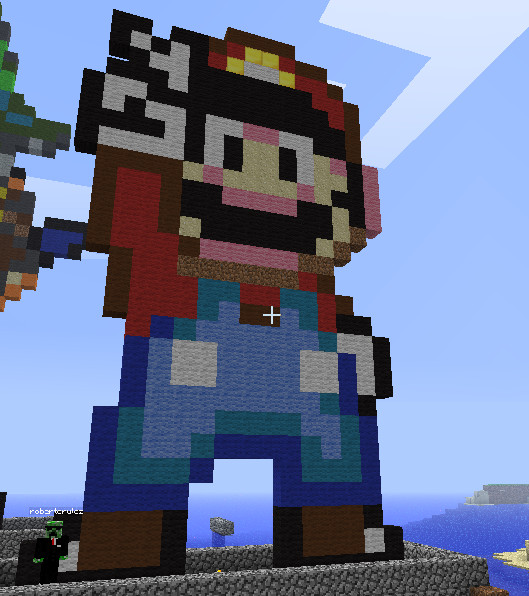
Yep, that's video game icon Mario in Minecraft.  When gamers are given 100% control over someone, almost every time a huge amount of creativity is going to come through.  But gamer creativity isn't just limited to things that can be done within the game; gamer creativity expands to what gamers can do with the game.

Recently in class, we have been talking a lot about collaboration.  Persson, known as Notch to the Minecraft community, highly values the opinions and ideas of those that play his games.  Notch frequently takes the ideas that gamers send him to make his own game better for those who are playing.  Notch is constantly updating Minecraft, often due to the ideas sent to him by the community he's so proud of.  Notch highly appreciates the entire Minecraft community that has spawned because of his game.  What pushed Notch to actually complete the game was the incredible initial response he received when he released an early version of the game.  Notch also was going to make the recipes for tools easier to figure out, but decided not to, because he did not want to take away from the community dedicated to figuring them out.  Notch will even hide secrets for players to find, and often it takes a group of players to find the secret together.  It's the kind of collaboration rarely seen in the games industry.  Recent attempts at so called "collaboration" have failed between the gaming community and the big studios.  It's refreshing to see that there are small steps being taken to redefine collaboration between players and creators.


But, as we said in class, collaboration has it's flaws.  Some ideas are constantly submitted with no end, for example dragons.  The community will get focused on this one idea, and the creativity stops for a little bit.  Other times some members of the community feel a little too entitled and complain when things aren't implemented the way they wanted.  But for the most part, Minecraft remains a place where a gamer can do whatever he wants, in collaboration with other fans of the game.  Some people (including electronic music artist Deadmau5) invite people over to their world through the internet to help them create crazy, fantastic things.  Notch has stated that he will support the Minecraft community as long as the fans want him to.  Minecraft owns the independent market not only becuae it gives players almost limitless possibilites, but it also has a great collaborative relationship between the creator and the community.

Much like many of the creators we have studied in class so far, Notch has really redefined a genre. The indie scene is thriving like no other, and it's success has even brought the reboot of some long forgotten indie series of past.  How did one simple game redefine a whole genre?  By collaborating with the people who play his game, and giving them a game that really has no limits, where just about anything can be created.  It would like if Martha Graham collaborated with everyone who watched one of her performances!  Still today, Notch, and now his wife, work with players to give them the ultimate creative game experience.

Tuesday, April 3, 2012

"Born on a Blue Day"


For most people, the first thing that comes to mind when one hears "autistic savant" is Dustin Hoffman's portrayal of  Raymond Babbitt in the 1988 movie Rainman. Raymond's character is based upon a man named Kim Peek, an autistic savant. There are many memorable lines and scenes from this movie and they are often associated with savantism as a whole, IE phone books, baseball stats and counting cards in Vegas. 
The Autisim Research Institute defines a savant as someone who has extraordinary skills that are not exhibited by most persons. These skills can be mathematical, artistic, musical, and interestingly many savants have impressive calendar memories.
And FYI:
 Aspbergers Syndrom is a developmental disorder, and form of autism, that affects social and communication skills. Many people with this disorder exhibit odd social behavior and awkwardness and most have a fascination with one particular subject (trains, for example). Aspbergers varies in severity, but is on the less-severe end of the autism spectrum.

Another real-life savant appeared on Talk of the Nation in 2007. Daniel Tammet 


is a man in his twenties and the author of a book titled "Born on a Blue Day". Tammet has Aspergers syndrome, and is an autistic savant, and his perception of the numerical world has helped him set world records in memorization and computation. I remember listening to this portion of the NPR program and being floored, and a little jealous, of his visual memory. Daniel sees numbers, and days of the week. Each of these has its own color, texture, "feeling", and personality. Because of this, they are easier to remember, making memorization, counting, and mathmatics easier. What I found most interesting is that when he does calculations, the numbers form patterns in his head, and these patterns are reminiscent of landscapes.
"And when I am thinking of a huge number like pi - I mean pi is an infinite number, it goes on forever - what I'm doing is I'm pulling all the different colors and shapes and textures into a kind of landscape and then I can just watch and become totally absorbed in how those numbers flow. The visualization of all of that flowing into this beautiful landscape that goes on and on and on, and I can get totally wrapped up in those numbers."

 This visualization helped him win memorization competitions. Most notably,  he set the world record for reciting pi to 22,514 decimal places (in 5 hours and 9 minutes). The title of his book "Born on a Blue Day" refers to his birthday falling on a Wednesday, which is blue in his mind. His calendar memory is very closely related to his mathematical ability. He can look at a date in history and within moments determine what day of the week it fell on. 

Tammet also has an incredible ability with languages. At the last count, he speaks ten languages. He has made languages his career by designing a french and spanish languages-learning program which is now highly regarded. In his book he talks about the visual imagery that other languages provide, which again makes it easier for him to learn them. 

Discussing mental illness and disorders in class made me think about Daniel Tammet. Even though he is not necessarily a prolific, creative person in the general sense, I believe that there is a connection to the way his brain works, and the production of creative output. We talked about  how brain disorders may help connect less-common associations. In the powerpoints, Bob mentioned the regions of the brain that are most often affected by mental illness, and the amygdala was one of them. The Autism Research Centre has some material that suggests that a problem with the amygdala could be a link to autism, as it controls many social actions. Could these findings coincide? I'm no scientist, and I'm not about to group the autistic community as a whole with the schizophrenic community (and I understand that schizophrenia affects another part of the brain), BUT a caller in the NPR story said that they could be misdiagnosed (people who really have autism could be diagnosed with schizophrenia). Could this further link autism to creativity?? 
I think that Tammet would score high on some of the creativity assessments simply because he is so intelligent. I also think that his creative output is in the language program that he developed. He was able to articulate what it is about his brain that makes it easy for him to pick up new languages and was able to translate that into a way for other people to learn like him. So I propose that he is creative because his was able to produce a novel way of doing something that people are already trying to do. 

In the more general and artistic sense, Tammet has had some creative output in that he is able (unlike many autistic savants) to articulate and actually reproduce his numerical visualizations...


                                              Like this Pi landscape...


                                       Or like this one of multiplication...

Tammet has also worked collaboratively with a photographer in an artistic capacity to try to reproduce other numerical visualizations like these...

 "Six" - "Like a black hole, a place to climb into, a retreat from the world" 


"Eleven" - A bright, round, vibrant number

These photos and paintings are all available on his website, which is very interesting. 

Monday, April 2, 2012

Weightless Problems

In this day and age, an unfortunately high number of people deal with being overweight (in the "first-world" at least). I think it's unnecessary for me to go into the numerous reasons why that might be a problem. However, on the other end of that spectrum (no not anorexia), being weightless poses a number of problems as well! For astronauts in space, being weightless is quite an issue. The lack of gravity related stimulation leads to both atrophy and muscle loss, especially in the lower body. In order to combat this, astronauts do exercises on a treadmill while wearing a harness which increases their body weight in space to an amount proportional to their body weight on Earth. 
The harness came with its own set of problems. The harness is limiting to the astronaut, reducing his or her ability to actually perform more effective exercises; it's uncomfortable and can cause a significant amount of chafing. Problems. 
Problems. While studying the biomechanics of exercise, a scientist at the Ames Research Center by the name of Robert Whalen proposed the idea of using air pressure to simulate body weight. Solution.
Oddly enough, this creative idea from Whalen did not turn out the way he thought of it initially. He patented his technology in 1992 and licensed it to Alter-G Inc. in 2005 to develop a product to help patients who need support (re)learning  to stand, walk, or run. From that, came the AlterG Anti-Gravity treadmill!

This piece of equipment is definitely beneficial and can be proven creative using Csikszentmihaly's three elements (nodes) that are a part of considering creativity:  Individual Talent, Field, and Domain/Discipline. 

In terms of individual talent, there is no doubt that Robert Whalen came up with a remarkable idea that solves multiple problems and is beneficial in its domain. He hypothesized "that musculoskeletal maintenance in space requires Earth-equivalent functional loading (or weighting), which is loading bones and muscles with activities and force levels in space similar to daily activity on Earth" and devised a way of doing so that was different from the crude method of using a painful harness. He also recognized that his idea may be beneficial to the rehabilitation industry and licensed a company to use his technology to develop a piece of equipment that uses his technology to help in rehabilitation. 

Robert Whalen actually introduced his idea to two separate domains in a sense. His one domain could be considered as space travel and the other the world of fitness. His idea appealed to both domains, however, it seems as though it was better received in the world of fitness as a tool of rehabilitation. 

The G-Trainer was approved by the FDA in 2008 for medical use and since then, many institutions in the field have invested in the use of this product despite its high cost. The AlterG Treadmill has a rather impressive list of customers to its name despite it's high cost. So Mr. Robert Whalen, thank you for your creative contribution that has become greatly beneficial in the world of fitness and rehabilitation! 

Sunday, April 1, 2012

The Sparrow from Minsk

Most people only think about gymnastics every four years when the summer Olympics come around. It's hard not to be mesmerized by watching these athletes perform tricks that seem beyond human ability. It is a sport of power, and perfection.  With this perfection driving the sport of gymnastics, an athlete does not often go beyond the realm of normal. Creativity is a risk, and your fate lies in the opinions of the judges. This did not stop Olga Korbut, however. Because of her determination and creativity, she not only redefined the sport, but also united the world during the Cold War. 


Born in Grodno, Belarus, Olga was the youngest of four girls. One of her older sisters, Ludmilla, was also a gymnast, winning the Master of Sports title. As a child, Olga was noticed for her innate athletic ability. Running faster and jumping higher than almost all the kids at her elementary school (including boys), from a young age, those who knew her, knew that she was a force to be reckoned with. She was known to constantly be breaking rules by climbing fences or trees. Pushing the limits became a habit throughout her life. Combining this with her natural athletic ability, there is no wonder why she was such a success. 


At the age of eight Olga would enter Renald Knysh's sport's school. This dualistic relationship was key and served as both a collaboration as well as a mentorship. Knysh had a well deserved reputation for being a boldly innovative coach. These two were a dream team. In 1969, Olga competed in her first Soviet National Championship. It was here that she debuted the two unique gymnastic moves she created with Knysh that would have the world talking. Just missing taking home a medal because of a slip on the uneven bars, she was not an instant success, however, people were already talking. 


Widely accepted by the crowd, as evident by the thunderous applause after her routine, the true criticism came from the judges. They felt that her routine was 'not at all keeping with the glorious Soviet gymnastics.' Like many of the creative individuals we have studied, such as Graham or Stravinksy, this comment was just the beginning of the struggle Olga and Knysh would face when it came to gaining the respect of the field. 


Although she was still unable to make it to the podium in the Soviet National Championship, she was beginning to gain the respect she needed. Because of the challenges, she was humbled, yet when she walked onto the floor, you could see the pride she took in her work. 


After winning third in the Soviet National Championship she moved onto the Riga Cup (Olga's first international competition). It was at the Riga Cup that Korbut Salto, the Korbut Slip and the Korbut Flic-Flac would be named after her. At the USSR cup it was clear that she had finally gained the respect of the judges. Judges noted how flawless her technique was despite them being completely novel tricks.  Many of her tricks have yet to be accomplished by other gymnasts today. Others, have been adopted by a number of subsequent gymnasts, each adding their own twist, but Olga was the one who had the truly novel idea and the courage to put it to the test. 


Finally at the Olympic games in Munich, Olga won three golds and the title, Athlete of the Year. She was a hero not only to the Soviets but to the world. She returned home to fan mail from all over the world including America, bridging the conflict due to the Cold War. 


Olga contained many of the personality traits characteristic of many creatives. She had a lack of conventionality as made clear by the ways in which she tested the boundaries of traditional gymnastic abilities. She showed integration and intellectually in the way in which her technique remained flawless despite the fact she was creating her own tricks. Lastly, her drive for accomplishment went unsurpassed. It is said at the age of 17 she had two goals in her life - to graduate secondary school and to win a gold at the Olympics. Both were accomplished.