Sunday, November 5, 2017

From Alleys to ACTIVATE: Kate Keleman

Picture a typical Chicago Loop alley. Pretty drab, right? Would you believe me if I told you the picture below is one of those very alleys, transformed into a pop-up urban experience?


The brains behind this summer series, called ACTIVATE, is Chicago Loop Alliance Placemaking and Creative Manager Kate Keleman. In order for you to fully understand what ACTIVATE is, and before I go into a little more about Keleman, here are some quotes describing the event from the Chicago Loop Alliance itself:

“Combining the talents of Chicago’s most creative minds, the events feature art, music, and more in unique urban settings."


“Art. Music. People. Alleys. These are the core components of every ACTIVATE.”


“ACTIVATE is not a festival. It’s an interactive exhibition of art and culture that takes place over the course of five nights from June through September.”


Keleman was featured as Artist of the Week in Chicago Woman magazine, where she talked a little about her process and inspiration for creating ACTIVATE. Keleman sees the city in ways most people don’t. Her passion for the older buildings that surround us is what motivated her to study historic preservation. What some people might see as an old run-down building, Keleman sees as an opportunity for reuse and reinvention.

“My work revolves around how people create their cities, neighborhoods, and homes – the planned and spontaneous actions that make places what they are,” Keleman said. “[ACTIVATE] temporarily transform[s] downtown alleys into beautiful immersive experiences filled with art, music, and drinks.”

When asked what was the best piece of advice she had ever gotten, Keleman wasn’t sure. However, she did speak on a piece of advice that had for some reason always stuck with her: “Don’t struggle.” She described it as meaning not to overthink, but instead “to get ideas out quickly and messily, then refine.”

The fact that this advice has stuck with her shows a lot about her process when it comes to producing these events. She has to draw from all types of fields in order to pull together one cohesive event that will leave attendees with a better appreciation for Chicago culture, art, and architecture.

Keleman clearly has an eye for the uncommon, and she uses that vision to create pop-up urban experiences for the public to enjoy. Based on The Four C Model of Creativity by Kaufman and Beghetto, I would categorize Keleman as a little-c as well as a pro-c. She has been able to make a career out of her creative vision for production, art, and architecture. It is clear she has a knack for putting a bunch of small chaotic things together in one cohesive experience, a creative skill that not many people have.

Citations

Kaufman, James C., and Ronald A. Beghetto. “Beyond Big and Little: The Four c Model of Creativity.” Review of General Psychology, vol. 13, no. 1, 2009, pp. 1–12., doi:10.1037/a0013688.


The Art of nature through Wolfe's lens.


Travelling across the world, exploring wildlife, relaying its beauty through photography, Art Wolfe is the legend in the field of wildlife photography. After spending about 5 decades pursuing his passion for photography, he has become one of the most successful photographers in the world. Wolfe's approach to photography is a multi-faceted one. Combining both artistic and journalistic aspects to his photos, Art Wolfe always seems to deliver "a superb evocation of some of the most breathtaking spectacles in the world", according to Sir David Attenborough. His works have earned him many of the most prestigious awards in the field of photography, including The Royal Photographic Society in 2005.
Having both commercial artists as his parents, Wolfe experienced their influences since he was a little kid. He was fascinated by the artistic style of his mother works, which later influence his photography style, making it extraordinary. Wolfe's photography philosophy has always been the educational values that it brings, the messages he can convey through his artistic view on nature. He always looks for “metaphors, things that remind people of something else” in his pictures. From early in his career, he has desired to practice "conservation photography even before the genre was created. He loves the thrill and excitement of traveling around the world, exploring Earth’s wonders and looking at it from an artistic viewpoint. Intrinsically motivated, Wolfe always tries to experiment new techniques in his photos, constant changing to adapt to the wildlife. By constantly traveling explore the worlds, doing what he loves, he successfully elevates his jobs to a new artistic level.
To Wolfe, keeping an open mind toward new experiment is very important. He believes the goal is not just taking pictures, but taking pictures that demonstrate the unobvious, the hidden pearl containing the context of the photos. People usually go to an ancient town hoping to learn its historical facts, shooting pictures right after they see it. Wolfe does it differently. He would walk through the town, not taking pictures, but be appreciating the beauty of it, trying to find a new perspective in looking at the decaying town. Doing this allows him to adjust to the environment and learn its most valuable aspect, then capture it in the photos. Wolfe also works in an isolated area by himself, but he is not limited to that confined area. He always keeps his mind open to new experiences. Constantly exploring his own creativity allows him to explore the beauty of nature in multiple layers. “So much of the creative process is just getting out the door and making imagery”. Talent is not the only factors that demonstrate Wolfe's creativity. Just like in Amabile says in her study, it is also his passion for his job and his constant experimenting and hardworking that gives the best results of his creativity. He loves exploring and he constantly does it both in his physical environment and his mental environment, allowing him to see the hidden wonders that mother nature meticulously masked.


https://www.naturettl.com/art-wolfe-interview/
https://artwolfe.com/about/
https://artwolfe.com/2017/06/07/wheres-art-episode-2/
x

Wednesday, November 1, 2017

Drawing Real-Life Inspiration for Imaginary Worlds

            The author of numerous successful young adult novels (although she would consider that label “bullshit”), Maggie Stiefvater has created worlds through her words.  She’s the author of The Raven Cycle and Shiver series, along with the fantasy novel The Scorpio Races. Growing up, she was homeschooled from sixth grade on. Stiefvater was a prolific reader, and her parents encouraged this. Many elements of her novels can be seen in the books she read growing up – for example, the Welsh mythology in the Dark is Rising trilogy heavily influenced the world she builds in The Raven Cycle. Her writing process is very similar. When drawing inspiration for a novel, Stiefvater says she begins with music. “I usually have a song that I listen to over and over at the beginning of a novel, something that encompasses that mood. And when I feel I’ve wandered too far from my original purpose, I will play it again.” She also draws inspiration for her characters from the people around her; Stiefvater says that her best characters are the ones that she’d “stolen from life”. As a former portrait artist, she follows the same process when building a character: she begins with a model, and then pulls it apart and puts it back together to make them her own. Yet above all, Stiefvater is intrinsically motivated to write what she loves. This shines through in her novels; she pulls from her passions and the people she cares about and combines them to build something wholly unique. Stiefvater loves to write, and to share what she loves with the world.

http://www.vulture.com/2016/04/maggie-stiefvater-says-ya-is-a-bullshit-label.html

http://www.yalsa.ala.org%2Fthehub%2F2014%2F01%2F09%2Fone-thing-leads-to-another-an-interview-with-maggie-stiefvater%2F&usg=AOvVaw2XzwYVjJwskC9-FYDexGtN

How to Cook That: Delicious Sweets & Surprise Cakes

Warning: this post may or may not make you hungry.
All the way from Sydney, Australia, Ann Reardon runs the blog How to Cook That which features creative desserts, cake, and chocolate. Alongside the blog, she also has a YouTube channel where she posts recipe tutorials. (Are you hungry yet?)


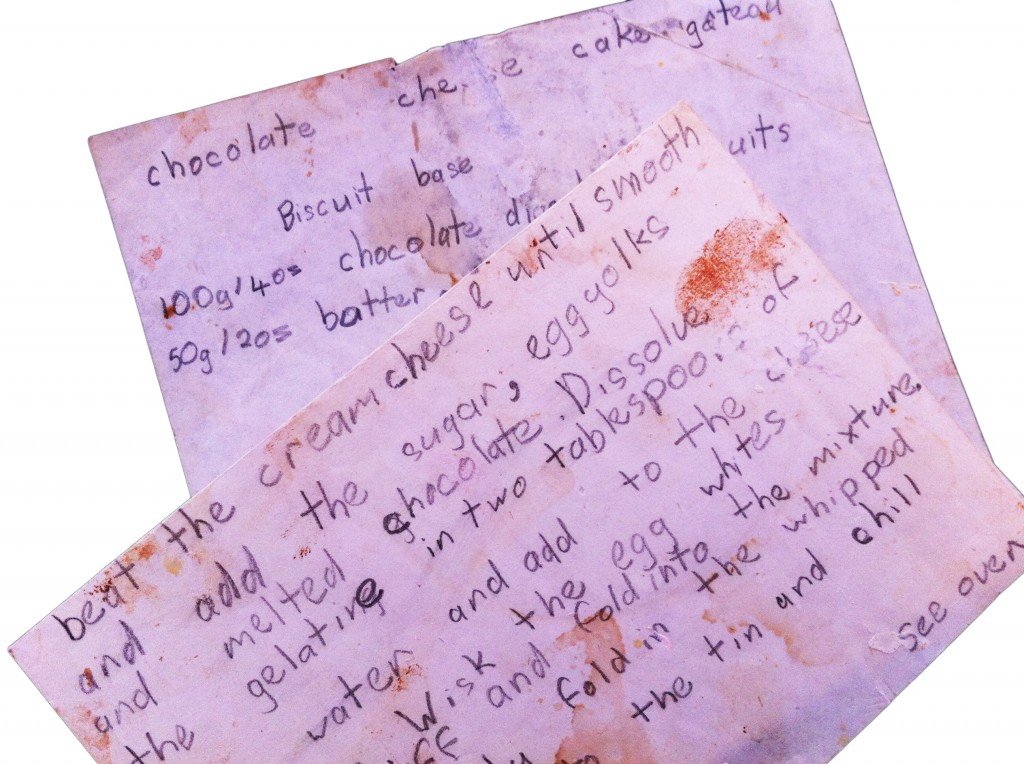
She didn’t start out as a blogger and YouTuber though! Ever since she was little, she remembered that she loved to cook. She would write down recipes and adapt them to her tastes. She finished school as a qualified food scientist and dietitian. Her first jobs included being a consultant dietitian in the food industry and a community and public health dietitian. After a few years, she resigned to take on the role as a youth pastor. It was as a youth pastor that she hosted dinner meetings at her house and people would ask her for her recipes. It was then that the idea of creating a cooking blog formed. It was finally in March 2011 that she started her blog. She would type out those blog posts at night when nursing her third son.

Ann Reardon's First Recipe Card
What’s so special about her sweets? A lot of them have a unique twist on them! Some sweets are media inspired (Moana cake wreath, Chocolate Wonder Woman Pop Art) and others are inspired by recent trends (Edible Fidget Spinner). Reardon would be considered a pro-c creative. According to Kaufman & Beghetto’s four C Model, this means that her creativity is advanced enough to be making a career out of it. Certainly, with her countless subscribers, Reardon has made a fun career out of doing something she loves.
https://www.instagram.com/p/BNBh5kvAo49/?taken-by=howtocookthat

She has done more than making sweets… She has been the very first to create an augmented reality app for cakes based off of a gaming app. A bit confused? Okay. So you bake a cake (which isn’t bad because she walks you through it!), print out a template to put on top of the cake, and then load the app while following the prompts. And then… Magic! You’ll see a unicorn, rainbow, dragon, or fireworks bedazzling your cake! (which you can also take pictures of). While this creative feat is very specific, perhaps it could be considered a big-c moment for Reardon. After all, merging baking and augmented reality seems relatively new.
Just because, here’s another food picture!
https://www.instagram.com/p/8DVSa0tqJ_/?taken-by=howtocookthat

Yummy, yes? Now go eat something!

Sources:
Smith, Steven M., and Thomas B. Ward. “Cognition and the Creation of Ideas.” 21 Mar. 2012, pp. 546-574.
https://www.howtocookthat.net/public_html/
https://www.youtube.com/user/howtocookthat/featured