Wednesday, February 11, 2015

The Tiny House Movement ⌂


There's a new trend in the housing market: Tiny Houses. Tiny houses are exactly what they sound like: fully functional stand alone homes that are typically 90-250 square feet. With a size like that, some of these homes could probably fit in your living room. These homes are often self-built for anywhere from $10K to $80K. They can also be purchased for around $30k-$70K.  

Their popularity started picking up in 2012 and has since been titled the Tiny House Movement. Tiny homes are mostly different from regular homes in term of size, but they also use different building materials, appliances, furniture, layouts, (dare I say different toilets!) and are sometimes regulated by different laws. Aside from the technical details, there is also a culture of environmental awareness that comes with the decreased carbon footprint.

In terms of building materials, tiny houses are often built on wheels. Yes, wheels. Almost like an RV, tiny homes are built on trailers. The purpose of this is to avoid the strict city regulations that pertain to the construction of a house. Tiny houses usually do not pass code because they are simply too small, but there would be a myriad of other issues even if they were large enough to be considered "safe."  The added benefit of building a house on wheels is that there is not need to buy land, because when on a trailer, the tiny house is considered an RV and can be parked anywhere a car can!  Tiny homes that aren’t built on trailers are usually built or placed on a skid. Because the houses are so small, they does not require a slab foundation like normal houses.


Some tiny homes look like little rustic log cabins, some like a modern oasis, and others like futuristic space junk. The smaller the house, the fewer materials you need, so owners/builders get creative. Instead of buying bulk amounts of drywall, a builder may opt to line the walls with recycled b board that was thrown away in a home renovation – that’s part of the environmental awareness. Tiny homes are often built with salvaged or recycled materials and tend to ration the store bought goods.

That may sound dingy, but the salvaged building materials give the small space a rustic cozy feel. Not to mention, with less money spent on store bought items and a smaller space to fill, owners can afford to buy nicer accessories.

Tiny homes look unconventional on the outside, but sometimes they get even weirder. Sheet metal, corrugated metal, and shipping containers are all commonly used to construct the exterior of a tiny house. As for the inside of a tiny house on wheels, the materials are "normal," but the content is anything but. For appliances, tiny house dwellers often use boat appliances and portable stove stops that they can stow in a cabinet. Many appliances are stowable to allow for more counter space when they are not in use. As for water, nomadic tiny houses can hook up to water lines at RV parks. Some tiny house dwellers live in the yard of a "normal" house and hook up to a hose. Houses that are semi permanent will sometimes collect rain water in barrels and use that in their home. Of course, if a tiny house is built as a legal house rather than on a trailer, it can hook up to city water. For electricity, many tiny homes use solar panels and store their power in car batteries. For heat, tiny houses use small propane heaters, since they are the heater is cheap and, even though propane can be pricey, the heater does not need to run often since there is not a lot of space to heat. Things get weird when it comes to the toilet. Tiny houses that are not legally "houses" cannot hook up to city sewage. The mass movement towards tiny living and the lack of sewer access, led to the popularity of the composting toilet. Composting toilets are simply buckets of sawdust that mask and break down human waste into soil. Toilets are pretty standard all around the world, but tiny homes challenged that and popularized a new way of "using the bathroom." 

As for the layout, tiny home builders had to think out the box to figure out how to fit anything in such a small place. In a tiny houses, glasses tend to hang from the ceiling and spices are tucked in the rafters, because when there is so little space, one must find ways to utilize every square inch of their space. Speaking of glasses hanging from the ceiling, so do the people who live in tiny homes. Tiny homes on wheels must comply with highway laws since it is meant to be driven. This includes height restrictions, so most homes utilize the small bit of vertical space to create a sleeping loft on one end and storage shelf on the other. Tiny home builders had to consider lifestyle habits in every aspect of design. For example, the kitchen is typically placed under the loft while the living room is left to enjoy the full height of the home, because less time is spent in the kitchen so ceiling height is a fair sacrifice. 
 So ... Why Live in a Tiny House??

The Tiny House Movement is most commonly viewed as an act against materialism and step towards a simpler life. For some, that’s  exactly what it is. For others, they’re just trying to escape the burden of rent or a mortgage and a tiny house is the only chance they have at owning a home. Both rationals are represented on Tiny Home Construction company Wind River’s merchandise, where they have shirts that read “Do More Be More Have Less” and “Bringing the American Dream Back.” Either way, there's a sense of peace and freedom that comes with living in a Tiny Home. 

Tiny Houses Around the World
In other countries, it is more common to see permanent tiny houses. These are often built with standard building materials and code, but made to fit into a smaller space. Why? Because there's less land. These are mostly seen in large cities. For example, the tiny house pictured to the right is located in Tokyo Japan. While these house have taken on extremely creative architectural and interior designs, the original purpose of their size was not economic freedom or minimalism, but rather necessity, because a tiny house is the only kind of house that can fit in a city like Tokyo.


Sources:
http://www.csindy.com/coloradosprings/the-big-picture-of-small-living-tiny-homes-at-tedx/Content?oid=2949778
http://www.windrivercustomhomes.net/#!store/c2uz
http://groovexi.com/admirable-small-house-types-plans-exterior-ideas/enjoyable-cabin-small-houses-with-small-open-veranda-also-green-garden-as-landscping-traditional-home-ideas/
http://en.rocketnews24.com/2013/07/25/10-amazing-tiny-houses-in-japan-a-photo-tour/


#BlogPost

Twitter, Facebook, Instagram... Our lives are consistently surrounded by the buzz of social media as access to technology becomes more of an expectation rather than a privilege. A prominent component of today’s social media based interactions is the #hashtag, which, despite being introduced to the internet a little more than seven years ago, has already become the front runner in connecting individuals based on the content of their posts and revolutionizing revolutions.

But who was the man behind this innovative, new use of the pound key? If you ask Twitter Inc. about the origins of the hashtag, the company responds that the hashtag “was created organically by Twitter users as a way to categorize messages.” But the man who first pitched the idea to the company, and got turned down, is Chris Messina.
According to his twitter bio (you can follow him @chrismessina), Messina is an "Agent of free will. Godfather of the#hashtag (http://nyti.ms/lJ6Kdj ). Golden mane, sophisticated eyewear, unstoppable majesty; not the actor." Messina, who is currently 34 years old, graduated from Carnegie Mellon University in 2003. He has worked for several major companies in his short career and has also co founded a marketing agency. Messina has worked as an Open Source Advocate for companies, including Vidoop and Google; in fact, he won a Google-O'Reilly Open Source Award in 2008 for his work. He is well known among his peers as a supporter of open source technology, which encourages universal access to source codes through the free licensing of products, mainly computer programs. 

But let's back track to hashtag. It all started in 2007 with the following tweet:
When Messina first pitched the idea to companies, including Twitter, he was faced with rejection. According to him, Twitter flat out declared that "these things are for nerds. They’re never going to catch on." Looking back at it, Messina told WCCO-TV in an interview, “It was one of those things where I had so many haters in the beginning that I thought this thing would never pick up. But, secretly, I sort of felt like, 'Come on, guys, this is the simplest thing that could work.'"

And it was! Messina was able to recognize the mass mobilization of communication that resulted from the launch of different social media networks and wanted to introduce a new
component that could further propel the us into the next generation of global communication. In the eyes of the tech companies, the idea was a bust, but for Messina, it was one that Sternberg and his colleagues would characterize as Advance Forward Incrementation    a contribution that will "move the field forward in the direction it is already going, but by moving beyond where others are ready for it to go." Messina received a hesitant go to try the "groups" and with it, he launched that first tweet to feature what soon came to be known as the hashtag. His aim with introducing the "groups" was to easily bring individuals discussing the same topic together. Messina chose the pound symbol because it was conveniently located on his 2007 Nokia phone. He was given the suggestion to call the pound symbol a hashtag since that "sounds catchier" by Stowe Boyd. 

Messina solely attempted to get the hashtag ball rolling and a few friends caught on, but it wasn't until the San Diego fire from October, 2007    when he private messaged one of the citizen journalists to use #sandiegofire with his twitter reports of the incident     that the hashtag was used on a massive scale. Fastforward to 2015 and the hashtag has revolutionized our social media interactions. Facebook, Instagram, Google+ are among the many now utilizing Messina's innovation to connect people from across the globe. Twitter explodes with trending hashtags during the release of new episodes from popular television
shows or whenever an award show is on air. But the same hashtags have also allowed us to get an intimate look at the perspectives of those experiencing horrendous tragedies. This last summer, Twitter was filled with the reactions and circumstances of thousands of citizens from Gaza as their tiny city was turned to ruins. Live tweets from a sixteen year old who's neighborhood was under fire woke the world to the reality of those stuck in war zones like Gaza throughout the world. With the hashtag, those often silenced are finding their voice. Although the hashtag has also allowed for bigots to connect with one another and increase in their hate speech (i.e. #KillAllMuslims), but there are louder voice advocating for acknowledgment, action, and justice. In the past few months (and in some cases, days), hashtags like #BringBackOurGirls, #BlackLivesMatter, #ICantBreathe, #YesAllWomen, and #ChapelHillShooting have brought to light the concerns of communities often marginalized and ignored by mainstream media. With it, we are perpetually stepping closer and closer to the real stories and downplaying the role of the middle man. 


Sources:
http://www.businessinsider.com/chris-messina-talks-about-inventing-the-hashtag-on-twitter-2013-11
http://blogs.wsj.com/digits/2013/10/03/how-twitters-hashtag-came-to-be/
http://minnesota.cbslocal.com/2013/11/07/good-question-how-did-the-pound-sign-become-a-hashtag/
http://en.wikipedia.org/wiki/Open_source

The Man Who Built America


Much to contrary belief Henry Ford did not invent the first car, nor the first assembly line.  What he did do was create a car that everyone could afford- the Model T.  He was the creative force behind the industry that changed the United States economy on a global scale.  Without his ingenuity, the automobile would have been left as an item only for the extremely wealthy.


Born on July 30, 1863, Ford lived on a small Farm with 7 siblings.  As a child Henry found himself working in Detroit for machine shops, where he first came into contact with machines, immediately realizing the potential that they had.  After returning home Henry kept tinkering with machines and built a tractor using steam engine for power.  It was then that he decided his goal would be to build a gas-powered engine and returned to the city to achieve this dream.  


During the 1990’s Henry founded his own company, with many investors.  Building a passenger car, his backers wanted Henry to send it to the market; however, Henry refused believing it to be too high of a price and a low quality car.  In response, Ford and his partner Alexander Malcomson, brought in another group of investors (including the Dodge Brothers) and founded the Ford Motor Company on June 16, 1903. 


It was then that Ford demonstrated his newly designed car the Ford model "999" by setting a new land speed at 91.3 mph at Lake St. Clair.  It took another 5 years before Henry Ford built his Model T and sent it to the market at a mere $825.  


The secret behind his success was the assembly line.  Henry Ford took the idea of the assembly line and perfected it.  He placed in conveyor belts creating the first moving line, getting the idea came from a meat packing company in Chicago.  With his amazing ingenuity Ford switched it around creating an assembly line much like we see today.  Having each person do a specific task allowed the workers to specialize in what they were doing causing each Model T to be built in 1.5 man-hours (before a car required 12.5 man-hours to finish). 


The assembly line greatly impacted America’s economy sending it through a second wave of the industrial revolution.  Because of Ford by the 1930’s over 50% of American families owned a car which allowed for easier transportation and kick started many other inventions and industries such as the airplane.  Kaufman and Beghetto would describe Henry Ford as a Big-C creativity thinker. 

 Kaufman and Beghetto describe Big-C thinkers as ones whose works would last centuries and Ford definitely fits the bill.  Not only will he be remembered for perfecting the assembly line and for creating the first affordable car, Henry Ford brought a lot of other great ideas to the American workplace including the 5-dollar work day and the 5-day work week.  Ford will always be remembered for being a great innovator.  Like many other creative people before him, Henry Ford took a good idea and made it better.  For him, it didn't happen over night, but Ford showed that through hard work and determination you can achieve greatness.


"Boyhood" director has created more than just a movie

   
    In my opinion, Richard Linklater is a “Big C” creative.  His most recent film, “Boyhood,” is destined to change the world of cinematography forever. Not only has Linklater created a touching coming-of-age story, he has also created an entirely new way to conceptualize the art of cinema.
    All movies must address the passing of time at least indirectly: time passes as the characters live out the film, as the actors shoot the film, and as the audience watches the film. Most directors rely on their audiences to suspend their disbelief by either ignoring the fact that time has passed or accepting the use of different characters to portray vast gaps in time. However, Linklater brings the issue of time passing to the forefront by making it a key feature of his film. To do so, he filmed “Boyhood” over a 12 year period.  He began filming back in 2002 when his leading actor, Ellar Coltrane, was only seven years old.  By shooting a few days each year until Coltrane reached age 18, Linklater authentically captured the life of an American youth from childhood to high school graduation. This is a feat that had never been done before.
    Although the film is a work of fiction, what makes Linklater so successful in his filmmaking is his ability to create moments that are both natural and poignant.  The creativity behind his work does not result in fantastical characters or never-before-seen plot twists, but rather, a depiction of everyday life that makes audiences feel something.  Through watching Coltrane grow up on screen, audiences share in Coltrane’s childhood in a way that has never been done before.  Such filmmaking tears down the wall between actor and audience as well as the disconnect between the actor and the character he is portraying.  Ellar Coltrane and his on-screen persona Mason have a relationship like no other: they actually grew up together.
    Linklater creates this extreme realism by seeking out actors he deems authentic and natural, even if they are not professionals, instead of just casting “big name” actors.  He draws on  real life experiences as inspiration for his films--such as his parents’ divorce which provides the model for Mason’s parents--and in doing so captures emotions that aren’t staged or forced--they’re real. He relies largely on his instincts to produce such authenticity, but also cites endless rehearsals as a key to his success. He also uses music to mark both authenticity and the passage of time--he uses the progression of music--from early 2000’s pop to more recent hits--to serve as a timeline. 
    The groundbreaking element of the film--the fact that it was filmed over a span of 12 years--came to Linklater in a way very similar to the description of “insight” provided by Jason van Steenburgh, Jessica I. Fleck, Mark Beeman, and John Kounios.  Just as these thinkers define insight as a kind of “A-ha! moment” that results in a new interpretation and solution to an ongoing problem, Linklater similarly reported the idea coming to him all at once.  He had been trying to figure out how to make a film on growing up in a non-cliché way for a long time before the new idea sprang into his head.  
    The movie’s trailer concludes with critic Andrew O’Hehir’s pronouncement that it is “A masterpiece that isn’t quite like anything else in the history of cinema.” While critics’ claims tend  to be huge exaggerations that bear no relation to the actual movie, this one lives up to the hype. Linklater’s film is both revolutionary in its cinematography and normal in its content.  It is both shocking and believable. It is truly one of a kind and unquestionably creative.
  
Sources:
https://www.youtube.com/watch?v=Ys-mbHXyWX4 
Van Steenburgh, Fleck, Beeman, Kounios, "Insight."

A Master of Photorealism


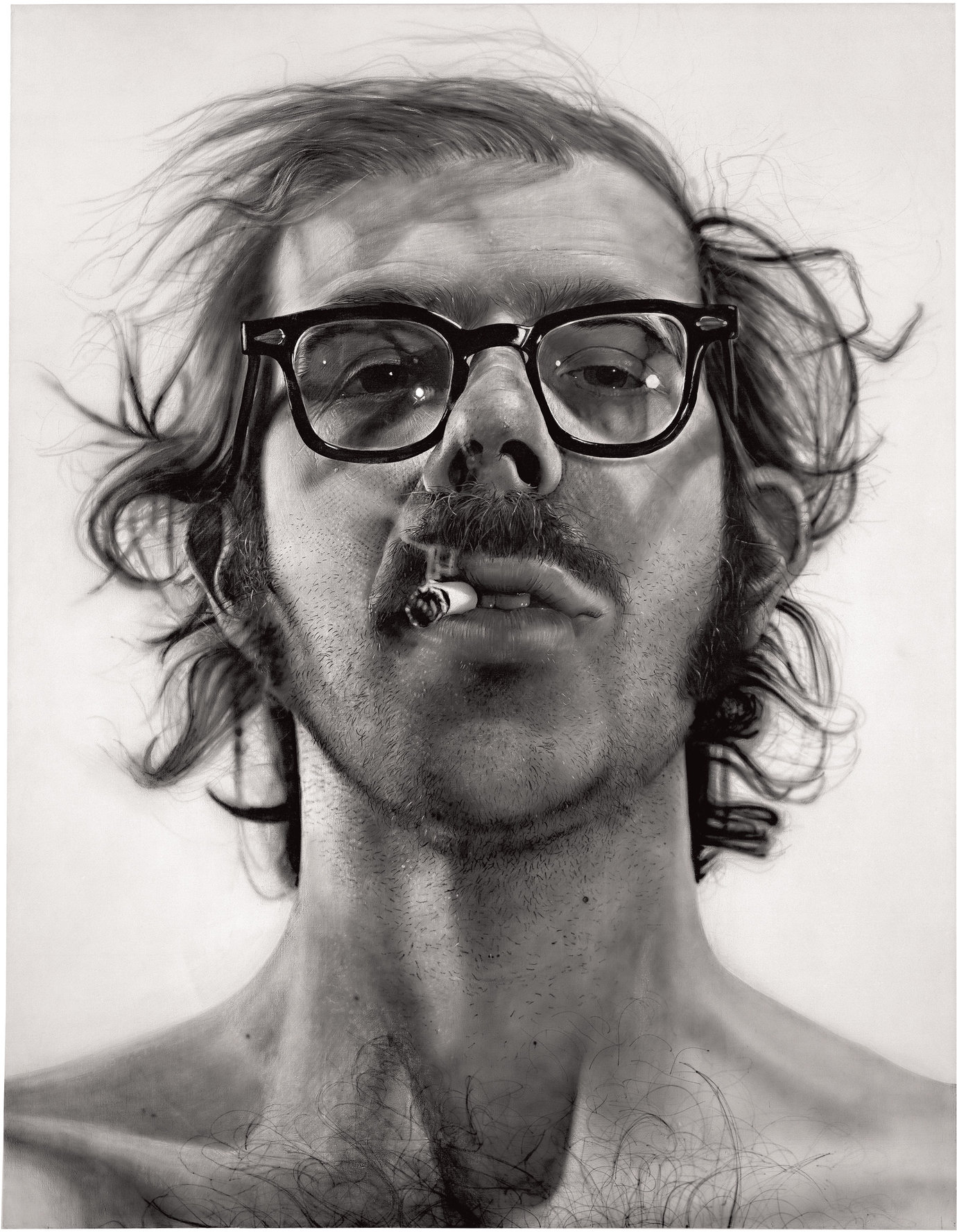
For those of you who may not know, photorealism is style of art that delves into the intricacies of painting and drawing in order to bring new life to photographs. Photorealists attempt to recreate, as accurately as possible, what they have photographed on an entirely different medium. One of the great masters of this art form is the American photographer/photorealist Chuck Close.  Close is specifically famous for his wonderfully realistic portraits of other people. Despite losing his father at age 11, he was still able to thrive creatively because he grew up in a supportive atmosphere. Close grew up in Monroe, Washington only thirty miles outside of Seattle, which was where he first began to understand art. His mother regularly took Close to art museums in Seattle where he was able to experience the works of many famous artists. His earlier works were mostly of other artists and family members close to him. 


As beautiful as his works are, many people do not understand Close's truly impressive artistic ability.  Close suffers from a disease called Prosopagnosia, otherwise know as face blindness, which means that Close's ability to recognize other peoples' faces is extremely impaired.  It is unbelievable that a man who is so overwhelmingly talented at recreating portraits of others would be unable to visually recognize someone's face. Close was not only talented at photorealism, and while in college he practiced a wide array of artistic styles.  As a Yale graduate, Close was more interested in expressionism, which was a very different direction than the majority of his current works. It was not until Close began to challenge himself that he stumbled upon photorealism. He decided that he should get rid of his everyday tools and attempt to express his art through new mediums.  The drawing below is a portrait of Phil Glass that came out of this challenge and has characterized some of his most famous works.


Chuck Close is definitely a big C creative; he revolutionized the world of art and has helped to popularize the photorealism genre.  His creative process is very serious and slow.  He starts with a huge canvas and make slow single marks/brushes in order to create such exact interpretations of photographs.  Close relies heavily on the metaphor of the artistic grid.  He uses it to describe his artistic process. In his opinion, the grid makes sense as a metaphor because he believes that everything in art and the world is the sum of different parts.  This is why Close's process is so based around calculated steps and accuracy.  Every mark he makes is just part of the grid which connects to make the whole image.


The canvases he used are even huge in comparison to another human (as you can see in the picture above). The grid system is almost necessary to keep the drawing so exact at such a large scale. In December of 1988, Close's art underwent a drastic change. Close suffered a seizure and was paralyzed from the neck down.  Since that da,y Close has had to rely on a wheel chair and can no longer paint to his full potential. Being the big C creative that he is Close did not allow this to deter him.  He now paints with a brush that he straps to his arm. In order to mimic his past works and style, Close paints small pixels that from afar appear as photorealism. Only a true artist like Chuck Close could come back from full body paralysis and still make an impact on the world.
 
 
Works Cited:


Lyn Evans - A Big-C Creative Creating Big Things


Lyn Evans is not a household name, not by a long shot. Most people have no idea who he is or what he has done; people should definitely know this man, however. Lyn Evans is the project director for the large hadron collider at CERN in Switzerland.


 Source: http://news.bbcimg.co.uk/media/images/64472000/jpg/_64472346_lynevans.jpg

 What is the large hadron collider (LHC)? It is a 27-kilometer long circular piece of machinery that lies 175 meters underground. It is a particle accelerator, used to simulate the beginnings of the universe by accelerating particles to near the speed of light and colliding them. What you get is something that looks like this model:


 Source: http://www.bnl.gov/today/body_pics/2010/09/ispy-run139779-evt4994190-v1-HR.jpg

 To people like you and me, this just looks like a mass of intersecting, squiggly lines. To Evans, though, this provides insight into how the universe began. The LHC has pioneered breakthroughs with the discovery of antimatter and the Higgs Boson, which are both part of larger physics theories trying to describe the rules of the world in which we live.

This is where Evan’s creativity is shown. There can be absolutely no doubt that he is a big-C creative. With 10,000 scientists collaborating, he led the entire community of physicists, scientists in general, and even the entire world into a new age of scientific discovery. His mastery of physics allowed him to progress from pro-C to big-C rather quickly and to wow the world with new discoveries.

Evans first began his study of physics at Swansea University, where he got his Ph.D. He then went to CERN as a Research Fellow, where he eventually was given a full time job and has stayed there since.

His work is relatable to Einstein because Einstein derived equations from thought experiments (which could not be performed in any physical capacity on Earth), just as Evans has done. The theories surrounding the LHC were previously untestable. Evans and his team of scientists made it possible to test those theories (specifically, String Theory) and give indication as to whether they are true or false. Ultimately, Einstein posed questions that could not be demonstrated, and Evans provided a new way to demonstrate physical phenomena to scientists whose theories were previously indemonstrable.


 Source: http://sitn.hms.harvard.edu/wp-content/uploads/2012/08/fig1.jpg

Although Lyn Evans is currently relatively unknown to the world, it is a name that should be honored. Lyn Evans enabled thousands of scientists to further their research while also satisfying his curiosity about the inner mechanisms of the universe. Evans truly is an innovator, and a physicist to be a proud of.


Works Cited

Gardner, Howard. Creating Minds: An Anatomy of Creativity Seen Through the Lives of Freud, Einstein, Picasso, Stravinsky, Eliot, Graham, and Gandhi. New York: Basic, 1993. Print.

"Lyndon Rees Evans, CBE, FRS." Lyndon Evans: 1956. Web. 12 Feb. 2015. <http://www.abgs.org.uk/FormerPupils/LynEvans


Beauty in the Bizarre

It is simple and intuitive to find beauty in traditional places. We are accustomed to hearing about the charm of a sunset overlooking the lake, curves on a human body, or a cascade of melodies played by a symphony. It is more difficult, however, to find beauty in the places society deems grotesque, hidden and dark. It takes a creative perspective to look past what sparks discomfort and social rejection to find the complex, nuanced beauty beneath the surface.

Rachel B. Stork Stoltz, MS - Anatomical Element Owner & Artist
Rachel B. Stork Stoltz finds beauty in the components that make up our bodies. She is not concerned with the superficial allure of a stunning individual. She is inspired by the organs that are nestled inside our frames and fundamental to our existence, using metalwork to create jewelry based on anatomy. Rachel discovered the intersection between two passions that are often viewed as opposites, combining her love of science and art into products used for aesthetics and advocacy.

Rachel's personality and experiences resonate with Professor Csikszentmihalyi's analysis of the creative personality. Professor Csikszentmihalyi studied the characteristics that contribute to creativity in individuals. Rachel's mother was an art teacher, suggesting that Rachel may have possessed a genetic predisposition for artistic ability. Rachel was also intellectual from a young age, demonstrating her interest in science by "owning a microscope and dissecting owl pellets at age 8" (Anatomical Element 2015). Her high IQ initially enhanced her creativity and allowed her to gain the foundation necessary for her science background. Rachel's curiosity, enthusiasm and passion propelled her to succeed in science and metalworking.

Anatomical OH BABY Uterus pendant
Rachel received a bachelor's degree in scientific illustration and a master's degree in biomedical visualization, defying gender stereotypes by pursuing degrees related to STEM fields. Csikszentmihalyi suggests that refusal to abide by gender norms is indicative of creative personalities (Csikszentmihalyi 70). Rachel's education provided her with access to the domain for scientists and illustrators, allowing her to receive the training, tools and connections necessary to develop her talent and receive recognition in her field. She navigated the analytical nature of hard sciences with the intuitive impulses of metalworking, moving between extremes of her cognitive processes. Rachel uses playfulness and wit to connect the components of our bodies to their social and cultural connotations.

Rachel is now based in Chicago, creating innovative jewelry and working for a pediatric urologist for a company called CEVL. She designs visuals for online education programs intended to improve efficiency and teamwork during surgical procedures. Rachel's passion for anatomy inspired her to begin creating jewelry, but her motivations have evolved to include advocacy for patients and caregivers. She creates pieces based on clients' personal experiences, utilizing tools like surgical staples that are significant and sentimental for her clients. Her jewelry raises awareness of illnesses, and she has focused primary on cystic fibrosis in the past. Rachel became a caregiver after her husband underwent open heart surgery and gained empathy for others in similar situations, exemplifying the notion that creative individuals express suffering, pain and enjoyment through their artistic mediums.

Rachel is an inspiration for all of us to examine the dark spaces of our world and reveal the beauty within them. She challenges the notion of traditional beauty and encourages others to defy social restrictions, recognizing that beauty exists everywhere. Taboo and eerie topics contain hidden treasures. It is the duty of creative individuals to find beauty in the bizarre.


Heart and Filigree style Lungs sterling silver necklace

Itty-Bitty Body Parts - Anatomical Brain!Itty-Bitty Body Parts - Anatomical Heart!


Sources:
http://anatomicalelement.com/about-events/
https://www.etsy.com/shop/AnatomicalElement?ref=l2-shopheader-name
Csikszentmihaly, Mihaly. Creativity: Flow and the Psychology of Discovery and Invention. New York: HarperCollinsPublishers, 1996. Print.