Tuesday, February 23, 2016

Robinhood: Democratizing the Financial Markets


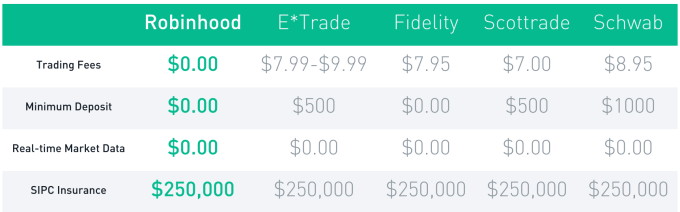
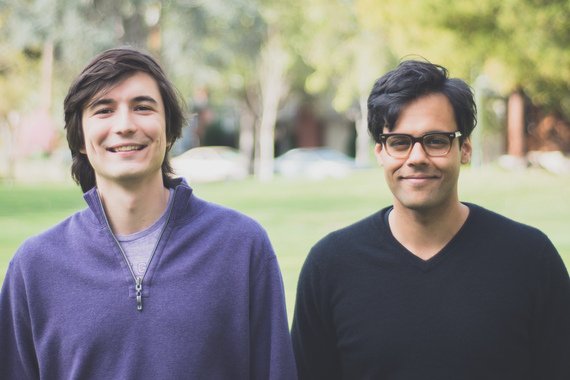
Shortly after arriving in New York City to pursue their dreams of building software for the world's largest financial institutions, Vladimir Tenev and Baiju Bhatt, began to become skeptical of the state of our financial markets.  Tenev and Bhatt started working in New York as computer engineers, developing sophisticated trading platforms for major financial institutions.  Through their work, they realized that these financial institutions and electronic trading firms were able to make trades in the marketplace at virtually no cost, while the individual investor (you, me, mom, dad, and your grandparents), through their investments with brokerage houses such as Charles Schawb, Fidelity, TD Ameritrade, were forced to pay a transaction fee of up to $10 for every trade they executed (See chart below for comparison of companies). This $10 fee may not seem too heavy, but when an individual investor is making upwards of 100 trades per year, this $10 adds up rather quickly.  Furthermore, since small investors are usually investing smaller sums of money, this $10 transaction fee quickly cuts into your overall return.  For Tenev and Bhatt, the solution was simple; they decided to create their own company and trading platform with no transaction fees for the individual investor.


Tenev and Bhatts' company, Robinhood, was created in 2013 and targeted young investors, mostly millennials, that planned on investing in simple stocks and ETFs (exchange traded funds), using a small amount of initial capital.  Robinhood provides a simple, focused, and understandable platform to the novice investor that allows all users to make as many commission-free trades as they wish.  Tenev and Bhatt are able to offer a free platform to their users because of their innovative trading software that allows Robinhood to execute trades at a very low cost.  Their software is effective due to their creative engineering team which has created their simple and cost effective platform in-house.
2015-08-12-1439383951-7602746-VladBaiju3.jpg


The process to found Robinhood began in 2011 when both Tenev and Bhatt worked in the New York City financial markets.  During this time is when they started to first understand the complexity and sophistication of the markets, which they believed had led to Wall Street insiders having tools and resources not possessed by those outside the "system".  To counter the Wall Street insiders, Tenev and Bhatt set out to create something "meaningful and something that empowered consumers."  They first had to solve the problem regarding how to provide and create a technology that was previously only available to the wealthy and give it to everyone.  Using their Wall Street insight, adept engineering ability, and drive to democratize the financial markets, Tenev and Bhatt, along with a team of fellow engineers, created the software and trading platform that is now known as Robinhood.  As of February 2016, over $600 million worth of money has been traded through Robinhood, and Robinhood has saved their customers over $12 million in transaction fees.  Also, the company has raised over $66 million in funding from venture capitalists hoping to ride the Robinhood train to riches.

Similar to many creatives before their time, Tenev and Bhatt were faced with a problem they believe needed to be solved.  Howard Gardner, a writer who specializes in the field of creativity, believes creative people are those who are repeatedly solving problems and one who "define(s) new questions in a domain in a way that is initially considered novel but that ultimately becomes accepted in a particular cultural setting."  At the time being, Robinhood is doing exactly that; they are defining a new normal for personal investing by offering a product and business model that has always been considered novel in the realm of personal finance: free commission and free trading.  Tenev and Bhatt have a different view of personal finance then today's norm.  In ten years, these innovative creators believe people will think its crazy they ever used to have to pay to trade stocks.    

Sources:
Gardner, Howard. Creating Minds. Basic Books. 1993, 2011.
http://www.huffingtonpost.com/david-ongchoco/startup-insider-the-story_b_7976446.html
https://www.robinhood.com/ 

Don't Hug Me I'm Scared!

What's creative? Well, before you can have a creative concept you must think, brainstorm, fire up the engine, or stare at a blank wall until the muse suddenly appears to you.  This is something that Joseph Pelling and Becky Sloan, a London based pair of artists, have become masters at: thinking-- creatively!  "Don't Hug Me I'm Scared", a multi-video series created by the two artists as been viewed around the world millions upon millions of times.

Set in what seems to be a child's fantasy world with felt upholstery and a cookie-cutter kitchen, the first video in the series at first appears to be right out of Blue's Clues.  Three life sized puppets sit around the table and discuss with their notebook friend what it means to be creative and most importantly: a tutorial on how to think creatively.  As I first watch I think it's a cute scene that I'd show my three year old brother but then I remember that most good things must come to an end.  The innocent scenario gets a small touch of the bizarre and I would even stretch to say a little bit witchcraft and the devil.  Too far? Well I for one have never seen a human heart start to be covered in glitter for an art project.

Why is it creative though? I'll tell you, because its entire existence is a paradox.  Pelling and Sloan say that the meaning behind the videos is a "how not to guide" and in this case how not make a creative tutorial on how to be creative.  Wow, that is a mouthful.  To boil it down: they made a video doing exactly what they said not to do, which in my opinion, is genius.  The pair of artists say they want fans of the video and series to take what ever they get from the video as the real message and it would be an understatement to say that there have been a few crazy theories.  The entire video is a breeding ground the the cultists and the creative thinkers to accumulate.  Fans have suggested that the video has ties to the early 1900's Russian Revolution all the way to commentary on the modern day artists in our society.  There may never be one true meaning but that won't stop fans from trying to find one.

All I can currently think of is divergent thinking.  How many different possibilities and scenarios can be associated with the video when perhaps there is nothing to associate at all?  The video itself.  Looking at ordinary objects like felt or a notebook and saying, "Wow. I really think this could be used to create a trippy how to guide about creative thinking." No one, and I mean no one, thinks this way.  I tip my hat or what ever other expressions apply to Sloan and Pelling.  These two are ones to watch and their videos definitely are as well.


Works Cited:

http://www.theguardian.com/culture/2016/jan/27/dont-hug-me-im-scared-youtube-viral-puppet-show-interview

http://www.dazeddigital.com/artsandculture/article/18301/1/beckyjoe-are-this-weeks-dazed-visionaries

The Ocean Clean Up Project


At the ripe, young age of 16, Boyan Slat was inspired to take on huge task - ridding the oceans of all plastic. He was inspired to do when on a trip to Greece and "saw more plastic bags than fish" when he looked out into the sea. It was this moment that he decided that something needed to be done. When discussing the issue with others, everyone told him that it was not possible to extract plastic from the ocean once it gets there. He went on to study the issue for over 6 months and used it as the topic for his high school science project. His dedication to the issue didn't stop there, he continued to research and develop a solution with the help of experts in the industry and professors. 


To further understand what Slat was trying to achieve, we need some background on the issue. In a nutshell, there are 8 million tons of plastic that find their way into the ocean every year. All of this plastic collects in places called convergence zones, or gyres. These zones exist due to the ocean currents that push all of the plastic into giant deposits. There are currently 5 major convergence zones on earth: two in the Pacific Ocean, two in the Atlantic ocean and one in the Indian Ocean.

The plastic that accumulates in the ocean has many disastrous effects on the plant and all of its life. Many oceanic creatures are killed every year due to the debris, whether it is via strangulation or ingestion. The plastics also cause harm to humans by releasing toxic chemicals such as PCBs and DDTs into the water when is then absorbed by fish that are consumed as food. The economic impacts are also apparent. Coastal areas spend extraordinary amounts of money to clean up beaches, fishing and shipping areas. 

To find a solution, Slat studied many concepts of ocean cleanup in order to find what didn't work. Most systems he read about were extremely expensive, time consuming, and even increased emissions. He used these concepts to develop his breakthrough system of the Ocean Cleanup Array. Based on his knowledge of the ocean currents, he came up with "a passive system of floating barriers that is attached to the seabed, and oriented in a V-shape. The barriers first catch, and then concentrate the plastic, enabling a platform to efficiently extract the plastic once it arrives in the center of the V."


When he first introduced this idea in his Ted Talk, he faced some criticism. There was a lot of speculation on whether or not his system would be successful since there had been numerous clean up proposals in the past. Once his idea went viral, it received attention from people all over the world. He started a raise funds and was able to build a large team of engineers, oceanographers, and other volunteers to help him bring his dream to reality. Now after four years, his team has run numerous trials in areas such as the Azores to determine the feasibility of his system. For the past few years they have been preparing for execution. They hope to officially begin clean up in 2020.

Gardner describes a creative person as someone who "regularly solves problems, fashions products, or defines new questions in a domain in a way that is initially considered novel but that ultimately becomes accepted in a particular cultural setting" (Gardner 33). Here we see that the problem is plastic pollution in oceans and Slat has designed a product to solve that problem.  He created his system by studying other previous proposals to figure out what not to do. This approach to developing his system is an example of divergent thinking. He researched for a very long time until he finally figured out the key to his system. As stated in Creativity, Intelligence and Personality  by Frank Barron and David M. Harrington "The aha! comes when the process reaches a conclusion"(Barron and Harrington 443). Slat's aha! moment came when he  "wondered; why move through the oceans, if the oceans can move through you?". 

Right now, the idea is still novel. The system is still in the developmental stages and there is still criticism and speculation, something that all inventors and creatives face. Along with the negative reactions, there are also many positive ones. Slat has gained much support from people, receiving millions in donations and many volunteers. Hopefully, his new invention becomes accepted in our world as the most efficient and best way to clean up the oceans. When his system becomes the norm, we can all rest easier knowing that there is one less environmental issue to face.


Works cited:
http://www.theoceancleanup.com/problem.html
http://inhabitat.com/interview-boyan-slat-teenage-inventor-of-the-ocean-cleanup-array/
http://www.boyanslat.com/
http://www.bbc.com/news/magazine-29631332
Creating Minds by H. Gardner (1993)
CREATIVITY, INTELLIGENCE, AND PERSONALITY  by F. Barron and D. Harrington (1981)


Monday, February 22, 2016

Upside Down & Inside Out


If you’ve heard of OK Go, you probably know that they are a super creative band. They brought us the famous treadmill dance, and an incredible Rube Goldberg Machine in what is probably my favorite music video of all time. This month, they came out with a new music video called Upside Down & Inside Out. It’s filmed on a plane in zero gravity. They start out simply opening and closing their laptops, but then…it’s amazing. I don’t want to spoil it, so watch it below first!


 Incredible, right? This was creative for so many reasons. It related to so many things that Howard Gardner wrote about in Creating Minds. This video has “mass appeal” (Gardner xix). It “blurred the lines between art [the music itself], science [it defied gravity], and technology [with the airplane and cameras used to film]” (xx). It exemplifies Gardner’s assertion that many creative breakthroughs entail “an intersection of the childlike and the mature” (7). Think balloons, piñatas, and bouncy balls but also laptops, grown men, and beards. The concept for this video was “divergent thinking” (20) because it was filmed in zero gravity. One lyric is “gravity's just a habit;” that sure sounds like divergent thinking! The way they filmed this also involved divergent thinking because it had to be done very strategically (more about that later)! Judging by how much fun they seem to be having, it seems that these creative individuals engaged in this activity “for its sheer pleasure” (25). Lastly, two of the four OK Go members are in Gardner’s proposed time of maximal productivity, “between ages thirty-five and thirty-nine” (26). This music video applies in multiple ways to Gardner’s ideas.

Now some interesting details about the video! Their challenge was making the video cohesive because it was strategically filmed in eight weightless periods of 27 seconds while flying in a parabolic flight maneuver. Total, they took 21 zero gravity flights over three weeks in order to make this film. The flight attendants were aerial acrobats. The band members were not, and as you can guess, they had to wear motion sickness stickers behind their ears. I found out that the cast and crew involved in making this video vomited a total of 58 times. Gross! But it was worth it. Are you interested in how exactly their creative process worked? Watch the video below. You’ll realize how insanely difficult it was to make. And they made it look easy! I’M OBSESSED.


Work Cited:

Gardner, Howard. Creating Minds: An Anatomy of Creativity Seen through the Lives of Freud, Einstein, Picasso, Stravinsky, Eliot, Graham, and Gandhi. New York: Basic, 2011. Print.

Saturday, February 20, 2016

Bloom Box: Energy System of the Future?

Global climate change is a serious problem humans must address in order to ensure our survival as a species on planet Earth. A major contributor to this climate change is the fuel burned in order to power homes and businesses around the world. A company called Bloom Energy wishes to address this issue with an invention it claims can produce zero-emission electricity using oxygen and fuel. This invention, popularly referred to as the Bloom Box, utilizes fuel cell technology in a new light. Bloom Energy's fuel cell is constructed using the cheap, abundant material of sand which is baked into ceramic squares and panted with secret green and black "inks". One fuel cell disk has the ability to power a light bulb, but the fuel cells may be stacked into brick-sized towers using metal alloy plates which allows for increased energy production.

K. R. Sridhar, the inventor of this technology, is confident that the Bloom Box will be able to provide power for businesses across the globe and residential homes, once the fuel cells can be manufactured in a cost effective manner. Sridhar, a former rocket scientist for NASA, got the idea for this technology from a project in which he was tasked with figuring out a way to produce oxygen on Mars. When NASA decided to scrap this mission, Sridhar had an idea to reverse his "Mars Machine" so that instead of oxygen being produced oxygen would be pumped in. Sridhar was able to invent a new kind of fuel cell in which oxygen is fed into one end and fuel is fed into the other. The fuel and oxygen combine within the fuel cell to produce electricity without the need for combustion or power lines from an outside source. The fuel most commonly used now is natural gas which does create carbon emissions. However, biogas, landfill gas, and solar energy can also be used as fuel for the Bloom Box, and the use of these fuels would result in a net of zero carbon emissions

Sridhar would be labelled a creative according to Gardner because he displays the characteristic of a divergent thinker. Instead of simply moving on after his Mars project was terminated, Sridhar came up with a unique way to utilize the technology he had be creating in order to produce a product with that may have the ability to provide clean, renewable energy. In addition, Sridhar is a creative individual because he has fashioned a product that seeks to help solve the issue of global climate change in a very novel way. Moreover, like any creative, Sridhar has a support system to help foster his creativity. Sridhar has $400 million dollars of investment at his disposal to continue to create and develop this technology further.

The Bloom Box has already been installed by well-known entities such as Google, FedEx, Walmart, Staples, and Ebay. The large boxes these corporations had installed cost between $700,000-$800,000. Ebay had five Bloom Boxes installed at its San Jose campus, and the company claims it has saved over $100,000 in electricity costs over a nine month period.

Sridhar is continuing to refine his production and manufacturing processes with the hope of scaling-down the corporate Bloom Box to a unit that would be affordable for the average home owner. His goal is to create a unit that cost about $3,000 and to have a Bloom Box installed in every home by the year 2020.


For more information regarding the science behind the Bloom Box: http://www.fastcompany.com/1561844/how-does-bloom-box-energy-server-work

http://www.cbsnews.com/news/the-bloom-box-an-energy-breakthrough-18-02-2010/4/
http://www.csmonitor.com/USA/Society/2010/0222/Bloom-Box-What-is-it-and-how-does-it-work


Tuesday, February 16, 2016

Bob Dylan: Inspiring the Greats

Bob Dylan is considered by many as one of the most influential musicians and songwriters of all time. In a list made by Rolling Stones he was placed as the second best artists of all time falling behind only the Beatles. http://www.rollingstone.com/music/lists/100-greatest-artists-of-all-time-19691231 It is not simply that Bob Dylan is amazing as a musician but also as a lyricist having his songs covered by stars like Adele “Make You Feel My Love”  https://www.youtube.com/watch?v=0put0_a--Ng and Jimi Hendrix “All Along the Watchtower” https://www.youtube.com/watch?v=TLV4_xaYynY.  His songs were so powerful that one of them “Blowin in the Wind”https://www.youtube.com/watch?v=vWwgrjjIMXA served as an anthem for the civil rights movement. Bob Dylan was an inspiration to many and even John Lennon has been quoted to say “I'd have a separate songwriting John Lennon who wrote songs for the meat market, and I didn’t' consider them (the lyrics or anything) to have any depth at all … Then I started being me about the songs, not writing them objectively, but subjectively. … I'd started thinking about my own emotions. … Instead of projecting myself into a situation, I would try to express what I felt about myself. … It was Dylan who helped me realise that”. http://www.aaronkrerowicz.com/beatles-blog/bob-dylans-influence-on-the-beatles  Bob Dylan was an inspiration for John Lennon to start to think of his lyrics from a more artistic, less fan pleasing point of view and this led to a turning point in the quality of his lyrics.  

Times They Are Changin’ Bob Dylan Live


What I believe is distinctly noticeable about Bob Dylan is that even now after 50 years he is still making new music. As Gardner brought up in his book on creativity, for people who are truly creative there is a need for their expression of creativity that cannot be put out. To Bob Dylan I believe it is less about the product and more about the process of creating which is why even though he has had countless hits and has made huge amounts of money he cannot stop.  Bob Dylan does not simply go with what the world wants from him. Bob Dylan is notorious for changing himself and his style. When Bob Dylan “plugged in” and went from folk song writing to a more Rock and Roll style of music many of his fans felt betrayed and believed he was selling out. I believe that rather than “selling out” Bob Dylan was simply allowing his creative impulses to take him where they led him no matter what his fans thought. In an interview with Time magazine Bob Dylan says that he “just writes” making it sound as if the lyrics are just gushing out of him not from necessarily a point of deep reflection but rather on pure creative instincts. https://www.youtube.com/watch?v=mnl5X5MQKTg This can be reflected when looking at original write ups of his songs seemingly done on the spur of the moment inspiration many on simple scraps of paper.


Bob Dylan’s creativity is reflected in almost every one of his songs. With interesting lyrics and a singing/talking tone all his own there is clearly a unique flair to his music. Bob Dylan in the course of his long music career has covered many genres including country, rock and roll, folk, and even gospel and through this variety he has left a mark in each influencing others and providing countless inspiring songs. 

Cell Saver Saving More than Cells

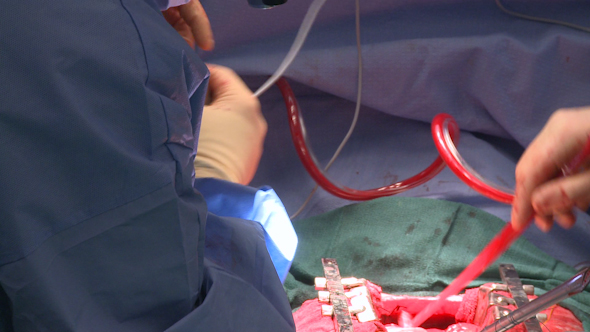
Peri-operative cell salvaging is a technique used during surgery when the estimated blood loss is expected to be significant.  When people are in situations that leave them presenting with blood loss, the health care providers must know the person's blood type.  Prior to any surgery, the hospital would have this on file given the presenting risks. Up until about 30 years ago, the only way to replace lost blood was by administering blood from another human donor.  Of course, any blood that must be given this way nowadays is closely monitored for bacteria and viruses, but there are still many, many different types of life-threatening reactions that can present to a patient regarding different antibodies in the blood, etc.

Since "most fatal transfusions result from human error," one can see how the intra-operative cell salvaging process greatly minimizes any amount of human error possible - there is no way the blood is the wrong type or has the wrong Rh factor!  Using the patient's own blood to infuse back into their body seems like a simple idea, but really is an intricate process.  In surgery, witnessing this type of blood collection and infusion, it appears that blood is suctioned out of the surgical incision, and collected in an IV bag for later infusion.  This detailed process must account for many different details of blood and surgery.  The suctioning of blood in the surgical cavity must be coated with an anticoagulant, to prevent the blood from clotting during the suctioning and filtering process.  The red blood cells are separated from plasma during centrifugation.  Typically, the plasma is removed and saline is mixed with the red blood cells to "wash" the blood; "washing the blood removes anticoagulation, plasma-free hemoglobin, and plasma proteins, including activated clotting factors and platelets."


This small but momentous invention has greatly improved outcomes of major invasive surgeries.  Though there is no such thing as eliminating human error, this process, when completed within the surgical suite, does completely eliminate the possibility of ABO (blood typing) incompatibility.  In fact, the possibility of bacteria contaminating the blood is the only perceived threat to this autologous blood donation (and is a minimal threat itself).  Through evidenced-based practice, this process of intra-operative cell salvaging has proven itself to be an innovative, yet obviously simple solution to blood loss.


Unfortunately in health care, and often times in life in general, there must be a presenting problem before people begin to contemplate preventative measures that could prevent similar issues in the future.  It was not until so many blood transfusion reactions occurred, that people really began thinking outside of the box on how to lessen the occurrence of this type of issue.  In this way, I am reminded of Gandhi compared to hospital-insurance provider relationships.  In the past, when a person had the wrong blood infused, due in part to some sort of human error, the insurance providers paid for treatment the patient received.  As time went on, the insurance companies started reevaluating what their clients were in the hospital for and decided they should not help pay for any treatment the patient received in relation to a complication they technically should not have experienced (if the hospital was doing everything correctly).  Now, generally, a hospital pays out-of-pocket for any complications that arise that were caused by hospital error.

Gandhi was a man who saw injustice, like the insurance companies covering treatment for complications their customers should technically have never acquired.  Gandhi utilized peaceful political techniques to advocate for change; Gandhi's refusal to eat mirrors the insurance companies's refusal to pay for hospital-acquired complications. In more ways than one, noticing that the cell salvaging solution came about because too many people were losing blood and there was too great a risk of transfusion reactions, reminds me of Gandhi's style of implementing change.  Gandhi implemented protest on a personal level, denying himself food in order to take a political stance.  Insurance companies are more selfish, saving themselves money, yet still peacefully protesting hospital acquired infections and the like.  It is almost that these simple, yet great, ideas have the inability to generate in a proactive way, but are both peaceful reactions to an inexcusable reality that effectively implement change for the better.


http://noblood.org/forum/content/209-intraoperative_blood_salvage

http://www.surgeryencyclopedia.com/A-Ce/Blood-Salvage.html

http://www.bloodcenters.org/hospitals-physicians/autologous-donation/