Wednesday, February 11, 2015

A Constrained Creation: The Seussical Saga


A Constrained Creation: The Seussical Saga

The tale here composed is not for the faint,
For I sought to write it with particular constraint.
To rhyme, I concluded, would be challenge enough
To assist me in producing some thoughtful stuff.

You see, Dr. Seuss, is the imaginative mind
Who inspired in me a most creative design.
Sharing his story will bring me much joy,
As many great books I will get to employ.

And so we begin a tale full of wit
With a young lad, bright, not lacking in grit.
His successes were few in his early years,
But with patience and practice, resulted in cheers.

When challenge arose, he ran not away
But risked his own pride. With courage, he stayed!
Given just 50 words to write a grand slam,
He produced what we know fondly as "Green Eggs and Ham."

That's right, Sam I am! Dr. Seuss is the man.
And that's not the last time he proved that he can.
Literacy was low back in those times
And Seuss was invited to lay down more rhymes.

As proven before, constraint paved the way
For this scintillating poet's persuasive array.
With only a first grader's lexicon to consult
Seuss constructed a story with fantastic result.

“The Cat in the Hat” found its way to the presses
Kids and parents alike were enthralled by its messes.
See Seuss had found the ideal motivation
To energize his writing and entertain the whole nation.[1]

Adding constraints to the challenge of writing a book
Helped Seuss to refine and define his nook.
Often a commentary on social reform
Seuss used his characters to urge and inform.

From wartime propaganda to the Watergate scandal
No polemical story was too unwieldy to handle.
This all while using a particular vocab
That was accessible to kids, exciting, not drab.

It was easy to cramp this perfectionist's style.
To articulate his yarns took more than awhile.[2]
Whole years he would take to compose some parts
Though with only 50 words, he had it down to an art.

So you'd best not forget to take a good look,
Put aside a few minutes, and pick up a book!
Shelf after shelf, don’t hesitate to plunder!
Explore the wide world of Seussical wonder.


[1] In the chapter on “An Investment Approach
to Creativity: Theory and Data,” it is revealed that motivation effects creativity on an upside down U shaped curve. There is an ideal level of motivation. Too much or too little can result in lessened creativity as the pressure to create might lead the creative to a block. It seems as though Seuss had found the optimal level of motivation for his creative process. Externally provided constraints and goals, paired with his desire to contribute to political conversations of the day were just enough motivation to result in dialect.
[2] As articulated in the Lubart and Sternberg article, many creatives require more time than normal to develop and approve of their pieces. This is true of Seuss with many of his works. See Creative Realism, page 273.

Turing Up for What?


Image result for alan turing
Alan Turing was a man at the forefront of creation during his lifetime. He was a revered cryptologist, mathematician, and one of the first computer scientist. He was born in England and studied at University of Cambridge with a concentration in Mathematics from 1931-1934. He became a fellow at the university upon graduation and subsequently published a paper which mentioned a machine capable of computing anything that is in fact computable. This gave way to the ideas of modern computers. After the publication until 1938, Turing worked on his Ph.D. from Princeton, in Mathematics and Cryptology.


Image result for alan turing
          (A Picture of Benedict Cumberbach portraying Turing in The Imitation Game 2014)

One of his most notable accomplishments however, was preformed during World War 2. After obtaining his Ph.D. Turing went on to work at the Government Code and Cypher School, at Bletchley Park. He was able to intercept the German Code and decipher it by creating a bombe, a giant machine that would enable him to crack the code through the use of rotors.

The reason I picked this person to write this article on Alan Turing is because he envisioned most of what he did. There were little to no resources in which he theorized his ideas of computers and artificial intelligence and straight up created that field and molded it into what it is today. One of his key accomplishments is what is known as the Turing test, which was a theory about a computer being able to exude the intelligence and intuition if a human so that it is indistinguishable from a real person. Also, through his ingenuity, he was able to decode the German code which was able to help win the war efforts by an estimated 2-4 years. Turing was a man ahead of his time, and set the path for many of today's modern inventions, since we rely on computers so much today. Turing Died in 1954, due to cyanide poisoning, potentially self-inflicted. He was a man who left behind a huge legacy, and one that we continue to use in our everyday lives to strive towards a better tomorrow.


(A replica of the bombe that was used to break the German Code.)

Nikola Tesla - A Creative Genius

Nikola Tesla, the man who revolutionized the world through his inventions, that even today, literally light up the world. He introduced the world to his developments using polyphase alternating current (AC current) which is used to power the world today because of its advantages over direct current (DC current). The exact science underlying these concepts is too complex to explain in a short post such as this one. In short, however, the use of AC current allowed cheaper long distance transmission of electricity by increasing efficiency. 
Furthermore, he has registered over 700 patents worldwide. Some of these inventions include the current induction motor, the Tesla coil, the fluorescent light, laser beam, wireless communications, remote control, and vertical take off aircraft.
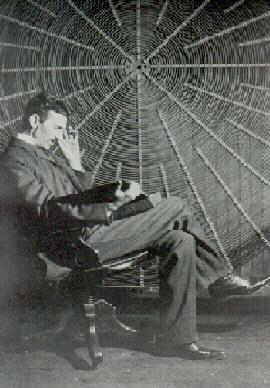
Nikola Tesla. Source: Tesla Society
When one sees the complexity and variety of products created as a direct or indirect result of Tesla's ideas, it is difficult to argue against the claim that he was creative. In fact, he describes his creative process which allowed him to make all his inventions in his autobiography. According to him, when he came up with an idea, he developed it in his mind. He edited, improved, and finalized the product in his mind before making and testing a model in real life. To him, it made no difference if he tested the product in his mind or in real life because he had been able to successfully create products in his mind his entire career. 

Tesla Coil. Source: Electric Museum
Tesla's creativity fits the definition that Howard Gardner defines in his book, Creating minds, where he defines the creative individual as a person who regularly solves problems, fashions products, or defines new questions in a domain in a way that is initially considered novel but that ultimately becomes accepted in a particular cultural setting. 

According to him, a person need only be creative in a domain, as opposed to being creative across all domains. This applies to Tesla, as he was not known for his creativity in the arts or music as much as his creativity with electronics. Gardener's second point about the creative individual is that they regularly exhibit creativity, and Tesla dedicated his life to his work and created new ideas or products throughout his life. The third point, ties into the second, in that creativity can involve fashioning of products, which is exactly what Tesla did in his career. Lastly, Gardener states that the creative activities are accepted in a particular culture, and the scientific and general community have come to accept and revere Tesla's inventions. For his work, he was awarded honorary doctoral degrees from Columbia and Yale University, among many other honors. 

I believe that Nikola Tesla is one of the most influential people to ever exist. His creative genius has allowed us to enjoy the technological advancements of the 21st century.  It is not difficult to imagine that without this man's creations, the world would be a very different place. 

Sources: 

Gardner, Howard. Creating Minds: An Anatomy of Creativity Seen through the Lives of Freud, Einstein, Picasso, Stravinsky, Eliot, Graham, and Gandhi. New York: Basic, 1993. Print.

Knapp, Alex. "Nikola Tesla: Unique Genius Or A Model For Everyone?" Forbes. Forbes Magazine, 28 Apr. 2011. Web. 12 Feb. 2015. <http://www.forbes.com/sites/alexknapp/2011/04/28/nikola-tesla-unique-genius-or-a-model-for-everyone/>.

"Tesla's Biography." Tesla Society. Tesla Memorial Society of New York. Web. 12 Feb. 2015. <http://www.teslasociety.com/biography.htm>.

Thomas Jefferson: A Colonial Renaissance Man


As an American Founding Father, Thomas Jefferson showed bravery and courage as a prominent figure in American history.  However, as the Founding Father who is credited with writing the Declaration of Independence as well as being the father of a form of architecture (Jeffersonian Architecture), some would argue he also displayed creative expertise in architecture as well as political philosophy.  In his book, “Creative Minds,” Howard Gardner explains that the three core elements needed to account for creative activity are the individual, the work, and other persons.  As a child coming from a large, wealthy family in Virginia, Jefferson’s childhood education allowed his teachers and tutors to play a vital role in him becoming a colonial Renaissance man. At around the age of 10, he began studying several languages including Latin, Greek, and French.   At age 16, Jefferson went to attend the College of William & Mary where he studied the works of prominent thinkers such as John Locke and Isaac Newton.  He also studied law there under George Wythe.  Along with this education, Jefferson also studied gained extensive knowledge in a variety of areas in his family’s library.  Although Jefferson did not receive any formal degree to practice law as a result of his education, it is obvious that he had access to gain expertise in a vast array of areas of studies.  However, his primary interests were in the fields of politics, law, and architecture.  Through his education, Jefferson began formulating his own beliefs on political ideals, and saw many issues with the way political systems ran during his early lifetime.

According to RW Weisberg in his article, “Creativity: Beyond the Myth of Genius,” the difference between ordinary problem solving and creative problem solving is “the high degree of motivation and expertise involved in the latter,” (Weisberg, p. 92) Jefferson’s education allowed him to gain the elite expertise in the fields of law and politics, and the American Revolution gave him the motivation he needed to display his creative expertise through applying his political ideals to this revolution.  Weisberg also states that those with creative expertise will find superior ways to solve a problem and reach the goal; one example is starting at the goal and working backward toward the initial problem.  This is exactly what Jefferson did to help the colonies during the American Revolution.

Jefferson had many political philosophies and beliefs that are prominent American political beliefs today, and are cornerstones of the American government.  First, Jefferson believed strongly in the inalienable rights of man as well as individual liberties.  You can see this through the first few lines of the Declaration of Independence, that Jefferson believed strongly in individual rights, and believe that any government should protect the rights of the individual from others within the society as well as the government. 
“We hold these truths to be self-evident, that all men are created equal, that they are endowed by their Creator with certain unalienable Rights, that among these are Life, Liberty and the pursuit of Happiness.--That to secure these rights, Governments are instituted among Men, deriving their just powers from the consent of the governed, --That whenever any Form of Government becomes destructive of these ends, it is the Right of the People to alter or to abolish it, and to institute new Government, laying its foundation on such principles and organizing its powers in such form,”
Along with individual rights, Jefferson also believed in what he called separation between church and state, which became the understanding of the Free Exercise Clause of the 1st Amendment of the United States Constitution.   Jefferson differed from other founding fathers in the amount of political power the federal government should possess as opposed to the state governments.  Jefferson believed strongly that the state governments should possess the majority of power, because he believed political systems worked best in small homogeneous groups as opposed to large diverse groups, where more conflict is to be expected.  Lastly, although he owned slaves and the abolition of slavery did not occur within his lifetime, he did speak in opposition to slavery throughout his life.  He even tried to pass several pieces of legislation that would have limited the oppression of slaves.  As you can see, many of Jefferson’s ideals are the ideals that are prominent within America today, which is the type of political system he wished to create (Weisberg would call it his goal).  It is evident that Jefferson used his creative expertise in politics and law in order to solve the problem of oppressive governments by working backward from his ideal political system, which was democracy.  However, the American Revolution was not the only example of this.  He also was a strong supporter of the French Revolution when he was the American Minister to France.  However, even in what many would consider the pinnacle example of Thomas Jefferson’s creative genius (The Declaration of Independence), there is evidence that his political ideals were not solely isolated ideals of his own, but had outside influence.  For example, John Locke wrote in his “Two Treatises of Government” about “life, liberty, and estate,” which sounds very similar to the inalienable rights described in the Declaration of Independence as “life, liberty, and the pursuit of happiness.”


Throughout Jefferson’s life he fought to create democracy and preserve it in the United States, and the formation of this country as a result of the American Revolution allowed Jefferson’s creative genius to take action and help create the foundation for what some consider the best country in the world.  If his eloquent writing in the Declaration of Independence and his prominent role in creating the foundation for America are not enough to convince you of his creative genius, I encourage you to tour the University of Virginia, where Jefferson was the architect of several buildings on what Forbes Magazine rates as one of the most beautiful campuses in America.  Thomas Jefferson; a Colonial Renaissance man.


Sources:

Gardner, Howard. Creative Minds. 2011.
Weisberg, RW. Creativity: Beyond the myth of genius. "Chapter 4." 1993.

Jonathan Larson: A Broadway Legend

To a Broadway fanatic, the name Jonathan Larson carries with it a note of excitement and pain. Much like a punch in the stomach, Larson’s initial impact seemed it would not leave much of a meaningful and lasting trace in the theatrical world of the nineties. He would of course go on to write the music to the tony award winning musical Rent, and win other prestigious awards such as the Pulitzer Prize, awarded posthumously. But to understand why I deem his input on the stage to be the most creatively important one of our times, you need to understand where he came from.

Interpreting Csikszentmihalyi’s reading, Larson had all the ingredients to become a great. Early on in his childhood, his parents encouraged him to take on music and acting. He was involved in every school play, musical, and band performance. He was awarded a full scholarship to Adelphi University and composed his first pieces while in undergrad. As a senior he even wrote a letter to Steven Sondheim, his idol. Sondheim actually responded and would become a mentor to him later on in his life, writing him letters of recommendation. After gliding through college, he moved to New York City to make it as a composer.


There, however, Larson faced unimaginable hurdles. This man spent every waking moment creating music that was not getting produced, and that people did not seem ready for. He waited tables on the side just to make enough money to get by. And when I say get by, I mean he was dirt poor. He even had to borrow money from his parents to pay the bills (not including heat, since he his loft had none). One of his earlier pieces was a futuristic musical rendition of Orwell’s 1989. After ten years perfecting it, he was refused the rights to produce it. He felt utterly rejected. At a time when Broadway featured more of the same classics (a.k.a. Cats, Phantom of the Opera…), Larson stood out like a purple bruise on pasty skin.

However, there was no denying his talent. He won every award out there: ASCAP, the Richard Rogers Production Award, the Stephen Sondheim Award and many more would come. In 1989 Larson was approached to write the music to a remake of Puccini’s La Bohème. At first what was a collaborative effort, resulted in Larson taking control of the project. He locked himself up in his loft and wrote the hours, days, months and years away. He told his sister, with whom he was very close, that if he was going to write the music, it would have to be on his own terms. He wanted this new musical to be the Hair of the 90’s. And it became so much more than that. Rent is the rock anthem of a generation. A musical that includes, the gritty reality of poverty and love in an HIV-infested nation. Its songs seem to come from at least 10 different artists, as he wrote ballads, pop songs, rock and roll pieces, gospel hymns, salsa dances, and blues that would resonate in every young person across the planet. Larson literally wrote hundreds of songs for Rent, of which only 30 or so were included in the final Broadway version.

Larson did what no other person had accomplished before, and it all came out of a tinny-sounding old keyboard he kept in his loft. He pushed all notions of Broadway Theater down a cliff and replaced it with reality rather than exaggeration. He included drug addiction, homophobia, AIDS, gentrification and much more in the musical, while he himself was surrounded by all these problems. For him, Rent was to become an epitaph to the lifestyle he shared with so many people in New York.


The perverse irony is that Johnathan Larson would die January 25th, 1996, the night before the first off-Broadway production of Rent. He would not witness the enormous success his music would have. The actors decided they would just sing through the lyrics, sitting on the stage for the entirety of the show, but by the end of the first Act, they could not stop themselves from getting up and playing their characters. It was a testament to how much they believed in what they were singing about. After the standing ovation at the end of the show, a complete silence emanated throughout the theater, until an audience member shouted out “Thank you, Jonathan Larson!”


Truly, thank you, Jonathan Larson.


Chest Pains and Tritones


1853 marked chemist Charles Gerhardt’s invention of a new medical chemical.  Initial tests showed that his chemical caused stomach problems when ingested.  Therefore, instead of working to improve his recipe, Gerhardt abandoned his discovery (1).  

However, in 1899, German chemist Felix Hoffmann rediscovered Gerhardt’s chemical and refined the synthesis process.  With the synthesis process improved and stomach complications reduced, Hoffman saw potential in the health benefits of his chemical (2).  

Unfortunately, his boss did not see that same potential.  When Hoffmann proposed this product to his boss, Hoffmann received a reply letter scoffing that “[Felix’s product] is typical Berlin hot air.  The product is worthless” (1). 


Does this creative product ring a bell? At this point could you tell me what Hoffmann synthesized?  Are you familiar with this chemical that Hoffmann's boss bluntly rejected?  
  
I dedicate this post to the underdog inventions, or those late-bloomer ideas teeming with potential yet lacking the right audience.  These cases I present today are a few of thousands of innovations initially doubted by investors or ignored by the general public before any hard-earned success.  Fortunately, these examples overcame the skepticism of the general public, while many other bright ideas are yet to receive the time of day.  Hopefully, from these few examples, perspectives on foreign ideas may become more accepting.

We see cases like this every day, from vetoed bills and untouched suggestion boxes to inventions brutally shot down in the television show Shark Tank on Channel ABC.  An example from one of my favorite Shark Tank episodes is when Travis Perry, a humble entrepreneur and music teacher, presented “Chord Buddy,” a product that aids in learning to play the guitar.  Five sharks listened to Perry’s hard work and effort invested in the product, yet only one shark Robert Herjavec considered jumpstarting the company with $150,000 (chump change for the sharks).  In fact, notoriously nasty shark Kevin O’Leary vocalized his lack of faith in the product and insensitively instructed Perry to burn the patent.  However, in hindsight, O’Leary is kicking himself over rejecting Chord Buddy, the revolutionary musical teaching device which presently grosses millions of dollars in profit each year, thanks to Herjavec, an open-minded audience member, for believing in the bright idea (3). 


Even composer Igor Stravinsky, my creative for the group project, wrote scores that did not receive immediate applause.  In response to one of Stravinsky’s ballets in particular, riots ensued outside the opera house.  Audience members insulted Stravinsky’s avant-garde musical dissonance with the use of tritone chords and chromatic scale layering, not to mention his ballet’s austere plot line of a woman dancing herself to death.  Nevertheless, Stravinsky remained true to his musical score and inspiration and barely edited his ballet to conform to the complaints of the crowd.  Today we know this work as The Rite of Spring, one of the most recorded and performed musical works around the world.  In fact, I remember playing an excerpt of Stravinsky’s Rite of Spring in one of my high school orchestra concerts (4).

Listen to Stravinsky's Rite of Spring at the link below: 
http://youtu.be/lWotpIy0uTg

In an interview with Dave Melcher (reading), jazz musician Greg Osby sums up the trials and tribulations of composing for an audience as if he stood in the same shoes of Stravinsky after that first performance of The Rite of Spring.  Osby describes improvisational musical technique and musical creation as a deliberate experimentation to push the buttons of the listener.  Reminiscent of Stravinsky, and all other unconventional inventions, creative minds want to challenge the precedent and strike a chord with the general public in the hopes that the general public accepts the new mode.  Osby reflects that tritones (the same dissonant chords used in Stravinsky’s work) sound jarring and wrong to the untrained ear while, to Osby himself, tritones have worth, for they sound striking and make a strong emotional statement in musical compositions (5).  

Osby continues to shed light on the unfortunate truth that unfamiliar things are more easily turned down, that “unfamiliarity is a generator for rejection” (5).  He warns that if you keep starting from the same musical motif, your music will lose its originality and implode.  This point stresses the importance of diversity of ideas in a skeptical world of “naturally intolerant human beings,” for inventors with bright ideas must be extremely persistent if initially the general public does not see the product’s worth (6). 


From these papers, I begin to question how many brilliant ideas went to waste and were not later accepted.  How much is close-mindedness to blame for missed opportunities? 

With that said, I will ask you one more time whether you recognize Hoffmann’s product. 

After the boss’s initial rejection, Hoffmann showed his persistence and resilience as a creative inventor.  He continued to refine his product and test the chemical’s medical effects on patients, from his dad with arthritis to neighbors with chest pain (2).  In 1900 Hoffmann pitched his new and improved product to a German company named Bayer, where the chairperson interceded and advocated to sell the product.  This chemical was initially incorporated in chewing gum for children who just had their teeth pulled, for Hoffmann’s chemical reduced pain and prevented blood clotting (1).  By the 1970s final modifications to the synthesis of Hoffmann’s drug yielded a pure product of salicylic acid, a blood thinner and pain reliever (2).
 
Over one hundred years ago, salicylic acid, better known as aspirin, was shrugged off as “worthless.”  Today this same aspirin product prevents millions of heart attacks and prolongs lives for several years (2). 

Consider creativity as lightning in a bottle, as discussed in class. Stravinsky, Perry, and Hoffmann captured lightning and harnessed it into various applications, from newly synthesized chemical bonds to clever teaching aids and strident musical chords.  As we discussed in class, popularity plays a part, for a creative product stems from not only an idea and an inventor but also the effect it has on the people of that situation.  With the possibility of facing skepticism, the inventor must have “willingness to take an enormous risk with the whole heart, soul, and mind on something where only he or she knows the impact—if it worked—would be utterly transformative” (6).The frustrating irony of invention is that some of the most impressive and significant discoveries reveal themselves at the wrong time and consequently suffer rejection, if not a very humble beginning.  Fortunately, Stravinsky, Perry, and Hoffmann had the persistence to persuade others that their lightning was bright.  


My solution to overlooked ideas lies in a public more open-minded to trial and error and more comfortable with the unfamiliar. That being said, this post can be a start of a new mindset or simply one thousand words glossing your eyes.  Now it is up to you the reader to make of it what you will!  Will you miss the lightning flash or capture it and run with it?  Lightning strikes fast and never in the same location.

If you would like more information, please visit the following sources:

1. http://www.dtic.upf.edu/~alozano/innovation/index.html#aspirin
2. http://www.aspree.org/AUS/aspree-content/aspirin/history-aspirin.aspx
3. http://www.cnbc.com/id/101531577#.
4.http://www.the-ballet.com/rite.php
5. http://sakai.luc.edu/portal/site/HONR_204D_01H_2139_1152/page/ef1d0c52-98be-4509-a2aa-036c38c68a5a
6. https://sakai.luc.edu/portal/site/HONR_204D_01H_2139_1152/page/ef1d0c52-98be-4509-a2aa-036c38c68a5a

FKA Twigs - Sounds and the Subconscious

FKA Twigs (Tahliah Barnett), a 27 year old, genre-crossing Brit has absolutely exploded in the last year. I'd love to try to explain to you what her music is like, but it's nearly impossible for me (as well as plenty of music critics who have tried to define her sound), and that's one of the reasons I find her so interesting. In lieu of words, why don't you take a listen:


FKA Twigs - Two Weeks

Taken from her latest release, LP1 (which dropped in August), "Two Weeks" is one of her more accessible tracks. The rest of LP1 is a similar mesh of bizarre clicks, electronic squelches, and a lovely soprano voice and carefully crafted lyrics that somehow make sense of her vast sonic palette. In addition to sculpting a sound that has critics lost for words, Twigs has a visual component as well. She's been on a music-video mission, producing videos for every song on her first two releases (EP1 & EP2) and three of the ten cuts on LP1 so far. Her aesthetic is bold, and many of her videos are discomforting, but there's no getting around her attention to detail. In every aspect of her work she pushes boundaries and works to create something decidedly new for contemporary music. Her videos, while not plot-driven, still somehow manage to feel like perfect compliments to her sonic experimentation. Lots of unique and vivid imagery that feels like a natural counterpart to the music.


FKA Twigs - LP1 Album Artwork


Some additional videos if you found yourself intrigued with "Two Weeks":
FKA Twigs - Pendulum
FKA Twigs - Video Girl
FKA Twigs - Papi Pacify

Her sounds and visuals are intriguing because of the sort of "gut feeling" they give me. Twigs has indicated in interviews that she enjoys experimenting with using everyday sounds in her work. These can be heard frequently throughout her work (prime example- the knocking sound in the beginning of "Pendulum", linked above) and have an interesting effect. Often, these everyday noises, not commonly associated with music, evoke an instinctual reaction. If you listened to the beginning of "Pendulum" did it make you feel anxious? That's probably because your subconscious brain thought someone was at the door trying to get in. There are plenty of other examples throughout her work thus far where these everyday noises evoke subconscious, "gut" reactions that match the energy of the track and draw you in to really focus on the intricate patchwork of sounds she's sewn together.

Twigs' music draws on a large number of genres such as R&B, Trip-Hop, Rap/Hip-Hop, and although she incorporates many different influences, she somehow manages to synthesize it all into something that doesn't feel like a conglomeration of 10 different genres, it just feels like FKA Twigs. Since EP2, Twigs has been working with Arca, a Venezuelan producer based in London who has production credits on four of Kanye's tracks on Yeezus. Although it is apparent that Twigs is the primary creative mind behind the project, listening to the differences between her first release and her subsequent work, it's clear that Arca and the additional producers credited on LP1 have had a significant effect on shaping and perfecting her sound.

Still from "Pendulum" music video.


Referring to chapter three of Csikszentmihalyi's Creativity: Flow and the psychology of discovery and invention, an interesting creative aspect of FKA Twigs is her history in the music industry, and her initial "access to a domain". Born to parents who were both dancers, FKA Twigs emerged into the music scene initially as a backup dancer in music videos. Twigs has explained in interviews that she achieved a sort of fame where people would recognize her occasionally, but only as a part of someone else's video. Eventually she grew to resent this recognition and wanted to make something all her own. Her entry into the domain as a dancer allowed her limited access to the more creative side of the music industry and gave her a taste for creating. Her jump from taking part in other's work to exploring her own creativity is the premise of her song "Video Girl", which shows how her initial limited access to the domain more or less led to her desire to break through and start creating her own, genre-defying music.


Sources:
http://pitchfork.com/reviews/albums/19590-twigs-lp1/
http://pitchfork.com/reviews/albums/18590-twigs-ep2/
http://en.wikipedia.org/wiki/FKA_twigs
https://www.youtube.com/watch?v=ir-WupQa6xg