Wednesday, April 6, 2016

Type-A Creativity

Recently I stumbled upon the book "The Life Changing Magic of Tidying Up."  I realize a book like this may not spark everyone's interest; I haven't run into many people like myself who like to clean to de-stress.  That being said, I do think the contents of this book, though seemingly dull, hold a lot of creativity and could be useful to the general public.  As the author, Marie Kondo, points out early on, whether or not a person does tidy, he or she more than likely would prefer their home to be tidy.  After devoting what sounds like her entire life to the endeavor of tidying and organizing, Kondo has created a fool-proof way to tidy, once and for all.


As described in her book, Kondo took to tidying at a very young age.  Just by her descriptions of efforts, I am not only reminded of my tendency to tidy and then a few days later be surrounded by a mess, but am exhausted by her efforts too.  Kondo claims, however, that all other tidying theories will only result in the re-cluttering of a home.  She has devised a way to clean, organize, de-clutter, and tidy one time and claims it is because her method is unlike any other; Kondo's method is focused on joy.  This might sound cheesy, and I cannot personally attest to the success, but Kondo's success rate is a mind-blowing 100%.  By assessing every item in a home, having the owner determine whether or not it "sparks joy," tossing if it does not, and properly organizing the rest, a home will never become cluttered.  This method is a new creation on the market for organization, and one that apparently works, which explains the success of Kondo's business.

Possibly more creative than Marie Kondo's one-of-a-kind method of tidying, is the business she has developed from it.  Kondo is a "professional cleaning consultant with a three-month waiting list," according to her online bio.  Contrasting her 100% success rate, Kondo also boasts a 0% return rate.  On top of that, she wrote a New York Times best seller outlining her business services, reaching people she cannot set up consults with.  That one book, "The Life Changing Magic of Tidying Up," has flourished into a sequel, "Spark Joy," and a journal.  Now exceedingly successful in her field of study, Kondo did not start off this way.


In Kondo's book, she outlines some of her young childhood habits; she tells of her favorite pastime of reading home magazines. It is easy to assume the Kondo spent well over 10,000 hours dedicated to her passion, by most definitions, an expert.  She was "inspired by the Japanese book Throw-Out Skills and a lifelong love of all things house and home, she began her study of the art of cleaning, established her consulting business, and founded the KonMari Method."  When reading about Kondo's originally devised method, fervor for tidying, and young age at which she started, I was reminded of David Feldman's article "Child Prodigies: A Distinctive form of Giftedness."   I do not believe Kondo was a child prodigy, having taken more years to develop her theory, in late adolescence/ early adulthood.  Kondo did, however, definitely possess a "distinctive form of giftedness," exhibiting unlikely dedication from an early age simply because of personal interest in the topic, pure intrinsic motivation.  Creativity is found in so many interesting ways and places.  I surprised myself when I began thinking how creative this seemingly very type-A person had to be to come up with her own method and business.  It seems to me that Kondo goes against the grain as a rigid personality birthing creativity.

Here's a short example of Marie Kondo's work:

http://www.fastcompany.com/3046086/most-creative-people-2015/the-life-changing-magic-of-having-marie-kondo-organize-your-office


http://tidyingup.com/bios/marie-kondo
The Life-Changing Magic of Tidying Up: the Japanese art of decluttering and organizing, Marie Kondo
Child Prodigies: A Distinctive form of Giftedness, David Feldman
http://www.fastcompany.com/3046086/most-creative-people-2015/the-life-changing-magic-of-having-marie-kondo-organize-your-office

A Spot to Identify


Sweden has given a LOT to the modern era. H&M. IKEA. Swedish House Mafia. The list goes on. The country itself seems to be churning out creativity left and right. However, there is one more recent product of Sweden that stands out above the others: Spotify.

Spotify is an extremely popular music streaming site and application launched in 2008 by a pair of Swedish entrepreneurs Daniel Ek and Martin Lorentzon. The name itself is a "portmandeau" of spot and identify, two concepts that they found essential to creating the personal atmosphere of individual music tastes that is the cornerstone of their company.


Ek is the primary creative behind this industry-changing application, and is an interesting story in his own right. He had little fear of the risks most entrepreneurs face, and he started his first company when he was only 14 years old. Before a US citizen could even take Driver's Ed, Ek was building a business and trying to gain a following for his advertising company. He has also played a key role in five other business ventures in Sweden, including companies acquired by eBay and TradeDoubler.


He was inducted into the SUP46's Swedish Startup Hall of Fame as of October 2013.

Spotify is Ek's greatest project to date, as it not only is a streaming service but a hub for finding new music, connecting with friends and their music, and organizing music that listeners already know and love. Ek has revolutionized the music industry by giving access to millions of songs for free to users, and even more opportunities to Premium subscribers. Spotify has managed to gain more popularity in comparison to other music sharing or streaming technology because of the price. Ek ensures that his motto is taken seriously, Spotify: Music For Everyone. He uses personalized software to better pick songs that listeners would like. Not only that, but the algorithms they use to recommend new music have proven to be more consistent and help draw in clientele. Anyone who has used Pandora and then followed by Spotify Radio (or even more particular, their Discover Weekly feature), knows the disparity is rather apparent.  He has also been the pioneer of a program within the application that matches music to the pace of a runner, to better encourage a workout.


Ek exhibits numerous aspects of a creative mind that we have discussed. He is an exemplar prodigy, as he began producing meaningful work at such a young age. He also has partnered with another strong creative who takes a somewhat lesser role in the creative processes of the business, as we have discussed in our last lectures. Daniel Ek is a modern creative, slowly bringing his ideas into the public sphere through his collaboration and years of experience in his field.

Another common factor in the life of a Big C Creative is controversy. Undoubtedly along the way, if the creative is introducing change to an established system, people will fight back. In the news recently has been the argument between pop idol Taylor Swift and Spotify over the payment that musicians receive for putting their music on Spotify. 


She spoke openly and publicly about how she felt Spotify does not pay enough and that she is fighting for the “underrepresented artists” that she feels Spotify is not treating properly. However, these artists can have very different views on the system, as it gives them access to a larger following, and does still pay them royalties. Also, Taylor makes plenty of money  for her music, so the debate is fiery.


Either way, Daniel Ek and Spotify have forever changed the way this generation listens to music, discovers it, and shares it. His ability to cross his entrepreneurial spirit with his extensive knowledge of technology allowed him to give birth to this creative masterpiece.


Tuesday, April 5, 2016

Woody Allen: 60 Years of Creativity

Probably one of the most successful and controversial directors in film history is Woody Allen. While Woody Allen has had some personal controversy in his life there is no denying that his body of work is not only extensive but also praised by many. He has been working in film for more than 6 decades and has come out with a movie almost every year. Allen has been nominated for 24 Oscars and recently he has won a Oscar for his film "Midnight in Paris" as a best original screen play, this was his 3 award for best original screen play and he also recieved an award for  best picture with his movie "Annie Hall". Allen is known for his comedic abilities. When watching a movie directed, acted, or written (sometimes even all three) by Woody Allen there is always a unique flair consisting quirky, bumbling, neurotic characters they seem to be almost a reflection of Allen himself. Often pulling from his life in some of his movies such as radio days which revolves around a boy in a tight nit family in the 1940's not unlike Woody Allen's growing up. In terms of collaboration with others we see that he does what Uzi and Spiro hypothesize works best. While Allen does often work with similar people he also brings new people in as well avoiding group thinking. Some common collaborators with Allen who have starred in multiple movies of his include Diane Keaton, Mia Farrow, Alec Baldwin, and Scarlett Johannson. This, however, does not mean he solely works with these people often bringing in famous outsiders including Cate Blanchett who starred in "Blue Jasmine" and won an Oscar for her performance Owen Wilson in "Midnight in Paris". It is interesting to note the way that Allen is said to interact with the actors in his movies as it is often portrayed as very stand offish. Owen Wilson once said in a interview that during the entire time he was filming "Midnight in Paris" he had only one time interacted with Allen face to face. Allen has been quoted to say that he believes that an actor know better how to portray a character then Allen knows how to tell them. Allen thinks that the actors need to put themselves into the role. This standoffish approach gives actors freedom that they often don't have and may be one of the reasons he is able to get such big named actors in his films. Another thing that is interesting about Allen's process as a writer is that he has been said to have a nightstand draw full of ideas for movies. It has been said that when Allen finishes a movie the first thing he does is go through this draw to look for another movie idea that he wants to make. This may explain why he is so capable of coming out with new movies almost every year, he is unable to control his urge to move on to his next idea.  Allen not only writes and directs movies but he also acts in them. When Allen is acting he often comes off as the same oddball neurotic character that bumbles similarly to the way Allen himself does in real life. Allen has dedicated his life to movies and through this has produced countless masterpieces and has created a style in his work all his own.
References:
Woody Allen: A Documentary
https://en.wikipedia.org/wiki/List_of_film_director_and_actor_collaborations

TGIT

Shonda Rhimes is a woman of many talents.  Among these talents are television producing and writing.  Rhimes is the executive producer, head writer, and creator of the popular ABC show, Grey’s Anatomy which has entered its 12th season.  The popularity of Grey’s Anatomy prompted Rhimes to create a spin off, Private Practice.  Rhimes also created, wrote, and produced the “political thriller,” Scandal (1).  She is also the executive producer for Off the Map, How to Get Away with Murder, and The Catch (1).  Rhimes also had a hand in various movies, such as Princess Diaries 2.  Of the many shows Rhimes has had a part in, three of them (Grey’s Anatomy, Private Practice, Off the Map) were medical dramas.
Rhimes’s interest in medical dramas stemmed from her high school years volunteering as a candy striper in a hospital in Chicago Heights for years.  In an interview, she explains, “I definitely think [volunteering] affected my view of hospitals.  Not in the sense of gorgeous interns racing around having sexual relations, but my comfort level with medical environments…” (2).  Rhimes was able to create a somewhat realistic medical drama because she was able to relate back to her time spent in the medical setting.

Aside from the engrossing medical drama, Rhimes also attributes the success of her shows by making them something she would like to watch; if she does not want to watch it, she excludes it from the show (2).  Rhimes also emphasizes the importance of her characters.  She gives them interesting personal stories with a slight emphasis on romance.  She emphasizes the romance in her shows because she believes “we all want that fantasy” (2).  Rhimes is also conscious to ensure that her characters “don’t speak in TV speak” (2).  She tries to create her characters and put them in situations that are as realistic as possible.

Rhimes is definitely not a one-time creative.  She has created successful show after successful show and does not show any signs of slowing down.  This is extremely impressive considering ABC has dedicated its Thursday night time slots to Grey’s Anatomy, Scandal, and How to Get Away with Murder, which means these shows are all in production simultaneously.  Collins and Amabile believe that “creativity is motivated by the enjoyment and satisfaction that a person derives from engaging in the creative activity” (3).  I think this statement aligns well with Shonda Rhimes’s motivation for her TV shows, specifically.  Rhimes admits to thinking that she wanted to be a doctor, an attorney, or a psychiatrist, but in reality she just wanted to write about these jobs, not do them (2). 


Work Cited
1. https://en.wikipedia.org/wiki/Shonda_Rhimes
3. Collins & Amabile: Collins, M. A., & Amabile, T. M. (1999). Motivation and creativity. In Robert J. Sternberg (Ed.) Handbook of Creativity. New York: Cambridge University Press.


Dean Kamen, Master of the Segway

Dean Kamen is no stranger to innovation.

Kamen poses in his signature denim.
Kamen, a sixty-three year old East Coast native, crafted his first invention while in college. The dialysis pump he created made it more comfortable for patients to receive dialysis in their homes. Today, Kamen holds more than 440 U.S. and foreign patents, many for medical devices. He was awarded the National Medal of Tenchology in 2000 by President Clinton and hosted a Planet Green television show called Dean of Invention. He usually wears denim head-to-toe.


Arguably, Kamen’s biggest invention to date is the Segway Personal Transporter. The Segway is a two-wheeled, battery-powered, self-balancing electric vehicle. It can travel at up to 12.5 miles and moves people without requiring them to sit down. Today, you might see packs of them cruising through Millennium Park or at any tourist destination in a number of countries. This wasn’t Kamen’s vision, though, and isn’t the only use for the alternative transportation tools.

In a 2002 TED Talk, Kamen discusses his creative process in inventing the Segway. According to Kamen, the idea was not to just create technology, but instead to use technology to find a solution to a problem. He explained that in 2002, more than 50% of the global population lives in cities and that urban populations are, in fact, very well connected. The problem? Cities are very dense and many transportation solutions lead to polluted, cloudy air. Car, bus, and train transport all have negative environmental aspects – and the polluted air can lead to health issues. Additionally, vehicle traffic takes up valuable space in packed urban areas. According to Kamen, 65% of any given city’s land mass is composed of parked cars. Kamen wanted to create a safe system of transportation that put minimal stress on the human body. The result? The Segway.

Photo courtesy of groupon.com

The invention of the Segway was not without obstacles. According to the law in many cities, Segways had to be used only on the street, as they were considered ‘recreational vehicles.’ Kamen refused to accept this. First, he approached the U.S. Postmaster General, who agreed to allow mailmen to use Segways. Next, he approached police chiefs in assorted cities. They allowed their officers to test Segways, too. Both groups – the postal service and police forces – felt that the Segway was a useful tool. Additionally, Kamen found that both young people and older citizens were receptive to the idea, as people that couldn’t use a skateboard, a bike, or rollerblades, or someone unable to drive but still needing to travel and carry things could use a Segway.

Kamen’s creativity comes from asking the right questions. As Malcolm Gladwell explains, creativity is figuring out that there is a problem in the first place. For example, Gladwell figured out that the problem with developing just one type of Coca-Cola or spaghetti sauce is that the same thing won’t appeal to everyone. Kamen took a similar approach. He found a problem – urban transportation that harms the environment and is not practical for the future – and worked to figure out an accessible solution.

Though Segways might not be seen regularly on the streets of Chicago today, who knows that the future could bring? With Kamen’s creative determination, we might be on the brink of a transportation revolution.


Interested in learning more about Kamen’s creative process? Watch ‘To Invent is To Give’ (2002) at right:

For more information about Dean Kamen, visit:
TED: Dean Kamen, Inventor
CBS News: Welcome to Dean Kamen's cool world
The Economist: Mr Segway's difficult path
Wired: Segway's Breakdown

What Comes After Us

When people use the term "Science Fiction" what usually comes to mind is a picture of man in the future, or an approximation of that. Star Wars, Star Trek, Blade Runner, the Foundation Trilogy and a huge anthology of other works from every genre, spanning from the fantastic to the technically precise. Science fiction has the power to teach us a great deal, not only by reinforcing the scientific knowledge that we currently possess, but also by providing concrete demonstrations of the implications of science and technology.

Paleontology, it would first seem, is not terribly suited to Science Fiction. Jurassic Park  comes to mind, of course, but even that is as much about the actions of man, and the potential consequences of irresponsible genetic engineering than it is about the dinosaurs themselves. For most people, the discipline of paleontology leaves little material for the Scifi author.

Dougal Dixon is not most people, however.

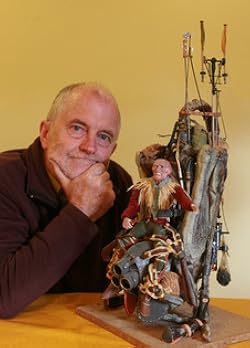
I'm not sure if the puppet is involved in his creative process, but it's entirely possible

Dougal Dixon, a Scottish master in paleontology from the University of St. Andrews first took his knowledge of biology, geology and evolution to write the strange and wonderful mock-zoology book After Man: A Zoology of the Future, published in 1981 (A fully online version of the book can be found here). Dixon's initial ideas were inspired by the crab-like inhabitants of the dying earth in H.G. Well's classic The Time Machine, a childhood favorite of his, but the main catalyst of the idea, Dixon cites, was the following exchange with his father:

I remember in particular the ‘Save the tiger’ campaign. I was watching a TV programme about tiger conservation with my Dad, he turned to me and said “Why save the tiger? The tiger will become extinct. Everything becomes extinct, other things evolve”. And I thought – that’s a very unhelpful attitude, but it basically started me on a learning curve about evolution, and I essentially realised that he was right: everything does become extinct, other organisms develop to take their place. And I began to think to myself – just as idle musings – if things do become extinct, what evolves to take their place?

The book itself, after spending some time reviewing the evolutionary process and lineage hitherto, jumps 50 million years into the future. Mankind, and all of its dependent species, has long died away. The legacy of the Holocene lives on, however, as the many familiar orders of are now extinct: true carnivores, simians, pachyderms and whales, along with many others, have all perished in the Holocene extinction. Even the land itself has changed drastically: Africa, Eurasia, North America and Australia has fused into a single continent, while South America and East Africa (now Lemuria) have become isolated island continents

It's a brave new world


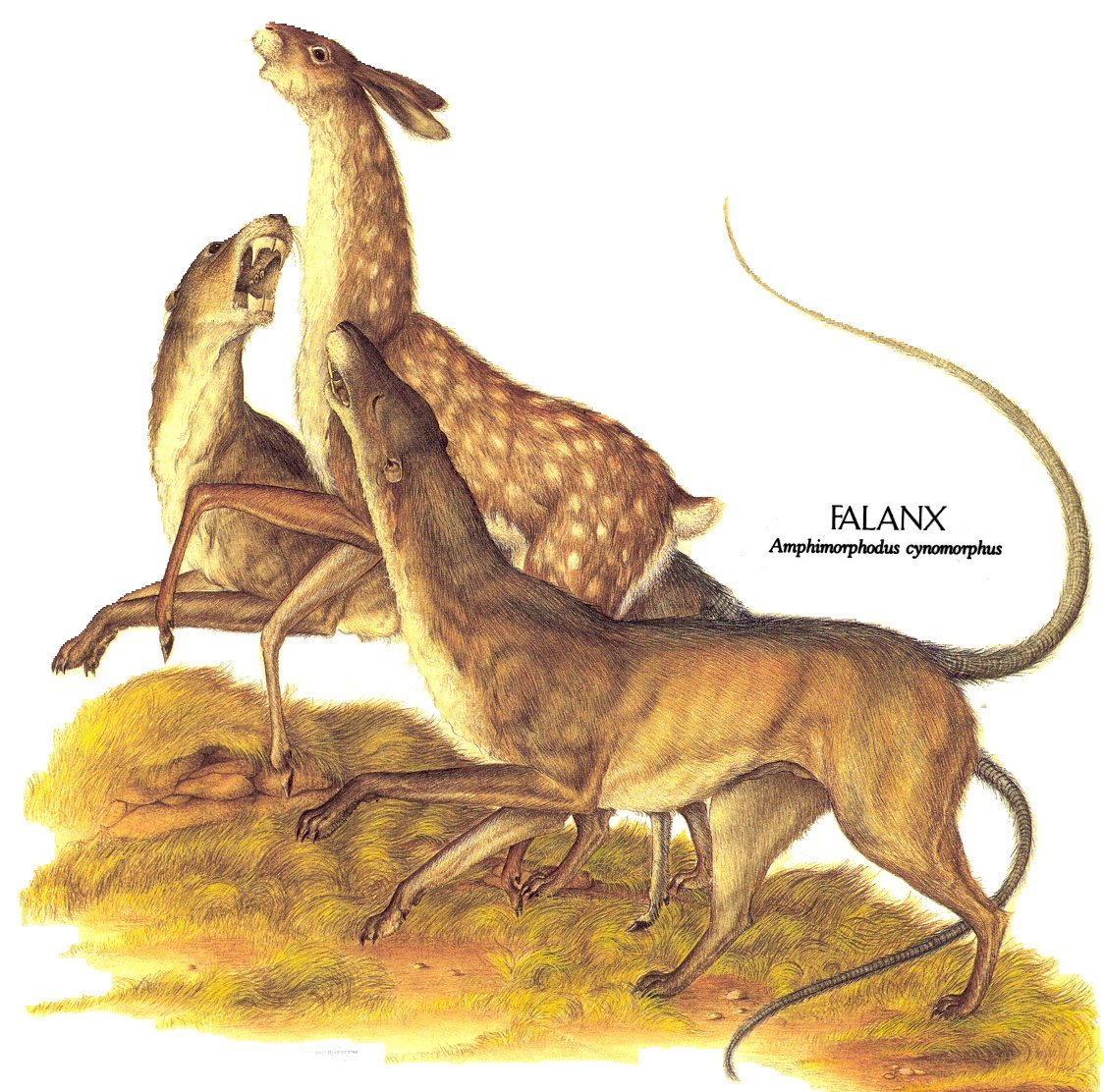
But while the animals familiar to us have passed their ecological niches remain. The animals that survived: rodents, rabbits, birds, bats, and other creatures, well adapted to the human world and undomesticated, grow and take on new shapes to fill the gaps in the world ecology. Some, like the Rabbuck, a large, camelid like browser descended from rabbits, and the falanx, a pack predator descended from rats, take on familiar shapes and roles.

Just another day in the future
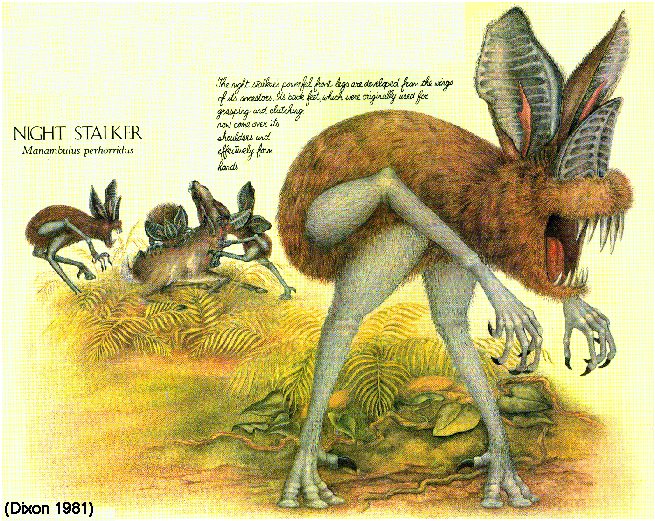
Other creatures, such as the infamous Night Stalker, a bat-descendant from the volcanic, Pacific island of Batavia are truly bizarre

Damn, future nature, you scary
Sorry, the Night Stalker is a bit too creepy. Here, have a mountain-dwelling Parashrew:

I don't really have anything to add here: just look at this thing

After Man was the founding work in the scifi subgenre of Speculative Evolution (also called Speculative Biology and Speculative Zoology). The idea is not just to come up with fantastical new creatures, but to make sure that they are grounded in plausible evolutionary biology. As a work, it can teach us to reach out beyond our expectations of what is possible and normal. It can demonstrate the power of evolution to create amazing adaptions, and at the same time show the power of convergent evolution to limit the possibilities of adaption to ways which don't seem so divergent as they first appear.

Dougal Dixon, drawing on his technical knowledge as a paleontologist and an inventiveness that belies his visual-spacial and logical intelligence, created a grand thought experiment, spanning the domains of zoology, geology and science fiction. The ability to conceptualize of an entire world's worth of new animals, not only creative, but also within the realms of biological possibility and evolutionary probability, demonstrates his well honed divergent thinking.

Dixon, largely considered to be the Father of Speculative Evolution, has created, collaborated and inspired many other works of this kind. Other works of his include The New Dinosaurs: An Alternative Evolution, a book exploring a world where dinosaurs didn't go extinct, Man After Man: An Anthropology of the Future, a horrifying book narrating future-man's use of genetic engineering to combat a failing global environment (and, by Dixon's own admission, a "disaster"). Some other works include Future Evolution by Peter Ward, The Last Dragon a 2004 BBC documentary and Alien Planet a 2005 Discovery documentary. Weta Workshop, Peter Jackson's go-to special effects studio, was innspired by After Man and The New Dinosaurs when designing the Skull Island monsters for the 2005 version of King Kong, and Dougal himself served as a consultant for the 2003 discovery documentary The Future is Wild, as well as writing the consulting book.


Would there ever been the subgenre of Speculative Evolution without the creativity and inter-disciplinary skill of Dougal Dixon? I mean, probably, but the point is that he did it first, so he gets the credit. Good work, Dicky.

History is Happening in Manhattan

Last week in class, we briefly noted that, for the most part, Broadway musicals tend to have a pretty high rate of failure and a pretty low rate of reaching phenomenal success. Even when a musical is considered a commercial and critical success, it's pretty rare that it becomes popular or well-known outside of the niche area of musical theatre (you probably haven't heard of last year's Tony Award winner for Best Musical Fun Home unless you're already into Broadway, for example). Even among more widely popular musicals, many are either popular by their sheer longevity (Wicked, Phantom of the Opera, etc.) or because they were almost guaranteed to be successes (e.g. The Lion King for being based on a wildly successful movie or Book of Mormon for being written by the creators of South Park), and few musicals become immediately culturally relevant on their own. One musical is starting to break that mold.

In the first week it went on sale, the soundtrack for the Broadway musical Hamilton debuted at no. 12, the highest debut for a cast recording in over 50 years, and has been sold out for almost the entirety of its run since it opened on Broadway in October 2015. In addition to its wild commercial success, Hamilton also breaks the mold in its content: the cast is almost entirely comprised of black and Latin@ actors despite being about the founding fathers of the United States, so that the play is "America now, telling the story of America." Additionally, the show's music is almost entirely comprised of hip-hop and rap songs, breaking the norms of more "traditional" show-tunes and rock ballads that seem to saturate Broadway today. So who's behind this ground-breaking rap musical about Alexander Hamilton? That would be playwright and lyricist Lin-Manuel Miranda, who also stars as the title character in the show.

Miranda grew up in a primarily Puerto Rican neighborhood in northern Manhattan (though he frequently visited his grandmother in Puerto Rico during summers), and as a theatre major at Wesleyan University, he helped found a hip-hop comedy troupe and wrote, directed, and acted in several musicals. After his graduation, he worked for several years on his first Broadway musical In The Heights, which went on to win a Tony Award for Best Musical. His work on all of these projects over the years helped to lead him to a sort of "domain expertise" that Simonton describes as one possible approach to understanding creative geniuses, laying the groundwork for the creativity that would lead to Hamilton.

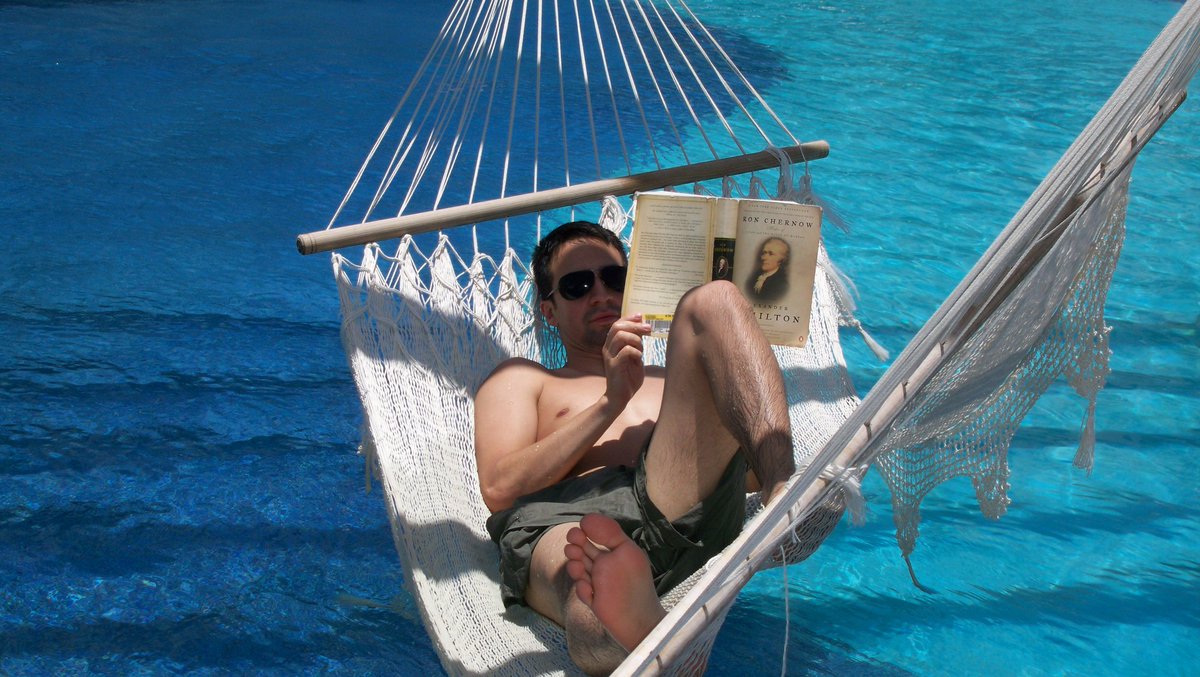
While in the airport about to leave for a vacation from acting in In The Heights in 2008, around 10 years after his freshman year of college, Miranda decided to purchase a copy of Ron Chernow's comprehensive biography of Alexander Hamilton to read while away. After quickly finishing it, he immediately began work on developing the musical adaptation that would become Hamilton. Drawing again upon Simonton's explanation of the domain expertise
Lin-Manuel Miranda reading Alexander Hamilton on
that fateful vacation
approach, education and experience needs to develop over at least a ten-year period before one can be considered enough of an "expert" for the fruits of genius creativity to truly be developed. Though Miranda wrote and worked on many shows in college and achieved success with In the Heights, it was not until he had been seriously working in theatre for 10 years that he was able to create a show like Hamilton that has already become so culturally relevant in its six-month run thus far.


-------------------------

Works Cited
http://www.billboard.com/articles/columns/chart-beat/6722015/hamilton-cast-album-billboard-200
http://www.playbill.com/article/beach-read-to-broadway-how-lin-manuel-miranda-turned-a-history-book-into-hamilton-com-355514
http://www.vulture.com/2008/03/linmanuel_miranda_of_in_the_he.html
Simonton, Dean Keith. Genius, creativity, and leadership: Historiometric inquiries. IUniverse, 1999.