Thursday, April 5, 2012

Can Mental Illness Change the World?

The world we live in today is a far cry from the technological dessert of the past. We have access to cell phones, the internet, facebook, twitter, e-mails straight to our phones and every type of communication needed to keep people in constant contact. Good or bad, the advances in technology create an ever shrinking world, allowing access to people and ideas on the other side of the globe in mere minutes. All of these creations foster an environment of immediate satisfaction and global networking. There are numerous examples every day of the progress made with use of technology, but never has there been a world wide campaign as large as Kony 2012. As I am sure you have all seen Kony 2012 is a video detailing the atrocities committed by the Lord's Resistance Army, led by Joseph Kony. The documentary makes a call to arms of all people regardless of age, sex, race or ethnic origin world wide. What makes this video unique is the request for involvement from all its viewers. Every person can help; simply repost the video and spread the message about the abhorrent practices of the LRA. The Kony 2012 campaign takes it a step farther: "On April 20th, we will take the next step in the global movement to finally bring an end to LRA atrocities. We will move the conversation from the digital to the physical world, where this conflict is happening, where real change can be made. We will earn the right to be heard by our national and global leaders by serving our local communities. And above all, we will prove that our liberty is bound together" (Invisible Children: Kony 2012). By making it a global problem, individuals move from education to involvement and begin to see the enormity of the situation, not as an "African Problem", but as a human problem. 

<iframe width="640" height="360" src="http://www.youtube.com/embed/c_Ue6REkeTA" frameborder="0" allowfullscreen></iframe>

A few weeks after the release of the Kony 2012 video, creator Jason Russel was hospitalized for "brief reactive psychosis", basically a stress-induced mental breakdown. While a mental break down is not in the same league as schizophrenia or a severe case of bipolar disorder, it does have similar tenants. As shown in the readings and the class discussions mental disorders have a long history of appearing in highly intelligent and highly creative individuals. The Russ article says that people with affect laden states are more creative for two reasons: 
                            First, they have access to more cues that activate other nodes in the search process. More associations occur. Second, more emotionally salient material would get coded and stored when individuals were in an emotional state. For individuals open to affect, more would "get in", thus providing the individual with a richer network of affect-relevant associations" ( Russ 31). 
Using this information and the discussion in class, Mr. Russel fits the mold of a creative individual through his adept use of emotional materials mixed with relevant facts and a revolutionary use of multimedia to spread his message. While other people and groups have used wide spread media to inform the public, Russel's use is unique in that it does not address any specific demographic. His mode is also extraordinary in his desire to 'Make Kony Famous'. His goal to increase awareness attacks the problem merely by informing as many people as possible and using these large numbers to force international action. 
As mentioned in class, many attributes that quantify mental illness are, in moderation, desirable characteristics. Strict attention to detail is a valuable quality, but an excess of that leads to an anxiety disorder. Confidence and charisma benefits those that possess it, but a lack of confidence can result in a recluse and an abundance creates a narcissist. It is highly ambitious to hope to change the world, as Jason Russel hoped to do. Some may even say this type of confidence is fool hardy and unrealistic, however it is these creative and dedicated individuals that have changed the world. The possession of specific traits that make some people great while destroying others begs the question of the long term benefit of these traits. For example, if Russel did not believe himself special enough to affect wide spread change, would he ever have made the video? Was it his extreme dedication that led to his success, and eventually his undoing? Overall, if outliers of particular behaviors have positive effects, can mental illness really change the world? 

Inside out

So I came across an article on NPR that was full of creative ways of thinking about things. I'll admit, I had to read it several times before I actually understood what was being said, so I'll parse it down a bit. But I swear, it's super interesting. So read on.

It starts with some pretty freaky pictures like this:


Yeah. It's weird. It's also a duck. A stuffed duck. It comes from a series done by artist Kent Rogowski, who took some stuffed animals, turned them inside out, and took some pictures of them. Why? He wanted to get a new perspective on them. I don't know about you, but I've never really thought about what the inside of a stuffed animal looked like.

It's exactly how creatives think though. In class, we talked about Guilford's Alternative Uses Task, in which you'd name all of this different uses for a particular object. And people were scored on how original or elaborate their answers were. My prediction? Rogowski would score pretty gosh darn high on the test.

Don't connect with teddy bears? Maybe Japan is more your thing.

In Japan, most streets aren't named. Instead the blocks have names. So instead of living on Loyola Avenue, you'd live on Block 1. And your building number would be in the order of the age of the building, from oldest to newest. Confused? There's lots of illustrations in the article. It's confusing, but if you think about it longer, it totally works.

Or how about China?

Doctors there believe their job is to keep you healthy, so you pay them when you're healthy, and don't pay a dime when you're sick. Kind of makes sense, right?

It's all about the idea of taking ideas and turning them inside out, kind of like the stuffed animals. This way of thinking has led to lots of new products by taking what exists and turning it inside out.

It's complete "little c" creativity, full of problem solving and personal discovery. You're not creating something completely new, just looking at things in a way never thought of before.

Read this here: http://www.npr.org/blogs/krulwich/2012/03/02/147825237/inside-out-your-mind


Slaves to Armok: God of Blood, Chapter II: Dwarf Fortress

 The game is Slaves to Armok: God of Blood, Chapter II: Dwarf Fortress, also known as Dwarf Fortress.

This is a screenshot of the game.  Each symbol stands for either a person (a dwarf), a substance, an object, an enemy (demons), a vampire dwarf, cats, or really anything.  It is very difficult to distinguish between anything easily, and I have often heard this described as being like the matrix.  The game is about making a sustainable fortress with dwarves.  It is a cult classic, and a hit among those enjoy a challenging game.  You can control the dwarves by make them build things and assign them jobs.  The dwarves themselves are autonomous.  They take the players directions as merely suggestions.  This is a difficult part of the game, if you want a dwarf to craft something, they have to be in a certain mood.  When they reach this mood, they require certain materials to create what they want. If they do not get these specific materials in time, they can go mad and bite other dwarves.  Sometimes they make something useful, like the strongest armor in the entire world, or something useless, like a magic stick with the history of the entire world on it.  You also interact with humans and elves.  The humans are essentially nobles, they go into your fortress and demand things, if you do not give it to them, they can put your dwarves in jail.   Elves are traders and regulators of how much wood you can cut down.  If you cut down too much wood, you will anger the elves and have an enemy.  There are also cats, and these cats can multiply to a level that essentially ruins your fortress, not due to overcrowding (unless you let it get so bad that the cats replace the oxygen in the room), but because the dwarves fall in love with these cats.  When they fall in love, they no longer do anything productive.  The main enemy of dwarf fortress are the demons, goblins, carp (the fish), elephants, and the list goes on.  Almost anything in the game can come and try to raid your fortress.  The only thing you can do is build the best fortress you can, and fight.  You can also be creative and create traps for the enemies.  This game is like the Sims, except for dwarves. In order to make this game playable, you need to modify it (adding another separate program) in order to play it.  This add on is called dwarf therapist and helps you make the game remotely playable.  This game is completely free, and you can download it here dwarf fortress, free .  It doesn't take very long to download because the game is essentially a generator.  It generates a map in which you build your fortress and have your dwarves work.   This game was created by Tarn Adams, with the help of his brother Zach Adams.  They began this project in 2002, Tarn is the main creator, Zach helps more with general ideas and some coding.  The bareness of the graphics is so Tarn could focus on mechanics, not visual effects.  Tarn is obsessed with details.  Every map generated has it's own history.  There are pages of information available on events that you never saw happen.  For each dwarf there is a description.  


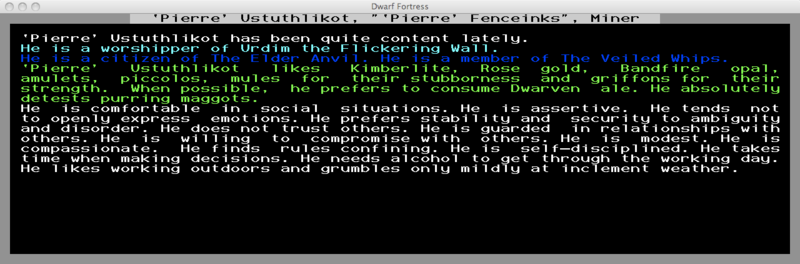
This is an example of a dwarf biography.  There is so much detail and there can be hundreds of these in each game.  This game is detail oriented.  Since there are so few graphics, the text has to describe everything.  This was painstaking to create.  Everything about this game is creative.  There is nothing else like it.  The detail alone sets it apart from any other game.  You also have free reign in this world.  You can do almost anything at any time.  This is the most appealing part to Tarn, he wants this detail and the ability to micromanage in a game. He created a game that he knew would not have no commercial appeal, but was for himself.  Tarn obsessively works on the game, he gets up at 3 in the afternoon, then codes until 6 am, when he goes to bed.  He gets into a certain zone when he codes.  He will sit for hours only coding dwarf fortress.  This game is his life's work, and he has set out since 2002 to perfect it. Tarn got his Ph.D. in mathematics in 2005, but didn't pursue a career in it because video games "[scratch] all the same itches" as math does.  The popularity of this game has been astounding.  There is a loyal cult following, and because this game is free, Tarn subsists only on donations from players.  When a new patch comes out, he can make 50,000 dollars a year, on any other year, he makes 30,000 dollars.  This is only from donations from a free game with a loyal cult following.  When someone donates, they can get a story written by Zach, or a crayon drawing by Zach that is colored by Tarn (this is an incentive for people to donate).   It is amazing that this man could turn his free game (that is only produced and made by him, with help from his brother) into a money maker.  This is his only job, and his life's work.  Tarn has refused to work on other games, and to work with other developers.  Tarn had an idea for a game, created this game from scratch, and has continued to perfect it for years.  This is an obsessive quality.  Tarn is extremely focused, to the point of obsession on this game.  It is his life and his life's work.  Tarn's expertise is in mathematics and coding games.  He became fixated on Dwarf Fortress, and has not stopped.  This fixation has created one of the most creative, challenging, and realistic games available today. He has refused to stop perfecting this game, to the point of it being on obsession.  He also has to use problem solving to create Dwarf Fortress. At some points, they did not realize what their coding would actually do.  For example, they made carp (the fish) the same size as a dwarf, and carnivores.  This led to carp being able to kill and eat dwarves.  Instead of being a problem, Tarn decided to keep this aspect of the game, thinking it made it more interesting.  There have been other problems involving the coding, and this is why Tarn continues to work on this project.  In terms of collaboration, Tarn worked exclusively with his brother Zach.  It seems that Tarn is the main creative in this project.  Out of the money that Tarn makes from Dwarf Fortress, Zach gets 750 dollars a month.  Zach seems to be a person that Tarn can bounce ideas off of, but the main producer and creator is Tarn. This game is not yet fully completed.  Tarn has said that it will be completed by his standards in 2030.  This game is incredibly detailed and incredibly difficult to play. It is amazing, that in a world filled with instant gratification games that this game can be so popular.  We'll all be looking forward to the completed version in 2030.  http://www.nytimes.com/2011/07/24/magazine/the-brilliance-of-dwarf-fortress.html?pagewanted=all


Making the "old" NEW. For us.

My first blog post was on the man who created microlending, Muhammed Yunus. I find the nearly endless opportunities of quite a simple concept to be extremely intriguing. The question that always comes to mind as that fact turns over and over in my head is--if the concept of microlending is as basic as it is, and yet it was just recently discovered, what else is there (related or unrelated to microlending) that we are still unaware of?

As my presentation group was brainstorming ideas for our final project, I stumbled upon an organization that shed light on a new facet of microlending: domestic microlending. I, and most people, had considered microlending to be an amazing new discovery that can boost both supply and demand in "developing" countries. What I had never really thought of is that we, the United States, could adopt this concept in order to increase drive in our economy as a whole. On a national level, this could really make a difference in the way that our economy is going. To be clear, I am not saying that microlending, in and of itself, can turn around the United States' economy. However, seeing as we seem to be in a bit of a gridlock, with neither sides of the argument willing to budge, this could be a great opportunity to try something totally new! On a personal level, domestic microlending gives the opportunity for those who don't have enough resources themselves to invest as an entrepreneur, they are not completely S.O.L.

http://www.ted.com/talks/hans_rosling_reveals_new_insights_on_poverty.html (from 14:13)

The organization's name is ACCION Chicago, with a team of about twenty that work together to make domestic microlending more than an idea. The team consists of a CEO, two vice presidents (working in different departments), various team managers, and loan officers. What surprised me is the sheer size of the group of ACCION leadership. I was interested in this aspect of the organization because of one of the reading that we discussed, that of Uzzi and Spiro. Uzzi and Spiro discuss the interplay between the heads of a Broadway show. While this is superficially more creative outlet, the theory of the "dynamic structure of the creative artist network" remains applicable.

ACCION's team, according to Uzzi and Spiro could have a network like this. The internal network of the organization would consist of mainly the leadership team of twenty people. However, it would also include those that work behind the scenes at the organization that don't get the recognition that the top twenty get. Imagining this as a spider web helps me to visualize it properly. In the center ring is this internal network of ACCION Chicago. The next ring of the web consists of the top twenty, the behing-the-sceners, and those in the community that are active supporters of ACCION Chicago. This follows Uzzi and Spiro's model. Here is where I deviate from that.

Because ACCION has more locations and networks around the nation, there would be an additional ring in the web before the final, international network. This second-to-last ring would the network that all ACCIONs create between each other and their supporters in each community that is home to a sector of the ACCION organization. The very final ring is the international ring. This is where ACCION's concept comes full circle. While this organization is based upon the idea of using microlending domestically, the concept itself is absolutely international. Muhammed Yunus already proved that.


http://www.accionchicago.org/default.aspx

Automats to Fast Food Restaurants


Today, some people hop out of bed in the morning and head to Starbucks for their iced grande caramel latte with skim milk and sugar free syrup, and a blueberry muffin. They then head off to work and right around noon, head down to the closest McDonald’s where they will quick grab a Big Mac to bring to their desk to eat while doing work. Lastly, on the way home from work, they will stop at the Chick-Fil-A, where that chicken strip salad is calling their name.

This meal plan might not sound like the healthiest option for a days worth of food, but it probably does not sound all that uncommon. Before 1902 the idea of fast food, however, was nonexistent in the United States. It took the joint collaboration and creativity of Joseph Horn and Frank Hardart to launch the fast food movement that led to an industry of hundreds of thousands of to-go options like we see today.

Uzzi and Spiroajs (Collaboration and Creativity, 448) wrote that “creativity is not only, as myth tells, the brash work of loners, but also the consequence of a social system of actors that amplify or stifle one another’s creativity.”  Horn and Hardart’s collaboration definitely amplified each other’s creativity.

Horn, from Philadelphia, and Hardart, born in Germany and raised in New Orleans, looked to change the restaurant industry. Instead of the customary sit-down restaurants, the pair opened the first Automat that the United States had ever seen on June 12, 1902. People could order their food through a machine with only nickels. Horn and Hardart marketed the automat as take-out food that rivaled and could replace home-cooked meals.

Much like we saw Steve Jobs and Steve Wozniak discuss Apple innovations or Sigmund Freud bounce ideas off of his mentors, Horn and Hardart constantly worked together to incorporate these new automats in their Philadelphia restaurant and later in New York City.

We established in one of our earliest readings this semester that creative people interact with their environments. Horn and Hardart listened to the demands for quick, delicious food. They then came up with a creative idea that could even flourish during the Depression era.  They helped solve the problem of getting food on the table amidst a busy day, something people still complain about today.

Horn and Hardart worked within the restaurant domain, but they largely reinvented this domain. Restaurants could now include take-out food. The field primarily had positive reactions. Many restaurant innovators took the pair’s automat idea one step farther. The opening of A&W fast food restaurant in 1916 and White Castle in 1921 used many of Horn and Hardart’s ideas.

Bamn! A failed attempt to revive the traditional automats in New York City
The automats suffered a large decline with the presence of fast-food restaurants and drive-thru windows. The last automat, one of 40 in New York City, closed in 1991. Horn and Hardart’s last restaurant endeavor, the Horn and Hardart Coffee Co., closed in 2005. Without the pair’s creativity, fast-food restaurants may never have developed quite like the powerhouses they are today. 

Creativity Considered (A final time)

In my last posts, I have been a bit verbose.  To test a hypothesis, I will keep this one short.  Maybe, someone will have an opinion on my thoughts.  Onward then.  In the last two posts I have been working through degrees of creativity, from the mundane to the fanciful.  In this last post, I want to expose our group to an extreme example of modern conceptual creative art.  This provocative piece epitomizes my idea of creative and highly esteemed pointlessness.  Enter Tania Bruguera.
http://www.nytimes.com/2011/05/19/nyregion/as-art-tania-bruguera-lives-like-a-poor-immigrant.html?_r=1
Ms. Bruguera is living as an illegal immigrant on a minimum wage salary.  Having been a U of C prof and exhibited art around the world, this change is probably large for Ms. Bruguera.  While the change is big, the change is entirely for artistic reasons.  A one year commitment to being a performance art piece is designed to raise awareness about economic differences from an artistic perspective.  Let's take a look at this from the perspective of our class.

Is this new?  Yes, the artist is changing her life in an economic way from an artistic perspective.  Is this useful?  Sure, socio-economic status is being exposed in a creative way.  Regardless of how pretentious this project may be, viewers are challenged to appreciate the issues of immigration, division of wealth, and cultural needs.  How about divergent thinking?  Making living in poverty a work of art is not an immediate association.  Are analogies at play?  The action group that has been established by Ms. Bruguera tries to create programs that find analogies between "mundane" services (language, legal, health) and artistic expression of local artists.  Is there any collaboration?  Absolutely, as the last sentence mentioned, artists are working together to help make community building an artistic expression.  In addition, Ms. Bruguera is living with a family of illegal immigrants and collaborating with them on this project.  Insight?  Bruguera has mentioned that several of her ideas about this project have occurred due to her collecting various perspectives and combining them in new ways.  Does the field accept the artist?  Yes, at least on critic very much supports this project.

From various perspectives, Ms. Bruguera is being very creative.  While we may not all agree that the artist is appropriate ( I personally think she is an ass), she is living life and producing art in a creative way.  This piece will probably be touted as a very important addition to the artistic community by some.

I wish to end my various musings by trying to tie these posts together.  The first post looked at the highly useful yet un-sexy side of creativity.  The second post looked at creativity that had intermediate levels of use and novelty.  This last post exhibits a case of fairly useless art that is very new and controversial.  All of these examples demonstrate how diverse creativity can be.  In addition, I hope to have chosen some examples that elicit some aesthetic sense wonder.  The examples are different, the emotional content may be different; yet, all have the ability to amaze us to the same extent.

How Dr. John Got His Groove Back

Dr. John: The Night Tripper got his start in New Orleans in the 1950's making big, bad, boogie woogie voodoo music. His incorporation of local tribal chants into his bluesy R&B music gained him big name followers such as Eric Clapton and Mick Jagger, and his music came to define the "New Orleans sound." Gris-Gris, his first album, would even go on to be ranked 143rd on Rolling Stone's 500 Greatest Albums of All Time list. You've heard him if you've seen Disney's The Princess and the Frog; he sings the movie's opening song "Down in New Orleans."
This is Dr. John.
It's certain that his music has accumulated critical acclaim, and he worked to define a genre that was completely original. However, Dr. John's career has been in a lull since the late 80's/early 90's, and he has been experiencing a similar phenomenon to many of our Creatives from class. His inability to produce work as original and beloved by the general public as his early works is directly parallel to Albert Einstein's struggle to complete groundbreaking work in the post-Theory of Relativity stage of his life. This is merely one example, and we've seen many Creatives struggle to continue to make multiple creative contributions to their respective fields.

Just recently, however, Dr. John has rediscovered his groove. With the help of the singer of my favorite band, The Black Keys, Dr. John has re-imagined his song writing and musical style to produce a new album, titled Locked Down. Dan Auerbach, produces the album in the music business sense of the word, and their collaboration is extremely relevant to topics we've been discussing in class. "It's hard being a musician that's out of fashion," says Auerbach. "When you can play that New Orleans stuff so well without even thinking about it, and can collect that paycheck ... you can't blame him." On Dr. John's new album, however, Auerbach pushed Dr. John to retrieve the magic of his early works.

The pair worked together to re-inspire Dr. John, and Auerbach pushed him by asking him to write its songs outside of his native New Orleans, for example. He also encouraged him to write about personal subject matters, previously unexplored by John.  It's interesting to analyze their partnership, as in class we've discussed examples which both catalyze (Watson and Crick) and hinder creativity (Graham and her husband).  It's certain that Auerbach and John's relationship was extremely beneficial to the creative processes of Dr. John, and the album has received the high acclaim similar to his earlier creative works.
Dan and the Dr.


It seems as if John has rediscovered his musical groove, and that Locked Down was the "Aha! moment" that our Creatives describe when creating something especially meaningful. "Everything came together for this album," says Dr. John. "Mystically, spiritually, emotionally, and musically. I wasn't expecting it, but it came together. That's how the world works sometimes." Sounds like inspiration to me.


[Here} is the link to read more about their collaboration and the review of Locked Down.